7.7 - Decay & Decomposition
Factors affecting decay
- Dead plant and animal material is broken down, or decayed, by microorganisms - mainly bacteria and fungi.
- As they feed on the dead material, they break it down and release the nutrients it contains (such as nitrates and other minerals) back into the soil, where living plants can take them up again.
Saprophytes and extracellular digestion
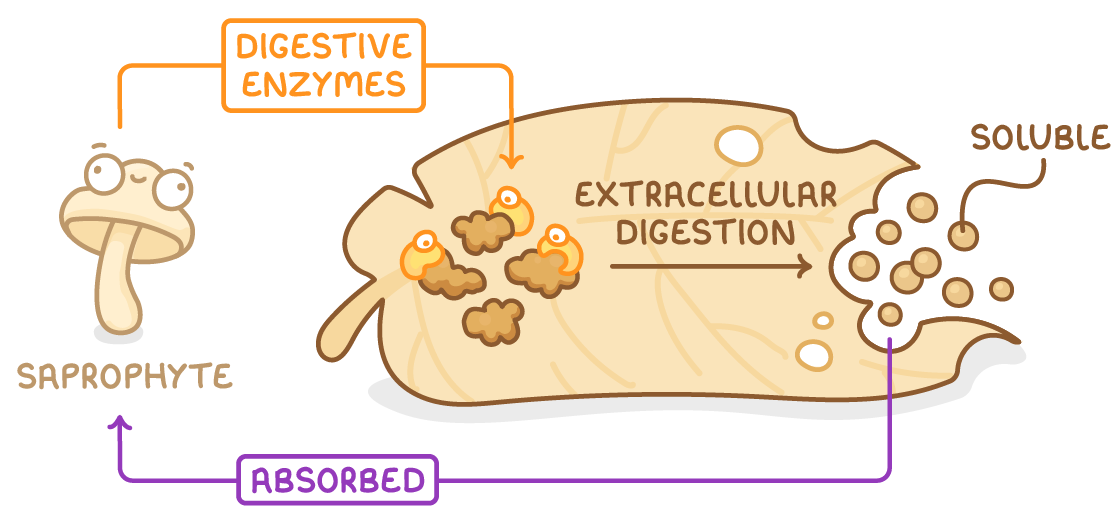
- Some microorganisms, called saprophytes, secrete digestive enzymes onto the dead material.
- They digest it outside their bodies (extracellular digestion), then absorb the soluble products.
- The partly broken-down material left in the soil is called humus.
Three conditions that affect the rate of decay
- Temperature - Microorganisms rely on enzymes, which work faster as it gets warmer:
- Too hot and the enzymes are denatured, so decay slows or stops.
- In the cold, the microorganisms grow and work very slowly.
- Water - Microorganisms need moisture to grow and to dissolve their food, so decay is faster in damp conditions and very slow in dry ones.
- Oxygen - Most decay microorganisms respire aerobically, so they work faster when there is plenty of oxygen.
These three conditions are also why food can be preserved by keeping it cold, dry, or sealed away from oxygen - each one slows the microorganisms down.
Aerobic vs anaerobic decay
- When there is no oxygen, decay still happens, but is carried out by different microorganisms respiring anaerobically.
- Anaerobic decay is usually slower than aerobic decay, because the microorganisms release less energy without oxygen.
- Whether decay is aerobic or anaerobic depends on the conditions:
- Plenty of oxygen favours the faster aerobic decomposers.
- Waterlogged or sealed-off material, where oxygen cannot reach, is broken down anaerobically instead.
Composting and biogas
Decay returns nutrients to the soil naturally, but people also put it to use - both the fast aerobic kind and the slow anaerobic kind.
Composting - Aerobic decay for fertiliser
- Gardeners and farmers pile up waste plant material to make compost.
- The heap is kept warm, moist, and aerated so that aerobic microorganisms decay it quickly.
- The rotted compost is spread on fields and gardens as a natural fertiliser, returning nutrients such as nitrates and other minerals to the soil for crops and garden plants.
Biogas - Anaerobic decay for fuel
- Where decay happens without oxygen, anaerobic microorganisms break the material down and give off methane gas.
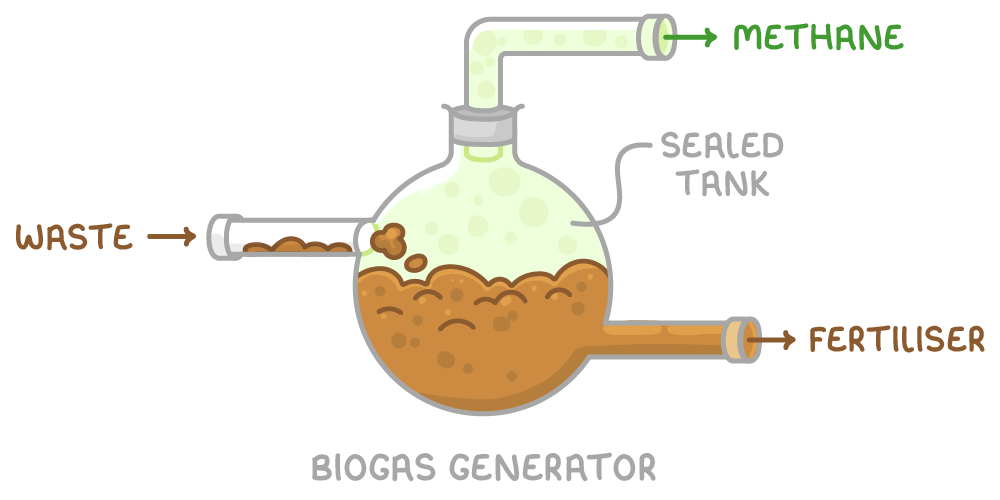
- A biogas generator uses this on purpose:
- Waste plant and animal material is decayed anaerobically in a large sealed tank.
- The methane given off collects at the top, so it can be piped away and burned as a fuel - for cooking, heating, or generating electricity.
- The leftover material from the tank can still be used as a fertiliser, so the same waste both supplies a fuel and returns nutrients to the soil.
TermDefinition
SaprophyteA microorganism that feeds on dead material by secreting digestive enzymes onto it and absorbing the soluble products.
Extracellular digestionDigestion that happens outside an organism's cells. The organism releases enzymes onto its food and then absorbs the soluble products.
HumusThe partly broken-down material left in the soil after decay.
CompostDecayed plant material used as a natural fertiliser to return nutrients to the soil.
Biogas generatorA sealed tank where waste material decays anaerobically (without oxygen) to produce methane gas for fuel.