8.2 - Transpiration
Transpiration and the transpiration stream
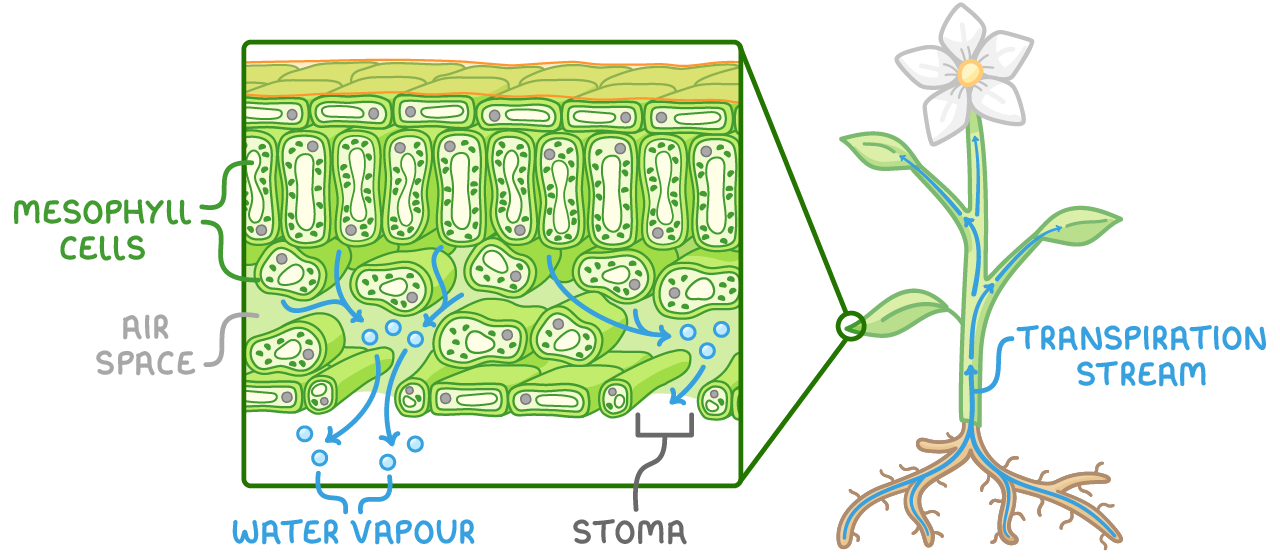
- Transpiration is the loss of water vapour from a plant, and it happens mostly at the leaves.
- It follows this sequence inside the leaf:
- Water evaporates from the surface of the mesophyll cells inside the leaf, turning into water vapour.
- The water vapour collects in the air spaces between those cells.
- It diffuses out of the leaf through the stomata (tiny pores in the leaf surface).
- This diffusion happens because there is much more water inside the leaf than in the drier air outside.
Why transpiration happens
- Transpiration is really a side-effect of the way a leaf is built for photosynthesis.
- The leaf must have stomata so carbon dioxide and oxygen can be exchanged with the air.
- Having those pores open also lets water vapour escape - so while the stomata are open for gas exchange, the plant unavoidably loses water by transpiration.
The transpiration stream
- As water is lost by transpiration, it leaves a slight shortage of water in the leaf.
- More water is drawn up to replace it, moving up through the xylem vessels from the rest of the plant.
- This in turn draws more water up from the roots, giving a continuous flow of water from the roots, up through the xylem, and out of the leaves.
- This steady upward flow is called the transpiration stream.
- The transpiration stream also carries dissolved mineral ions up from the roots along with the water, distributing them to the stems and leaves where they're needed.
Factors that affect the rate of transpiration
- The rate of transpiration is how quickly a plant loses water, and it changes with the conditions around the leaf.
- Both factors work through the same idea: water vapour diffuses out of the leaf, so anything that steepens the difference in water concentration between the inside of the leaf and the air outside speeds transpiration up.
Temperature
- The warmer it is, the faster transpiration.
- When it is warm, the water molecules have more kinetic energy, so they evaporate and diffuse out of the stomata more quickly.
Wind speed
- The higher the wind speed around a leaf, the faster transpiration.
- In still air, the water vapour just surrounds the leaf, keeping the water concentration outside high - so diffusion out is slow.
- When it is windy, the water vapour is swept away, keeping the concentration outside low - so water continues to diffuse out quickly.
TermDefinition
TranspirationThe loss of water vapour from a plant, mostly from the leaves through the stomata.
Transpiration streamThe continuous upward flow of water from the roots, through the xylem, and out of the leaves.
StomataTiny pores, mostly in the lower surface of a leaf, that let carbon dioxide and oxygen diffuse in and out and let water vapour escape.