10.3 - The Immune System
Physical and chemical barriers
- The body's first line of defence is a set of barriers that stop pathogens getting inside in the first place.
- These work against many different pathogens rather than one in particular, so they are non-specific.
Physical barriers
- Skin - Covers most of the body and acts as a barrier pathogens cannot pass through. It also secretes oils and antimicrobial substances that kill pathogens resting on its surface.
- Nose - Hairs and a layer of mucus trap particles in the air before they can travel further into the body.
Chemical barrier
- The stomach produces hydrochloric acid, making the stomach contents strongly acidic.
- This kills most pathogens that are swallowed, whether they came in with food or in mucus from the airways.
Backup defence
White blood cells seek out and destroy any pathogens that get past the physical and chemical barriers.
Phagocytosis
- When pathogens get past the body's barriers and into the body, the white blood cells of the immune system destroy them.
- White blood cells travel in the blood and move into the tissues, constantly patrolling for pathogens.
- One of their main defences is phagocytosis - carried out by white blood cells called phagocytes.
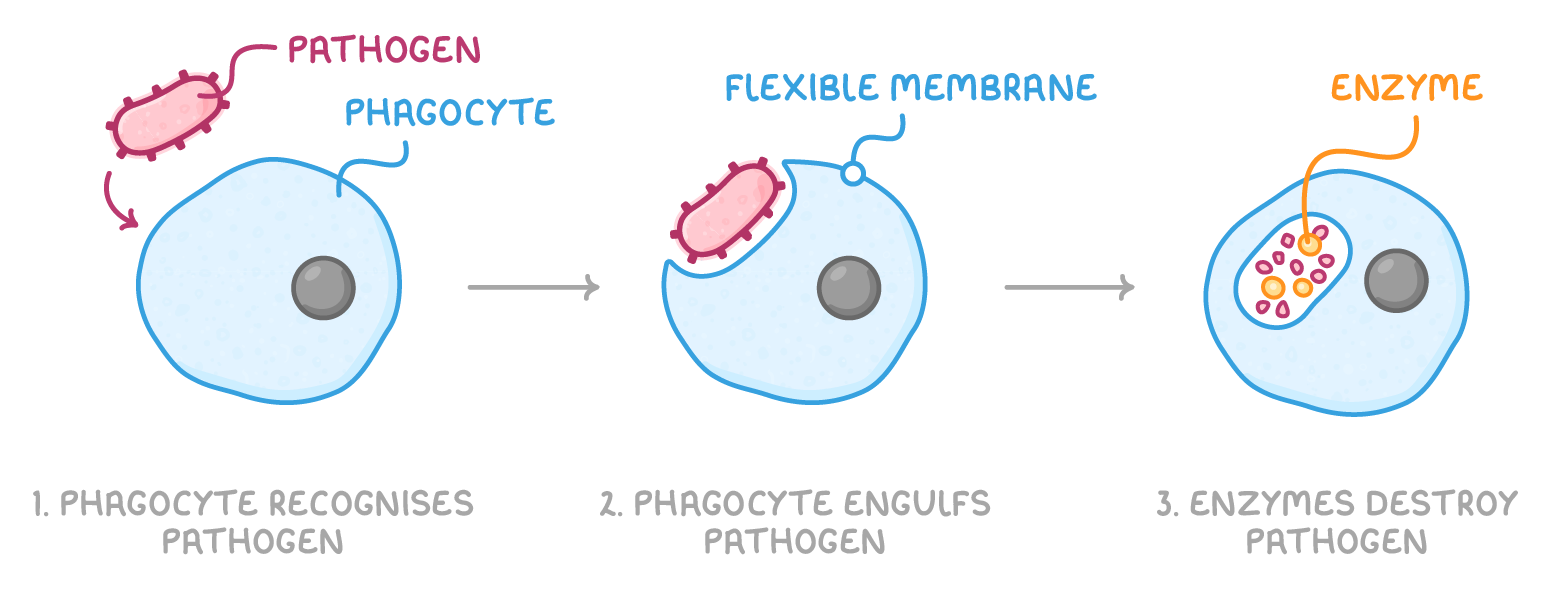
How a phagocyte destroys a pathogen
- The phagocyte tracks down a pathogen and binds to it.
- Its flexible membrane changes shape and wraps right around the pathogen, engulfing (surrounding) it and taking it inside the cell.
- Enzymes inside the phagocyte break the pathogen down and destroy it.
Key features of phagocytosis
- Non-specific - The same phagocyte can engulf many different kinds of pathogen, rather than acting against one in particular.
- Works alongside antibodies - Phagocytes more easily find and engulf pathogens that have been clumped together or marked by antibodies.
TermDefinition
PhagocytosisThe process by which a white blood cell engulfs and digests a pathogen.
PhagocyteA type of white blood cell that carries out phagocytosis.