6.7 - The Human Genome
The human genome and the Human Genome Project
- The genome of an organism is its entire genetic material - all of the DNA found in that organism.
- The whole human genome has now been worked out.
The Human Genome Project
- A major international effort in which thousands of scientists from all over the world worked together to find and map every single human gene and record where it sits.
- It officially began in 1990 and a complete map was finished in 2003.
- The map gives the locations of around 20,000 to 25,000 genes.
- Now that all the genes have been found, scientists are working out what each one actually does - so far around 1,800 genes linked to disease have been identified.
Why understanding the genome is useful
- Working out and understanding the human genome is a powerful tool for science and medicine.
- The human genome is almost identical from one person to the next. The small differences between individuals, and the link between particular genes and particular characteristics or conditions, are what make this knowledge so useful.
- Knowing the full sequence lets scientists:
- Compare the genomes of many people
- Connect specific genes to specific diseases
- Study and treat inherited disorders
- Learn more about human biology and history
- This opens up the medical applications that genome research is now being used for.
Using genome research in medicine
Understanding the human genome lets scientists use it in medicine in several ways, all built on linking particular genes to particular diseases.
Searching for genes linked to disease
- Scientists compare the genomes of people who have a disease with those who don't, to identify the genes and alleles involved.
- This is the first step towards diagnosing, preventing, or treating diseases.
- It especially helps with inherited disorders - conditions caused by inheriting one or more faulty alleles, such as cystic fibrosis.
- Once scientists know which genes and alleles cause a disorder, they can identify the faulty allele in a person much more quickly than before, and work towards better treatments or a cure.
Predicting and preventing common diseases
- Many common conditions, such as cancers and heart disease, aren't caused by a single gene - they're caused by several genes interacting with lifestyle factors.
- If doctors know which genes make a person more likely to develop a disease, they can:
- Give individually tailored advice on diet and lifestyle to lower the risk.
- Check them regularly so any disease is caught and treated early.
Designing new and better medicines
- Genome research has revealed common genetic variations between people, and some affect how well a drug works or how a person responds to a disease.
- Knowing a patient's genetic make-up lets doctors choose the medicine most likely to work and the right dose.
- It lets scientists design new drugs aimed at people with a specific variation.
- The result is more effective, better-targeted treatments with fewer side effects.
Genetic testing of individuals
- A person can be tested for the genetic variants linked to a particular disease:
- Some variants only raise the risk of a condition - someone who knows they carry one can make lifestyle changes to reduce that risk.
- Other variants mean a person will definitely develop a condition - e.g. someone with two copies of the recessive cystic fibrosis allele will have the disorder - so treatment can start early.
- Genetic testing can also inform family planning:
- Parents can be tested to find out whether either carries an allele for a disorder.
- A developing embryo or foetus can be tested to find the risk of a child inheriting it, helping a couple make informed decisions.
Risks of genetic testing:
- The stress of knowing you carry a disease gene.
- The chance of discrimination by insurers or employers.
These risks mean such applications have to be weighed up carefully.
Genetic profiling
- Almost everyone's DNA is unique - the only exceptions are identical twins and clones.
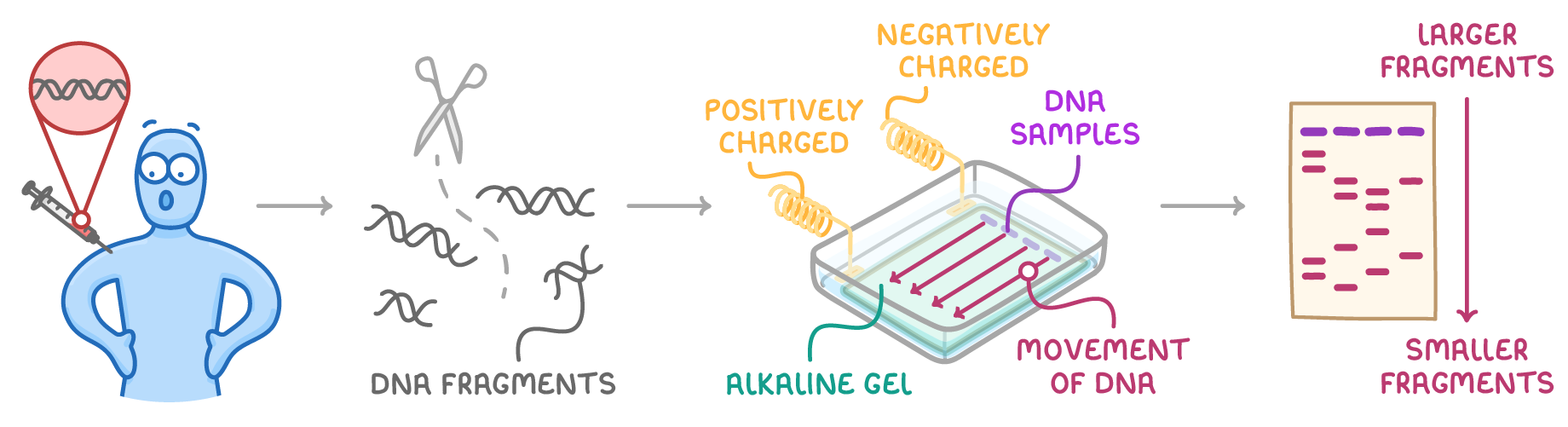
- Genetic profiling (also called DNA profiling) turns a person's DNA into a banding pattern that is unique to them.
How a DNA profile is made
- Extract the DNA from a sample of cells, such as blood or semen.
- Cut the DNA into fragments - these come out at many different sizes, and the set of sizes is different for each person.
- Separate the fragments by size using gel electrophoresis:
- The fragments are placed in an alkaline gel and an electric current is passed through it.
- In the alkaline gel the DNA is negatively charged, so it moves towards the positively charged end of the gel.
- Smaller fragments travel faster than larger ones, so they end up furthest through the gel.
- Treat the separated fragments so the bands become visible - this banding pattern is the DNA profile.
Uses of genetic profiling
Because each person's banding pattern is unique, profiles from different DNA samples can be compared to see how similar they are:
- Paternity testing - A child inherits half their DNA from each parent, so about half the bands in a child's profile match the father's, showing whether a man is the child's father.
- Forensic science - A profile from a crime scene is compared with a suspect's profile; a matching pattern suggests the suspect was present.
- Sorting organisms into groups - Profiles can be compared between species; the more closely related two organisms are, the more similar their profiles.
- Medical diagnosis - If certain genes are known to be associated with a disease, those genes can be looked for in a person's profile, so a disease can be diagnosed earlier or a higher risk identified, leading to better treatment.
A national genetic database
- Some people would like a national database holding everyone's profile.
- Others see this as an invasion of privacy and worry the data could be stolen or used by insurers to refuse cover.
TermDefinition
GenomeThe entire genetic material of an organism.
Human Genome ProjectA major international scientific effort that found and mapped every single human gene.
Inherited disorderA condition caused by inheriting one or more faulty alleles from a parent.
Genetic profilingA technique that cuts a person's DNA into short pieces and separates them into a pattern of bands that can be compared with other samples.
Gel electrophoresisA method used to separate DNA fragments by size using an electric current.