2.8 - Blood Vessels
The three types of blood vessel
- There are three main types of blood vessel, each with a different job.
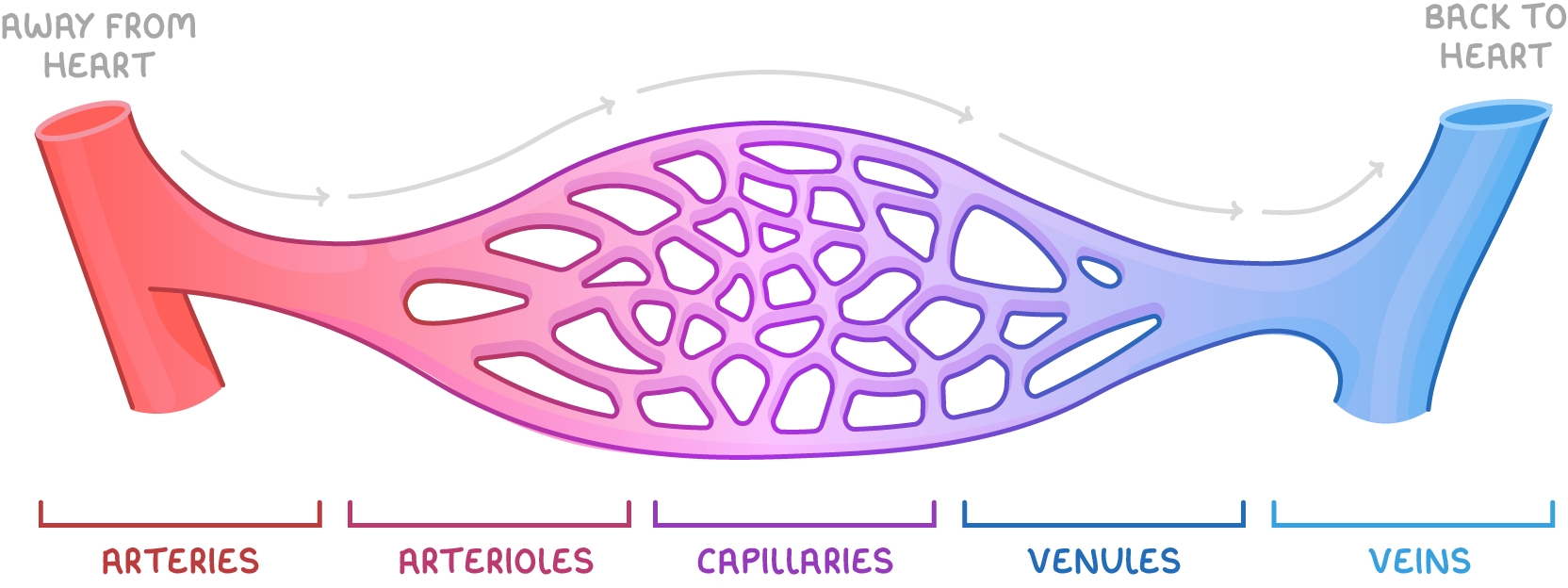
- Blood leaving the heart passes through arteries → capillaries → veins, then back to the heart.
The job of each vessel
- Arteries - Carry blood away from the heart to the rest of the body.
- Veins - Carry blood back to the heart.
- Capillaries - Tiny vessels that link arteries and veins. They carry blood close to the body's cells so materials can be exchanged between the blood and the tissues.
How the vessels connect
- Blood pumped out of the heart travels through arteries.
- Arteries branch into ever smaller vessels - the smallest are called arterioles.
- Arterioles lead into capillaries running through the tissues.
- Capillaries join up into small vessels called venules.
- Venules combine to form the veins that return blood to the heart.
Capillaries
- Capillaries are the very small blood vessels found in the organs.
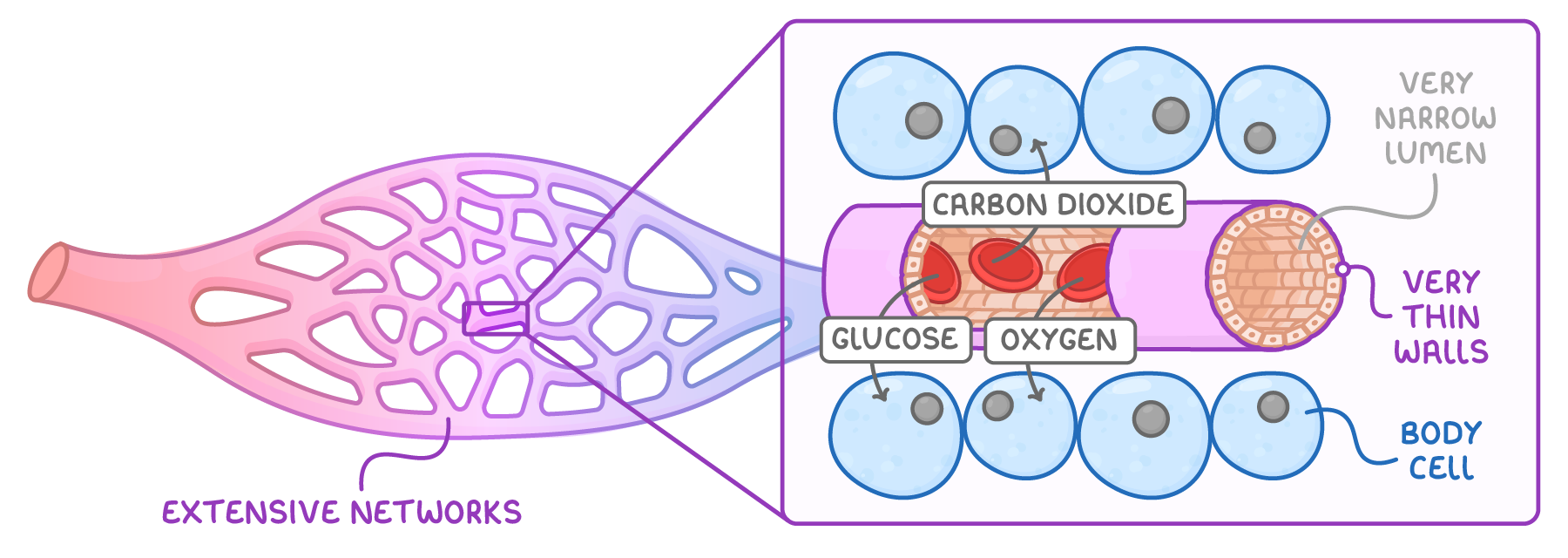
- They carry blood close to the body's cells so that substances can be exchanged between the blood and the tissues.
- This exchange happens by diffusion across the capillary wall.
What is exchanged
- Out of the blood - Substances the cells need, such as glucose and oxygen, pass from the blood into the tissues.
- Into the blood - Substances the cells produce, such as carbon dioxide, pass from the tissues into the blood.
Adaptations for exchange
- Very thin walls - Substances have only a short distance to diffuse across.
- Extensive networks - Capillaries spread throughout the tissues, so every cell is close to a capillary supplying it.
TermDefinition
ArteryA blood vessel that carries blood away from the heart.
VeinA blood vessel that carries blood back to the heart.
CapillaryA tiny blood vessel where substances are exchanged between the blood and the body's tissues.