7.14 - Food Security
Food security and increasing yields
- The world's human population is rising quickly.
- To keep feeding everyone, the amount of food produced globally must rise as well - so that each person still has enough food that is safe to eat and has the right balance of nutrition.
- Food security - Reliable access to enough safe, nutritious food for everyone.
Why farmers focus on raising yield
- There is a limited amount of land available for farming, and it isn't possible to keep clearing more and more land for crops and livestock.
- So the main way to produce more food is to raise the yield - the amount of food produced from a given area of land in a given time.
- Farmers use a range of techniques to increase the yield of their crops and animals, producing more food from the same area without simply taking over more land.
Factors affecting food security
Food security means having enough food to feed a population. Several biological factors affect it, on top of the rising population itself.
Changing diets towards meat and fish
- As people in wealthier countries become better off, their diets change to include more meat and fish.
- Producing meat and fish is a less efficient use of land than growing crops: energy and biomass are lost at each step up a food chain.
- A given area of land feeds far more people when it grows crops directly than when it rears grazing animals.
- Grazing animals are often fed crops that people could have eaten themselves.
Pests, pathogens, and environmental change
- New pests and pathogens - insects, bacteria, fungi, and viruses - can emerge and damage crops and livestock. This reduces yields and can sometimes cause widespread famine.
- Environmental change caused by human activity can reduce how well crops grow, including:
- A changing climate and altered rainfall patterns
- Soil pollution
Sustainability and costs
- Farming must be sustainable - meeting today's needs without harming future generations' ability to meet theirs.
- Growing crops for biofuels competes for land that could grow food.
- High input costs - seeds, fertilisers, fuel, and machinery - can make food production too expensive to maintain in some areas.
- Conflict over food and water can disrupt supply further.
Intensive animal farming
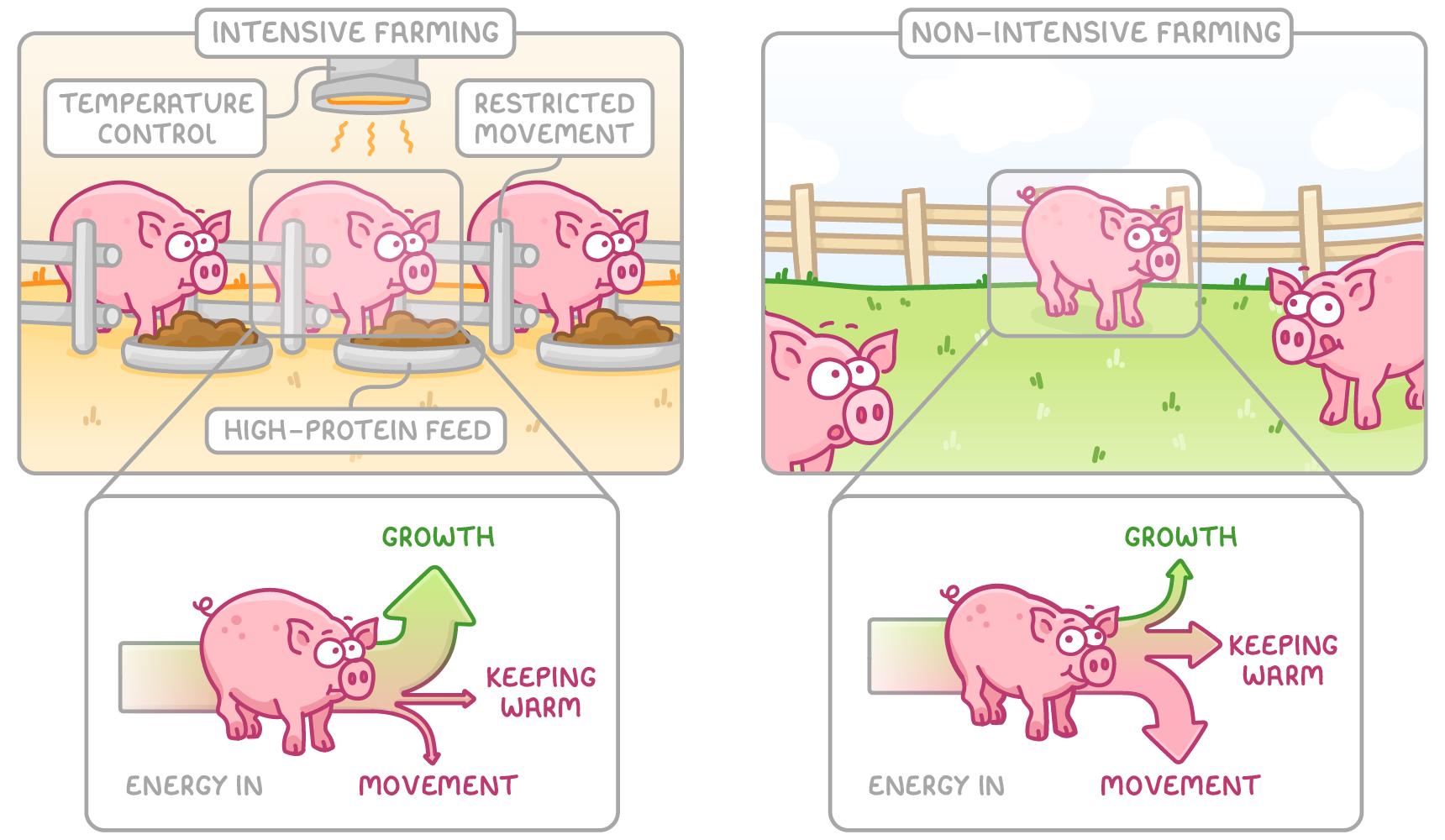
- Intensive (or efficient) animal farming aims to produce as much meat, milk, or eggs as possible from a given input of resources.
- The central idea is to reduce the energy that farm animals transfer to their surroundings, so more of the energy in their food is left for growth.
How the energy is saved
- Limiting movement - Animals are often kept in small pens or cages so they move very little.
- Temperature control - Animals are kept in a temperature-controlled environment, so they don't use energy keeping themselves warm.
- High-protein feed - Animals are sometimes given high-protein feed to increase growth further.
An animal that moves little and doesn't have to keep warm uses less energy on those things, so more energy goes into building body mass - producing more food from the same amount of feed.
Ethical objections
Many people object to intensive farming, arguing that keeping animals in such cramped, unnatural conditions is cruel.
Sustainable fisheries
- Fish stocks in the oceans have been falling because we catch so much fish.
- Overfishing causes several problems:
- Less fish for people to eat
- Disturbs the ocean's food chains
- Can make some species disappear from an area altogether - e.g. cod are at risk of vanishing from the north-west Atlantic
- To keep fishing going long term, stocks must be kept at a level where fish can continue to breed and replace what is caught. This is sustainable food production.
Two measures that maintain fish stocks
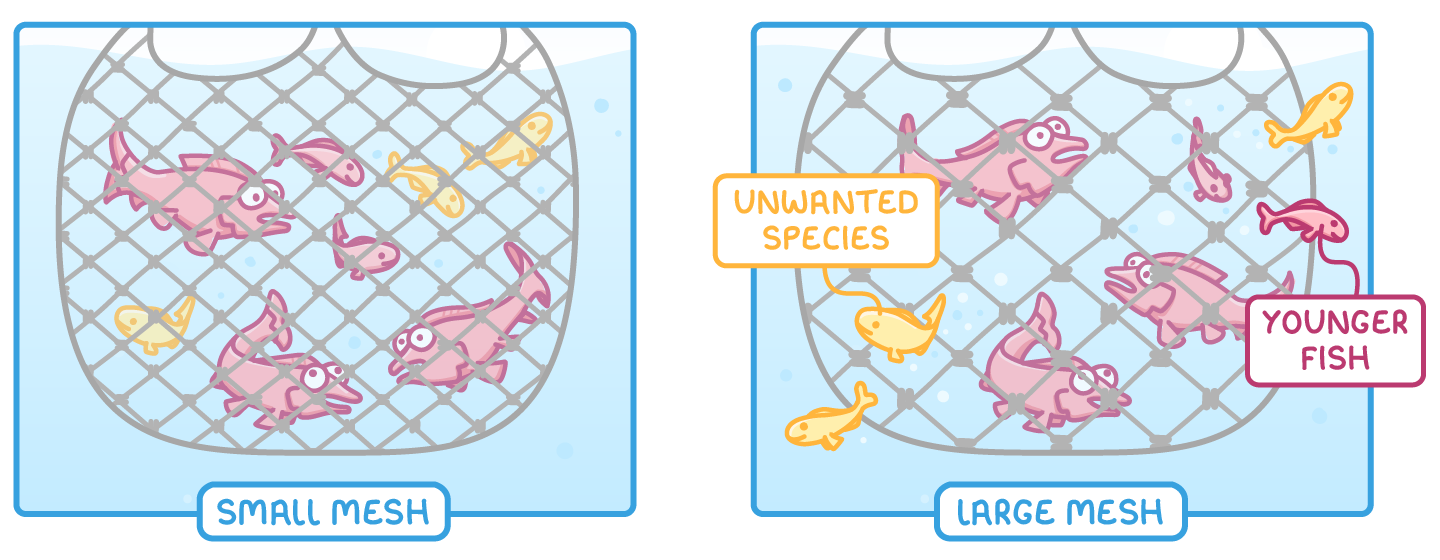
- Fishing quotas - Limit the number and size of fish that can be caught in a given area, which stops particular species from being overfished.
- Controlling net mesh size - Sets how big the holes in the nets are:
- A larger mesh lets unwanted species escape rather than being caught by accident
- It also lets younger, smaller fish slip through so they survive to reach breeding age
TermDefinition
Food securityReliable access to enough safe, nutritious food for everyone.
YieldThe amount of food or other useful product obtained, for example from a given area of land in a given time.