8.11 - Effect of Temperature on the Rate of Decay
The experiment
Aim
To find out how temperature affects the rate of decay of fresh milk, by timing how long it takes for the pH to fall as the enzyme lipase breaks down the fat in the milk.
Background
- Decay is the breaking down of dead material by decomposers, microorganisms such as bacteria and fungi.
- Decomposers release enzymes that digest the material. Temperature changes how fast those enzymes work, so it changes the rate of decay.
- In this experiment the enzyme lipase stands in for the decomposers. It breaks down the fats (lipids) in milk into fatty acids, which lowers the pH.
- You can't see the fat being broken down, but you can see the pH fall. Phenolphthalein indicator is pink in an alkali and turns colourless once the pH drops far enough.
- So in this practical you time how long the pink colour takes to disappear at different temperatures. The shorter the time, the faster the rate of decay.
Variables
- Independent variable - The temperature of the mixture, set with a water bath.
- Dependent variable - The time taken for the pink colour to disappear.
- Control variables - The volume and concentration of the milk and of the lipase, the volume of sodium carbonate solution, the number of drops of phenolphthalein, and the starting pH.
Method
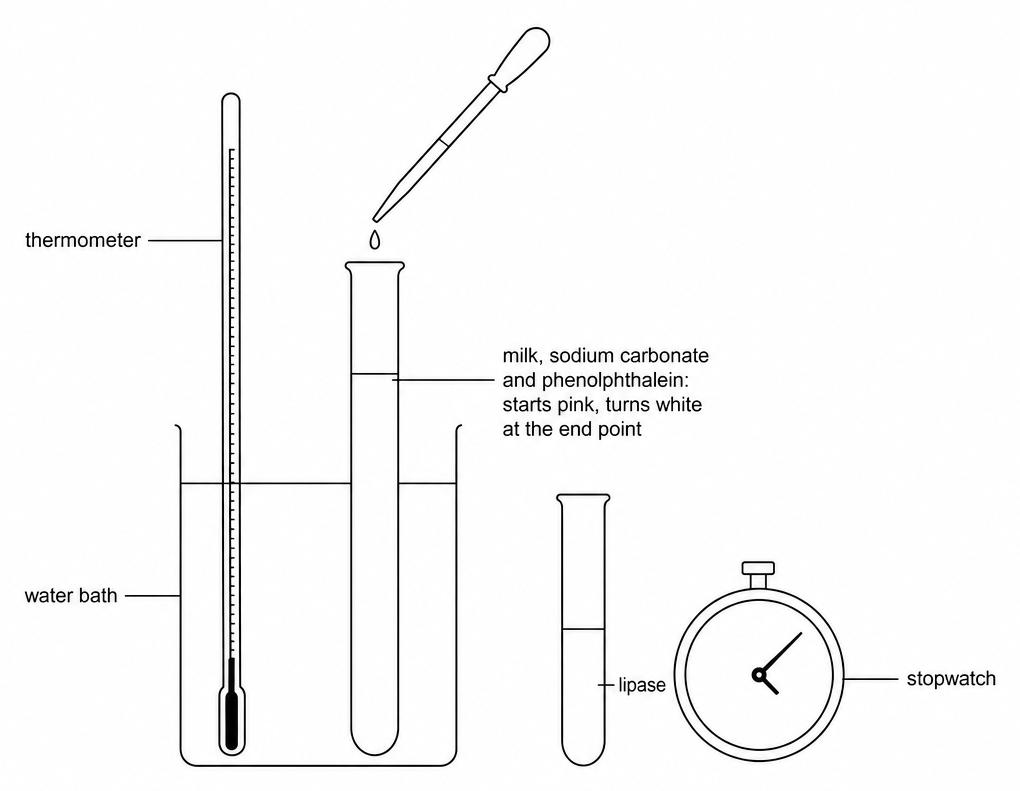
- Make the milk mixture - Measure 5 cm3 of milk into a boiling tube, then add 5 cm3 of sodium carbonate solution and a few drops of phenolphthalein. The mixture turns pink.
- Bring it to temperature - Stand the tube in a water bath at your first temperature, for example 10 °C, along with a separate tube of lipase, and leave both until they reach that temperature.
- Add the lipase - Add 1 cm3 of the lipase to the milk mixture, start the stopwatch, and stir.
- Stop the clock - Record the time at the exact moment the pink colour disappears.
- Repeat at other temperatures - For example 10, 20, 30, 40, and 50 °C. Repeat the whole experiment and find a mean time for each temperature, leaving out any anomalous results.
Safety
- Eye protection - Sodium carbonate solution and lipase are irritants, so wash off any splashes at once.
- No naked flames - Phenolphthalein is dissolved in ethanol, which is flammable.
- Hot water - A water bath at 50 °C is hot enough to scald, so lift tubes in and out with a test-tube holder.
Worked example - Effect of temperature on rate of decay
A student timed how long the pink colour took to disappear at five different temperatures.
| Temperature (°C) | Time for colour to disappear (s) |
|---|---|
| 10 | 400 |
| 20 | 200 |
| 30 | 100 |
| 40 | 80 |
| 50 | 250 |
Work out the rate at each temperature using rate = 1,000 ÷ time, plot the rates, and describe and explain the trend.
Step 1 - Turn each time into a rate
At 40 °C the colour disappeared in 80 s.
The rate has no unit. It's a relative rate, so the values only mean something when you compare one temperature with another. Do the same for every temperature.
- At 10 °C, the rate is 1,000 ÷ 400 = 2.5.
- At 20 °C, the rate is 1,000 ÷ 200 = 5.0.
- At 30 °C, the rate is 1,000 ÷ 100 = 10.0.
- At 40 °C, the rate is 1,000 ÷ 80 = 12.5.
- At 50 °C, the rate is 1,000 ÷ 250 = 4.0.
Step 2 - Plot the graph and find the peak
Plot rate on the y-axis against temperature on the x-axis, and draw a smooth curve. The curve rises to a peak at about 40 °C and then falls away. That peak is where the lipase works fastest, so decay is fastest there.
Step 3 - Describe and explain the trend
As the temperature rises towards 40 °C, the rate increases, because the enzyme and its substrate collide more often and react faster. At 40 °C decay is 12.5 ÷ 2.5 = 5 times faster than at 10 °C.
Past about 40 °C, the rate drops sharply. The high temperature denatures the lipase. Its active site changes shape, so it can no longer break down the fat.
Common exam questions
Question 1
Why is the rate worked out as 1,000 ÷ time, rather than using the time itself?
A faster reaction takes less time, so the time goes down as the rate goes up. 1,000 ÷ time goes up as decay gets faster, as a rate should. The 1,000 just keeps the numbers tidy, and the rate it gives has no unit. It's a relative rate, only used to compare one temperature with another.
Question 2
Why are the milk mixture and the lipase both left in the water bath before they're mixed?
So that both are already at the temperature being tested when the reaction starts, and only that temperature affects the time.
Question 3
Why is sodium carbonate solution added to the milk at the start?
It makes the mixture alkaline, so the phenolphthalein starts pink. The colour only disappears once the lipase has made enough fatty acids to lower the pH.