11.9 - Sex-Linked Inheritance
What a sex-linked characteristic is
- A sex-linked characteristic is a feature whose gene is on a sex chromosome, not on an ordinary (autosomal) chromosome.
- In practice this almost always means the X chromosome.
- Because the gene sits on a sex chromosome, the characteristic turns up more often in one sex than the other.
Why the two sex chromosomes matter
- The Y chromosome is much smaller than the X chromosome and carries far fewer genes.
- Most genes on the sex chromosomes are found only on the X, with no matching version on the Y.
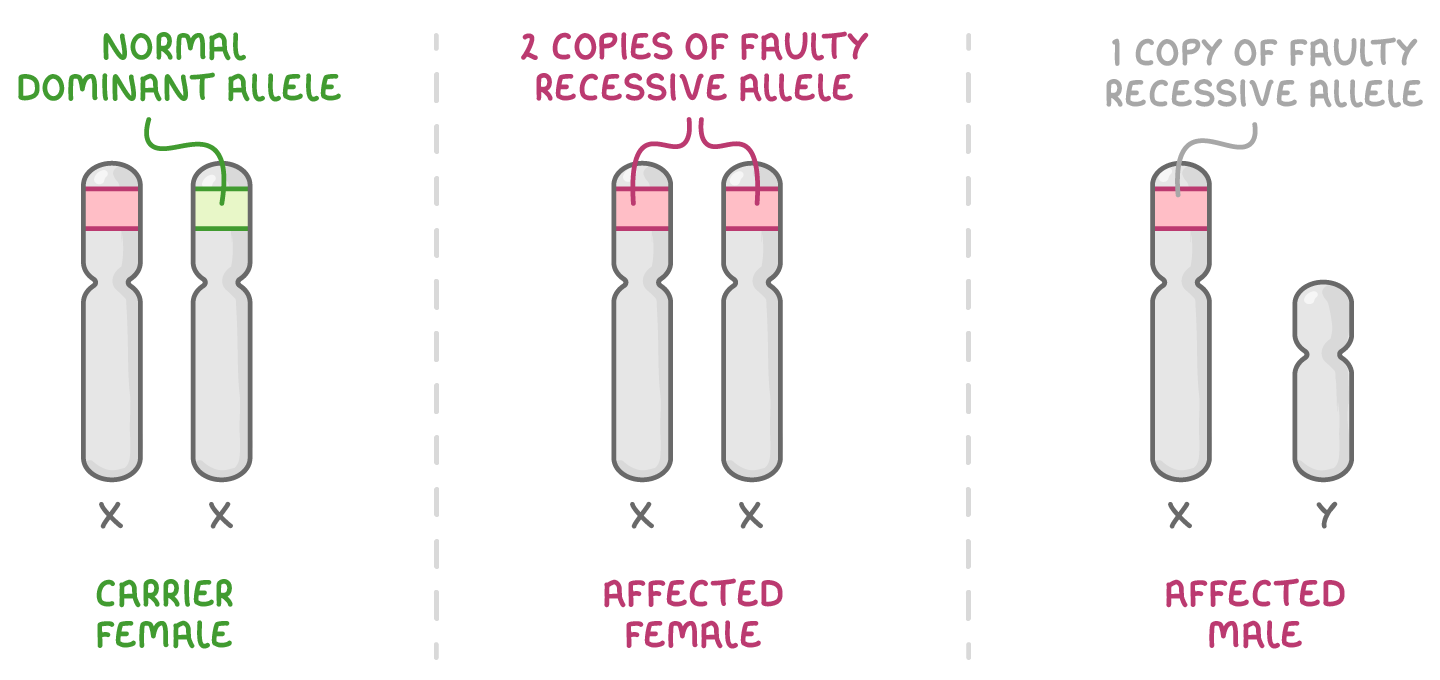
- Males (XY) - Have one X and one Y, so for a gene found only on the X they have just a single allele. That allele is expressed even if it is recessive, because there is no second X carrying a dominant allele to mask it.
- Females (XX) - Have two X chromosomes, so they have two alleles for that gene. A recessive allele on one X can be masked by a dominant allele on the other.
Why males are affected more often
- A male needs only one copy of the faulty recessive allele to be affected, because his single X has no partner to mask it.
- A female needs two copies, one on each X, to be affected.
- A female who carries a single copy of the recessive allele is not affected herself, because the dominant allele on her other X masks it - but she can still pass the faulty allele on to her children.
- Such a female is called a carrier.
Following a sex-linked cross
- Haemophilia is a sex-linked condition - a blood-clotting disorder caused by a recessive allele carried on the X chromosome.
- Because the allele sits on a sex chromosome, it's written as a superscript on the X:
- XH - The normal allele
- Xh - The haemophilia allele
- Y - Carries no allele for this gene, so it's written as a plain Y
- A sex-linkage cross must always use symbols showing both the sex chromosome and the allele on it (e.g. Xh Y).
- A male has only one X, so a male carrying the haemophilia allele (Xh Y) has the condition - which is why most people with haemophilia are male.
Cross 1 - Affected father × unaffected non-carrier mother
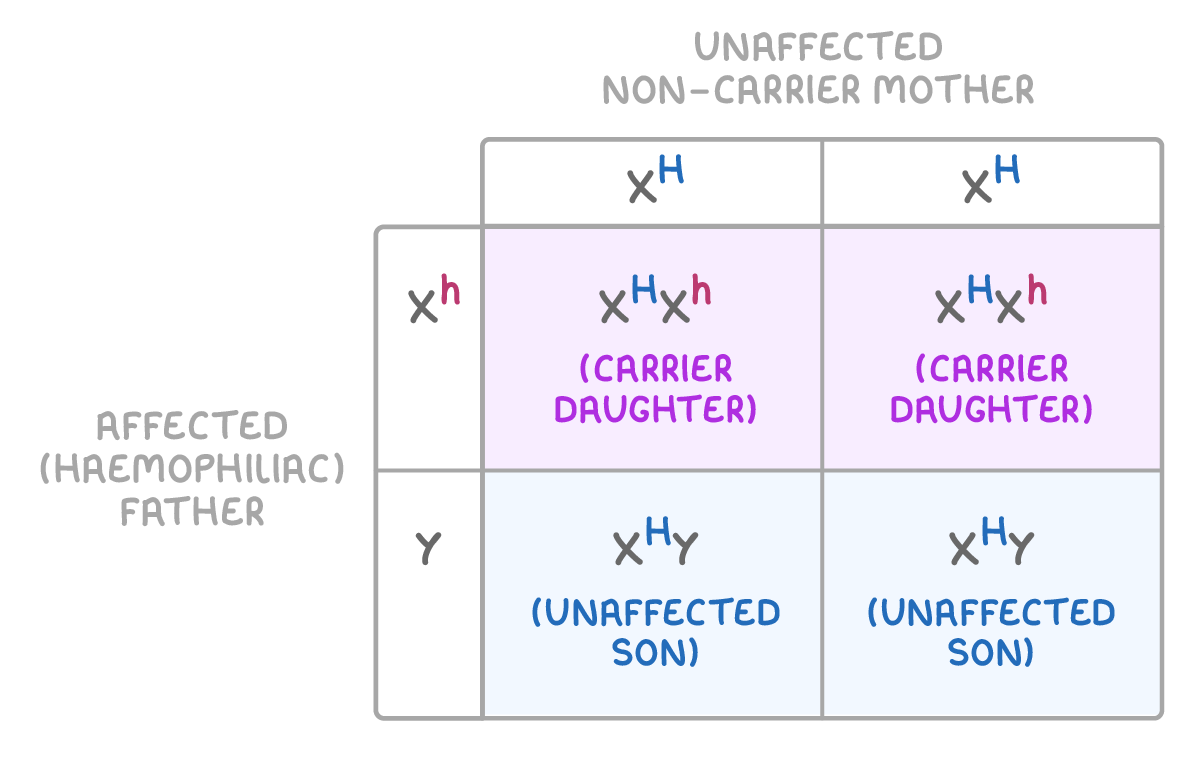
Affected (haemophiliac) father Xh Y × unaffected non-carrier mother XH XH.
- Every daughter is XH Xh - an unaffected carrier.
- Every son is XH Y - unaffected.
- None of the children has haemophilia, but every daughter carries the allele - this is how an affected father passes it on to grandchildren through his daughters.
Cross 2 - Unaffected father × carrier mother
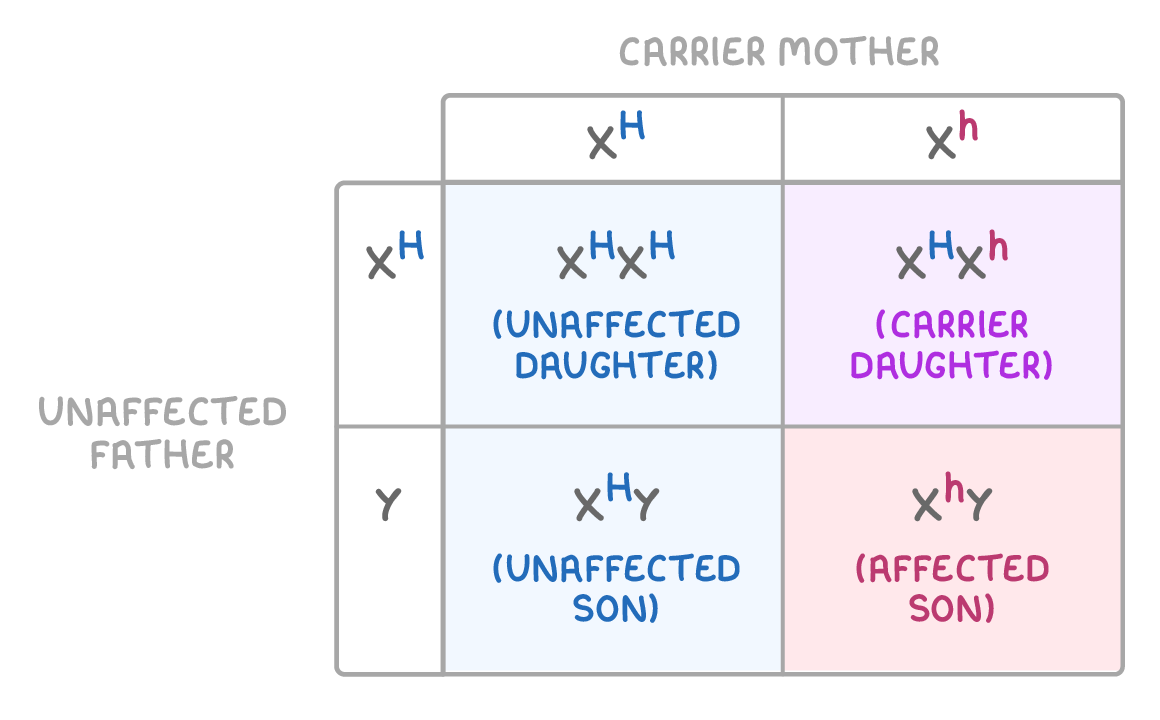
Unaffected father XH Y × carrier mother XH Xh.
- Four equally likely offspring, giving a ratio of 3 unaffected : 1 affected.
- Only a son is affected: a 1 in 4 (25%) chance for any child, rising to 1 in 2 (50%) once you know the child is a boy.
- No daughter has haemophilia, because each daughter inherits the father's normal XH.
Why haemophilia is usually found only in males
- A male needs just one faulty X to be affected.
- A female needs a faulty allele on both X chromosomes, so she must inherit one from each parent - which happens only very occasionally.
TermDefinition
Sex-linked characteristicA feature whose gene is located on a sex chromosome rather than an ordinary chromosome.
CarrierA person who has one copy of a recessive allele. They do not show the characteristic it causes, but can pass the allele on to their children.