4.3 - Absorption of Food
The villus and its adaptations
- The small intestine is adapted to absorb the products of digestion quickly and efficiently.
- It is very long, giving plenty of time to digest and absorb food before what's left reaches the end.
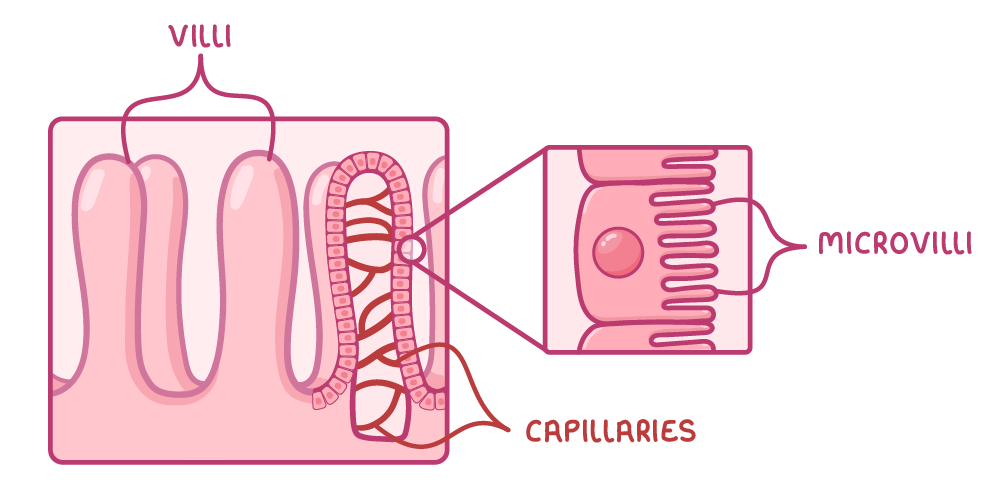
- Its inner wall has an enormous surface area - it is folded and covered in millions of tiny finger-like projections called villi.
- Each villus is a microscopic finger-like extension sticking out into the inside of the gut.
- The surface cells of each villus are themselves covered in even smaller projections called microvilli.
- Together, the length, folds, villi, and microvilli give a very large surface area, so a great deal of food can be absorbed at once.
- Most of this absorption takes place in the ileum, the last and longest part of the small intestine, whose inner wall is covered in villi.
A short diffusion distance
- A villus has a single, thin layer of surface cells - the wall is only one cell thick, and the cells have thin, permeable membranes.
- So the products of digestion have only a very short distance to travel from the gut into the blood, making absorption fast.
A rich blood supply
- Inside each villus is a network of blood capillaries lying very close to the thin surface.
- The capillaries absorb the soluble products - such as glucose and amino acids - and carry them away in the blood.
- This constant removal keeps the concentration inside the villus lower than in the gut, maintaining a steep concentration gradient that drives more products to diffuse in.
- Some absorption also uses active transport, which is why the surface cells contain many mitochondria to provide the energy needed.
TermDefinition
VillusA microscopic finger-like extension sticking out into the inside of the gut.