13.10 - Developing New Medicines
Discovering new medicines
- Many medicines used today were first discovered by studying the natural world.
- Plants and microorganisms have evolved over millions of years to make chemicals that protect them. Some of these chemicals turn out to be useful drugs for treating disease or relieving symptoms.
Medicines discovered from natural sources
- Digitalis - A heart drug developed from a chemical found in foxgloves
- Aspirin - A painkiller developed from a chemical found in the bark of willow
- Penicillin - An antibiotic discovered by Alexander Fleming
How penicillin was discovered
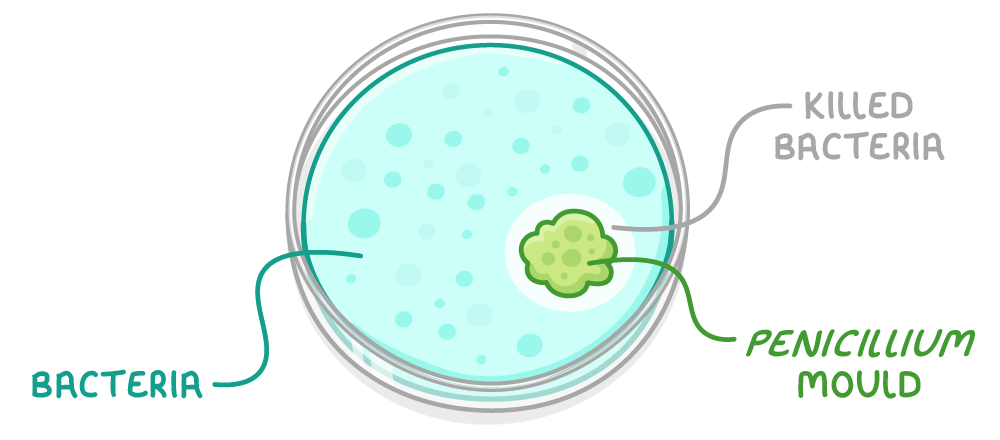
- Fleming noticed that a Penicillium mould, growing by accident on one of his bacterial plates, had killed the bacteria around it.
- He found the mould was producing a substance - penicillin - that killed the bacteria.
- Later, two other scientists, Florey and Chain, isolated this substance so it could be produced commercially as the first antibiotic.
- The discovery shows how important careful observation and the scientific process are in developing new medicines.
How new medicines are made today
- Most new drugs are now synthesised by chemists in the pharmaceutical industry, though the starting point may still be a chemical extracted from a plant.
- Another modern approach begins from the disease itself:
- Scientists identify a target - usually a gene or protein involved in causing the disease.
- They screen large numbers of chemicals to find ones that act on that target.
- They modify the most promising ones into a possible drug.
Preclinical testing
- Any possible new drug must be tested thoroughly before being given to people, to check it is both safe and effective.
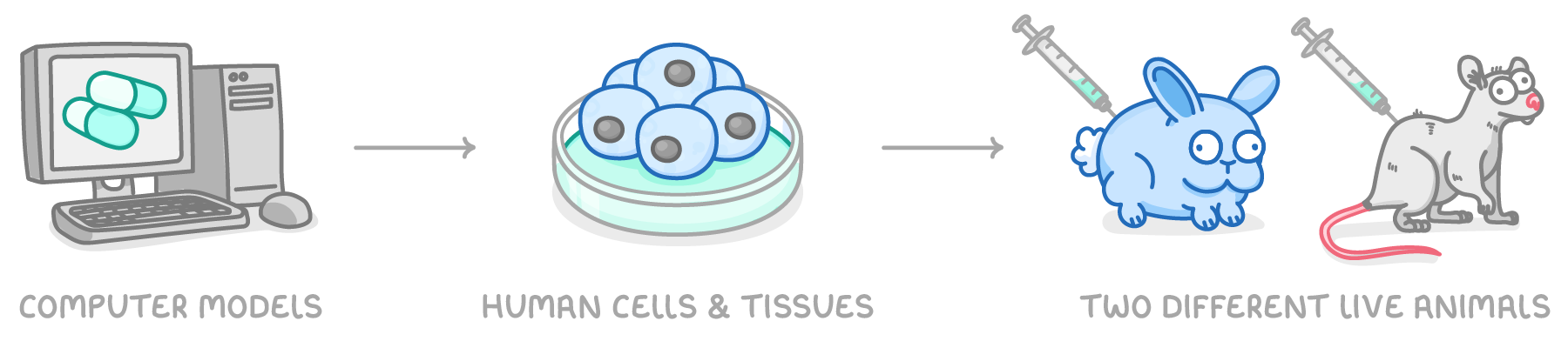
- Preclinical testing is the first stage. It is carried out in the laboratory, not on people, and works through three steps in order.
Stages of preclinical testing
- Computer models and simulations - Used first to identify the most promising drugs before any living material is involved
- Human cells and tissues - Grown in the lab; a cheap way to screen many substances
- Live animals - In Britain the law requires any new drug to be tested on two different live mammals
Why cells and tissues aren't enough
- Testing on cells and tissues cannot show how the drug would affect a whole body, because cells and tissues are not joined into working organs and systems.
- For example, a drug for blood pressure has to be tried on a whole animal with an intact circulatory system.
What animal testing checks
- Efficacy - Whether the drug actually produces the effect wanted
- Toxicity - How harmful it is and whether it causes side effects
- Best dose - What amount should be given
The ethical debate
- Animal testing is a subject of ethical debate.
- Some people object to it, while others argue it is the safest way to be sure a drug is not dangerous before any human takes it.
- Computer models are increasingly used and may one day replace some of it.
TermDefinition
Preclinical testingThe first stage of drug testing, carried out in a laboratory on computer models, human cells, tissues and live animals.
EfficacyWhether a drug actually produces the effect wanted.
ToxicityHow poisonous or harmful a substance is (for a new drug, whether it has harmful side effects).