11.12 - Inherited Disorders & Screening
Cystic fibrosis, a recessive inherited disorder
- Cystic fibrosis is a genetic disorder of the cell membranes, caused by the mutation of a single gene.
- The faulty protein this gene makes can no longer properly control the movement of salt and water into and out of cells.
- As a result, the body produces a lot of thick, sticky mucus that builds up in:
- The air passages of the lungs (the bronchioles)
- The pancreas
- This leads to frequent, serious lung infections and to problems with digesting food.
A recessive allele
- The disorder is caused by a recessive allele, usually written as a lowercase f.
- Because the allele is recessive, a person only has cystic fibrosis if they inherit two copies of it - so an affected person is homozygous recessive (ff).
- A person with just one copy (Ff) does not have the disorder, because the normal dominant allele still works. They are called a carrier and can pass the faulty allele on.
- The recessive allele is fairly common - about 1 person in 25 carries it, so many carriers have no idea they could pass it on.
Inheriting cystic fibrosis
- For a child to be born with cystic fibrosis, both parents must each pass on a recessive allele - so both must be carriers or have the disorder themselves.
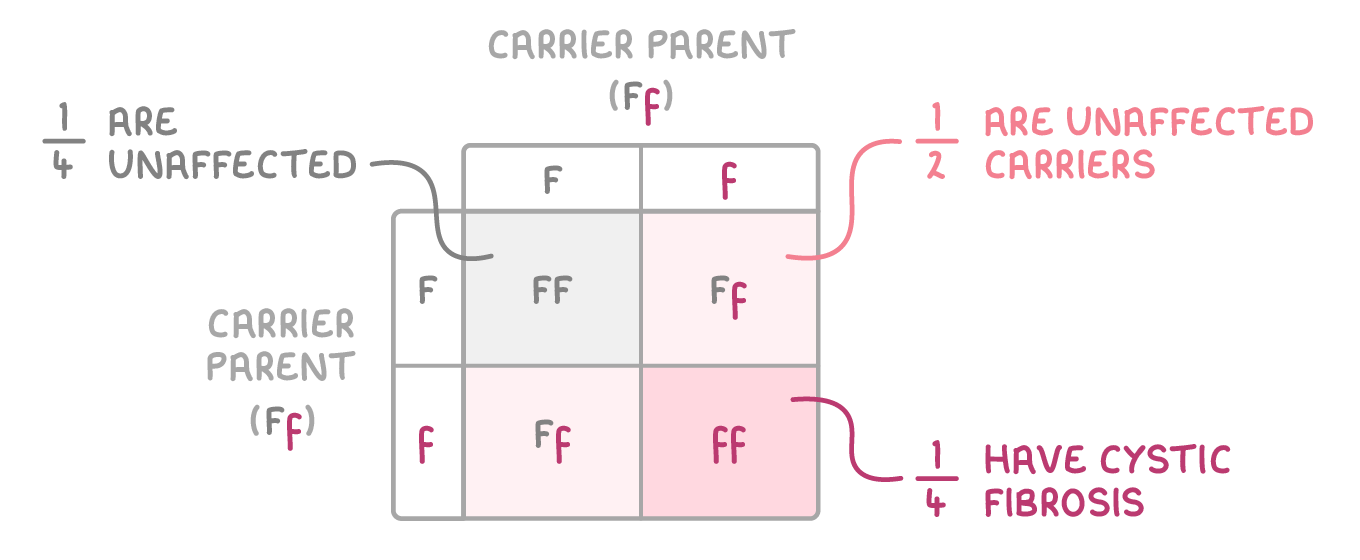
- Crossing two carriers (Ff × Ff) gives four equally likely combinations: FF, Ff, Ff and ff.
For any one child, the chances of each outcome are:
Huntington's disease and Down's syndrome
Some inherited disorders are caused by a dominant allele rather than a recessive one, and Huntington's disease is one of these. Down's syndrome arises differently again, from a whole extra chromosome.
Huntington's disease - A dominant allele
- Caused by a faulty dominant allele, so only one copy is needed to develop the condition.
- An affected parent can pass it on directly.
- It causes progressive deterioration of the brain, which usually doesn't appear until middle age.
- It is fatal, with currently no cure.
- Because symptoms appear late in life, a person may already have had children before they know they carry the allele.
Down's syndrome - An extra chromosome
- Not caused by a faulty allele at all, but by a whole extra chromosome.
- People normally have 46 chromosomes in their body cells, and each gamete (sperm or egg) normally carries 23.
- Occasionally a gamete forms with 24 chromosomes instead of 23. If it fertilises a normal gamete, the child has 47 chromosomes rather than 46 - this causes Down's syndrome.
- Features include a distinctive facial appearance, reduced muscle tone, and reduced cognitive development.
How Down's syndrome differs from inherited disorders
- It comes from a mistake during gamete formation, not from passing on a particular allele, so it isn't inherited in the way cystic fibrosis and Huntington's disease are.
- It can be identified using a karyotype - a display of all a person's chromosomes - by counting them to find the extra chromosome.
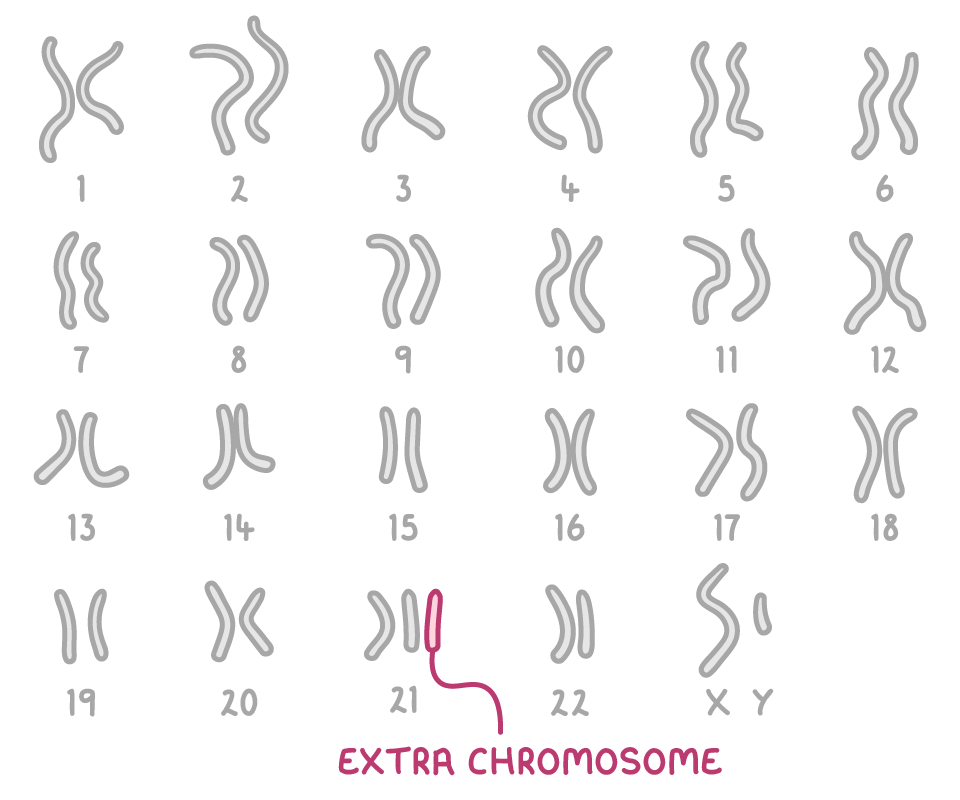
A karyotype showing Down's syndrome, with three copies of chromosome 21 instead of two.
Prenatal screening - Amniocentesis and the blood test
- Genetic screening checks whether a foetus in the womb has a genetic condition - such as Down's syndrome or cystic fibrosis - before the baby is born.
- Two methods are used: a blood test and amniocentesis.
The blood test
- Offered to a pregnant woman first, after about 10 to 14 weeks of pregnancy.
- The result estimates whether the chance of the baby having a condition such as Down's syndrome is higher than normal.
- It carries no risk to the mother or the foetus, but it's less accurate - it doesn't give a definite answer, only flags who is at higher risk.
- Women shown to be at higher risk are then offered the more accurate but riskier amniocentesis.
Amniocentesis
- The fluid around the foetus, called amniotic fluid, is held in the amnion and contains some of the foetus's own cells.
- A sample of this fluid is taken, the cells are grown in the laboratory, and the number of chromosomes in each cell is counted - for example to detect the extra chromosome of Down's syndrome.
- It gives a more accurate result than the blood test, but carries a risk of about 1 in 100 (1%) of causing a miscarriage.

The ethics of prenatal screening
When screening diagnoses a genetic condition, parents face a difficult decision about whether to continue the pregnancy, and people disagree strongly about what is right.
| Arguments for ending the pregnancy | Arguments against ending the pregnancy |
|---|---|
| Prevents a child being born to a poor quality of life. | The unborn child has no say. |
| Caring for a severely affected child can take time away from a family's other children. | Some believe it is not morally right to end a foetus's life. |
| Abortion is forbidden by some religions and in some countries. |
Screening raises wider questions too:
- Who should decide who is screened?
- What level of risk is acceptable?
- Should the cost of screening be weighed against the cost of treating people with a condition?
- Should genetic information be made available to wider society - for instance, insurance companies could use it to refuse cover or charge more?
TermDefinition
Cystic fibrosisA genetic disorder of the cell membranes caused by a recessive allele. It makes the body produce thick, sticky mucus.
CarrierA person who has one copy of a recessive allele. They do not show the characteristic it causes, but can pass the allele on to their children.
Huntington's diseaseA fatal genetic disorder caused by a dominant allele, in which the brain gradually breaks down.
Down's syndromeA condition caused by a mistake during gamete formation that results in a person having a whole extra chromosome.
AmniocentesisA method of prenatal (before birth) screening where a sample of amniotic fluid is taken to count the chromosomes in the foetus's cells.