Homeostasis - exam practice
Homeostasis
Question 1 of 3
The endocrine system coordinates many internal functions of the body.
Give three ways in which the endocrine system differs from the nervous system.
The response of the skin to cold weather is an involuntary action.
How is an involuntary action different from a voluntary action?
Give the name of the process by which the internal conditions of the body are maintained.
The kidneys maintain a constant amount of water in the body.
The table shows the volume of water that the kidneys filter from the blood and the volume of urine produced in one day.
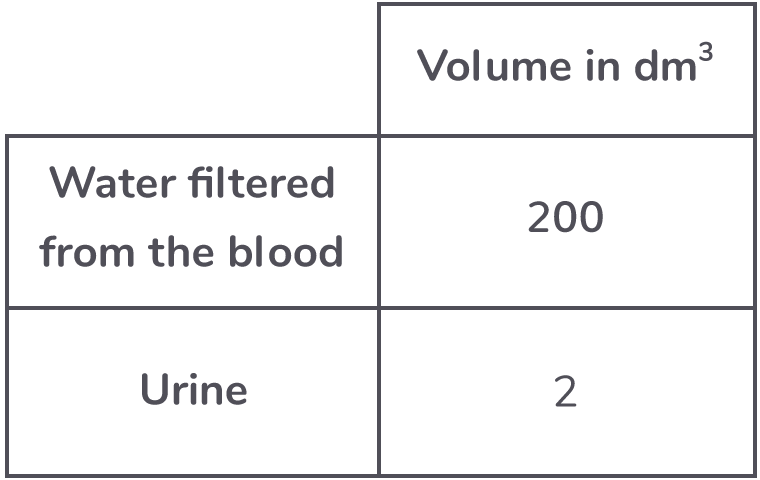
Calculate the volume of water reabsorbed into the blood that day.
Which of the substances are found in the urine of a healthy person?
Add ticks to the correct boxes.
Explain, for each of the four substances in c), why they are found in the urine of a healthy person or not.
Some people suffer from diabetes.
People with type 1 diabetes do not produce enough insulin to maintain an appropriate level of blood glucose.
Which organ in the body monitors blood glucose concentration?
Insulin causes its target organs to take in glucose from the blood.
Which of the following is a target organ for insulin?
Explain how the body of a person who does not suffer from diabetes lowers the blood glucose levels after they eat a meal rich in carbohydrates.
Insulin is a protein.
Insulin must be injected as it cannot be taken as a tablet.
Suggest what would happen to an insulin tablet if it reached the stomach.
Compare the causes of type 1 and type 2 diabetes, and explain how each type of diabetes can be treated.