Food Chains - exam practice
Food Chains
Question 1 of 8
The diagram below shows a food chain comprising corn, mice and falcons.
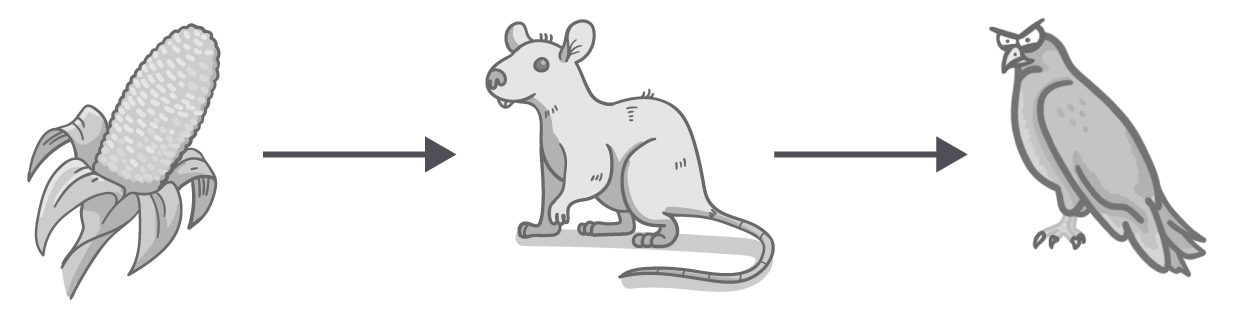
Which trophic level is the falcon?
The corn is a producer.
What is meant by the term producer?
What is the source of energy for the food chain?
Some of the mouse biomass does not become part of the falcon biomass.
Which of the following is a valid reason for this loss of biomass?
A new pet food brand is selling insect-based cat food.
The insects in the cat food factory are fed on waste vegetables.
Sketch and label the pyramid of biomass for the food chain that produces food for cats from insects.
Which of the following words correctly describes the vegetables' position in the food chain?
Which of the following words correctly describes the insects' position in the food chain?
Which of the following words correctly describes the cats' position in the food chain?
A food web contains several food chains.
The image below shows a food web.
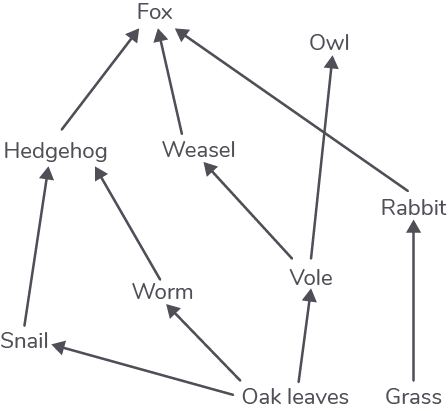
The animals in the food web above get their energy by eating other organisms.
Describe how the grass gets energy.
Name one primary consumer in food web above.
Name one producer in the food web above.
The different food chains in this food web have different numbers of organisms.
Write a food chain with four organisms, including the fox.
Some bacteria are decomposers.
These bacteria change organic matter into carbon dioxide and inorganic mineral ions.
Describe how the bacteria do this.
Food chains illustrate the passage of food (or energy) from one organism to another.
The diagram below shows a typical freshwater food chain.
algae → stickleback → trout → osprey
Name the process carried out by the algae that allows energy to enter the food chain.
Name the secondary consumer in the food chain above.
In food chains, biomass is lost between different trophic levels.
One reason for this is the release of undigested food from the body.
What is the release of undigested food called?
The diagram below shows a pyramid of energy for a typical food chain.
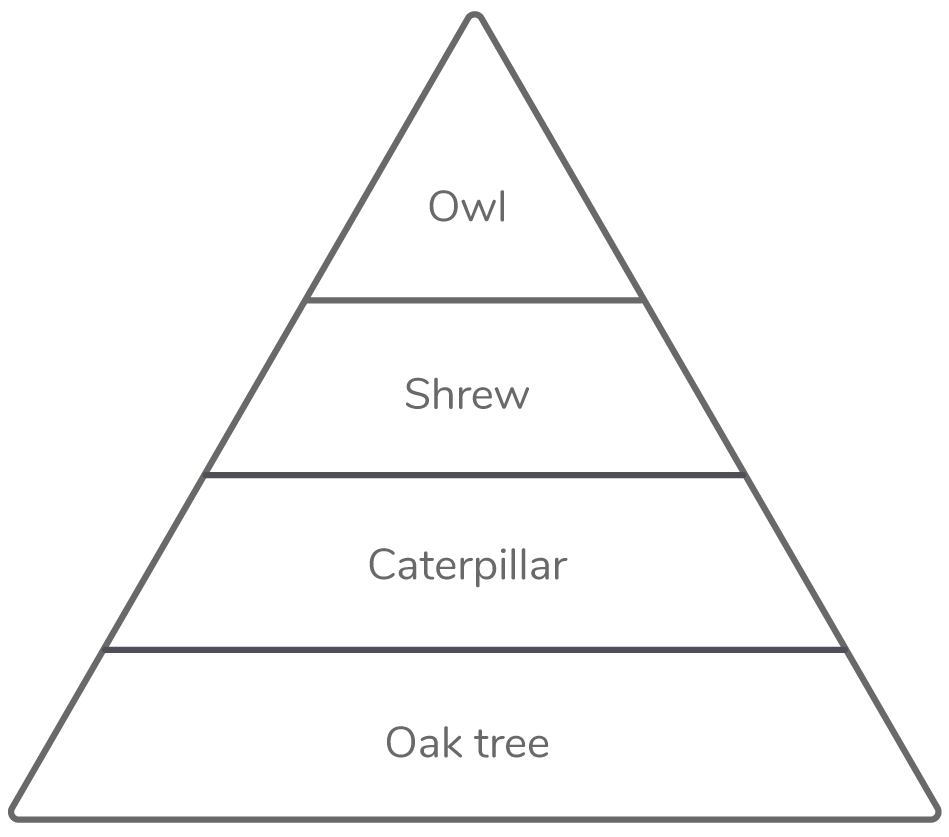
Explain why a pyramid of biomass always has this shape.
Only 5% of light energy landing on an oak tree is absorbed by leaves.
This is converted to chemical energy.
Calculate the total light energy landing on the leaves if they contain 20,000 units of chemical energy.
The shrews are consumers.
Give another ecological term that describes the role of the shrews in this food chain.
The table below shows what happens to each 20 J of energy gained by the caterpillar from food.
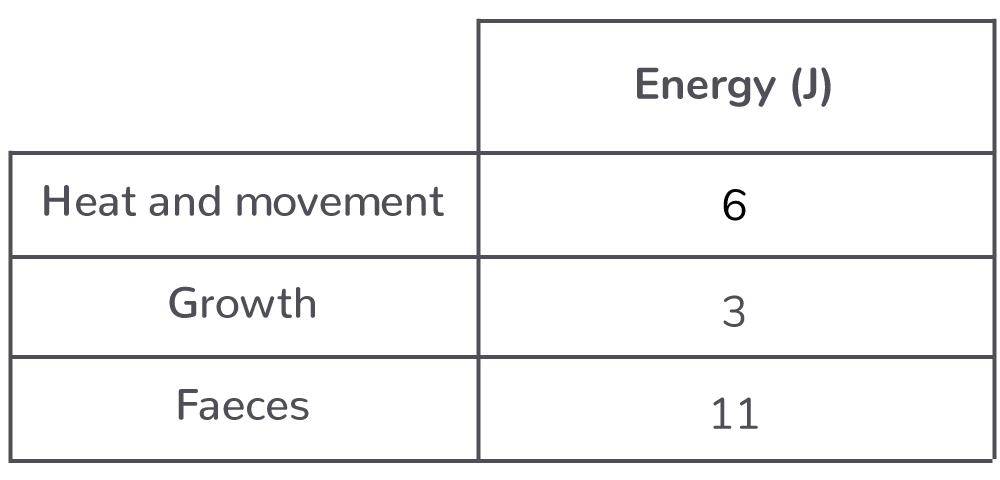
Which percentage of the energy gained from food is used for heat and movement?
Which one of these processes allows energy to be passed on to the next level in a food chain?
The diagram below shows a food web.
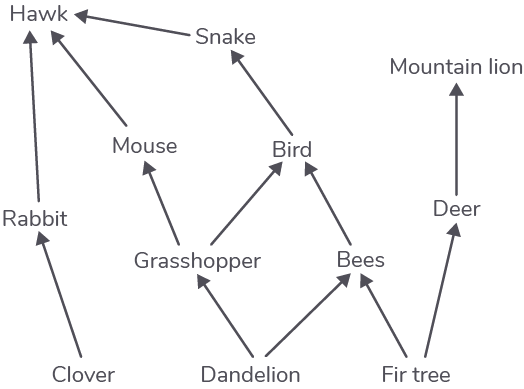
State the number of primary consumers in this food web.
State the number of food chains in this food web.
The mountain lion catches and eats its prey.
Give the name used to describe the lion in this food web.
A pesticide can be used to kill the grasshoppers in this habitat.
Describe the effect that killing grasshoppers would have on:
- the number of grass plants
- the number of mice
A gardener investigated the populations of organisms in her garden.
The figure below shows estimates of the number and biomass of some of the organisms she studied.
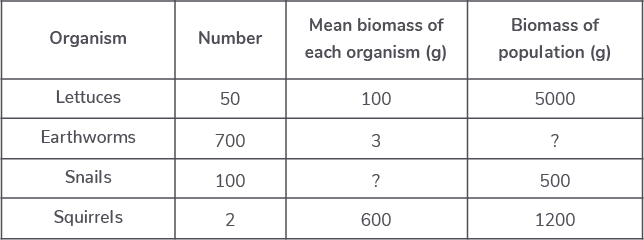
Calculate the biomass of the population of earthworms.
Calculate the mean biomass of each snail.
Snails eat lettuce and earthworms.
The gardener used a pesticide that killed most of the earthworms in the garden.
Predict how this will affect the population of lettuces.