5.17 - Cloning Animals
Embryo transplantation
- Embryo transplantation produces many genetically identical animals from a single mating of two chosen parents.
- It's used in farming to get large numbers of offspring from the best breeding animals - for example a prize bull and a prize cow.
How it's done
- Sperm cells are taken from the chosen male and egg cells from the chosen female, and the eggs are fertilised artificially.
- Each fertilised egg starts to develop into an embryo.
- While the embryo is still a small ball of cells - before any cells have specialised - it's split apart into several separate clumps of cells.
- Because the cells haven't specialised yet, each clump can develop into a complete animal. They all carry exactly the same genetic information, so they are clones of one another.
- The cloned embryos are implanted into the uteruses of several host mothers, which carry the pregnancies and give birth to the calves.
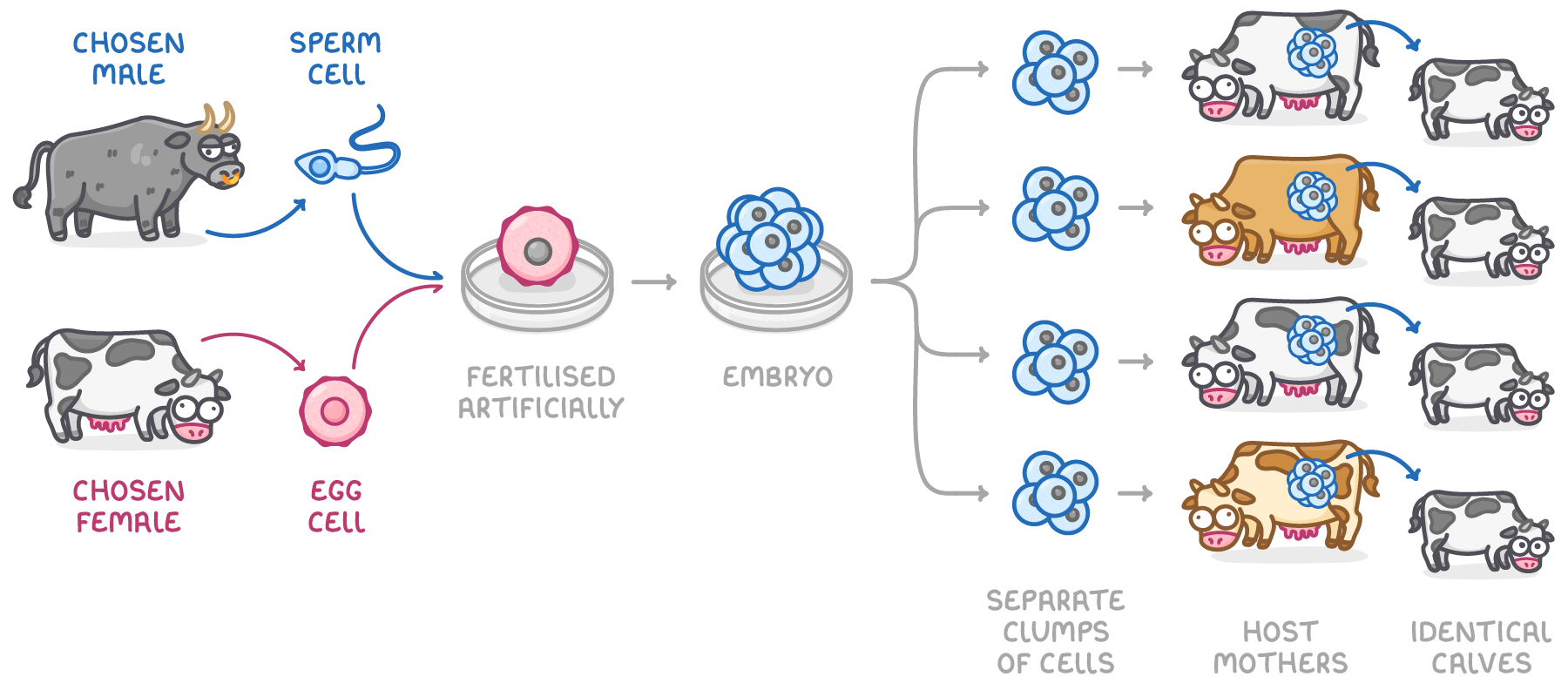
The host mothers aren't the genetic parents
- The host mothers simply incubate the embryos - they are not the genetic parents.
- This means a single prize pairing can produce many identical, high-quality offspring each year.
Adult cell cloning by nuclear transfer
- Adult cell cloning (also called nuclear transfer) makes a clone of an existing adult animal.
- The first mammal cloned this way was Dolly the sheep, in 1996. Other mammals have since been cloned by the same method.
The steps of nuclear transfer
- Take an unfertilised egg cell and remove its nucleus, leaving an egg with no nucleus (an enucleated egg).
- Take the nucleus from an adult body cell of the animal to be cloned - e.g. a skin cell or an udder cell.
- Insert this body-cell nucleus into the empty egg cell. The nucleus is diploid (it has two sets of chromosomes, one from each parent), so the egg now contains all the adult's genetic information.
- Give the egg cell a small electric shock, which stimulates it to start dividing by mitosis, just as a normal fertilised egg would.
- Once it has divided into a ball of cells (an embryo), implant it into the uterus of an adult female (a surrogate mother).
- The embryo develops until it is ready to be born.
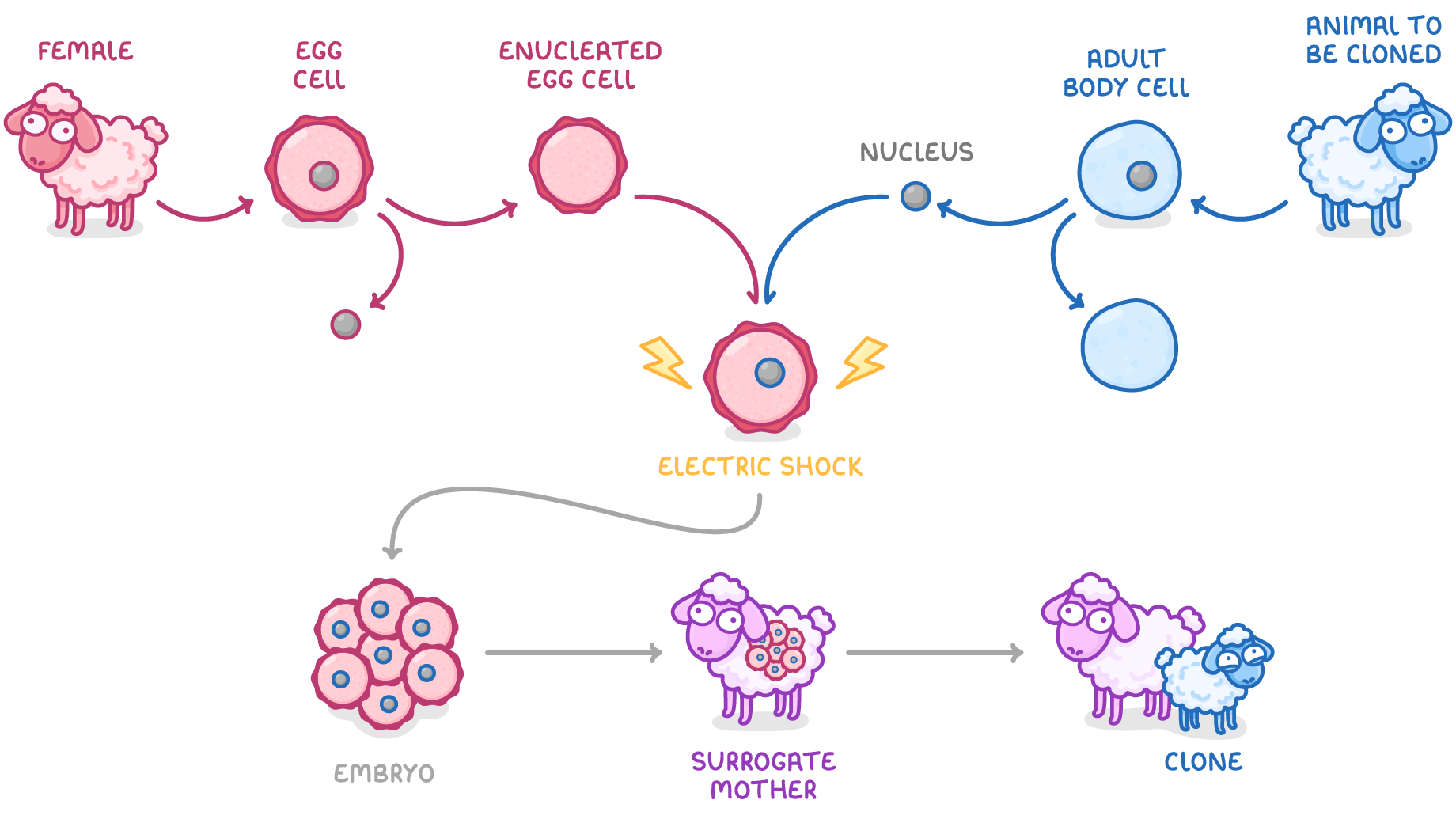
The result
- The animal that is born is genetically identical to the adult that supplied the body-cell nucleus, because it has the same genetic information.
- It is a clone of that animal.
TermDefinition
Embryo transplantationThe process of splitting an early embryo into separate groups of cells and implanting them into host mothers to produce genetically identical offspring.
Adult cell cloningA method of cloning an existing adult animal by inserting a nucleus from one of its body cells into an empty egg cell.
Enucleated eggAn egg cell that has had its nucleus removed.