4.3 - Animal Behaviour
Courtship and mate choice
- Sexual reproduction needs two individuals to breed, so before mating an animal must first find and choose a suitable mate.
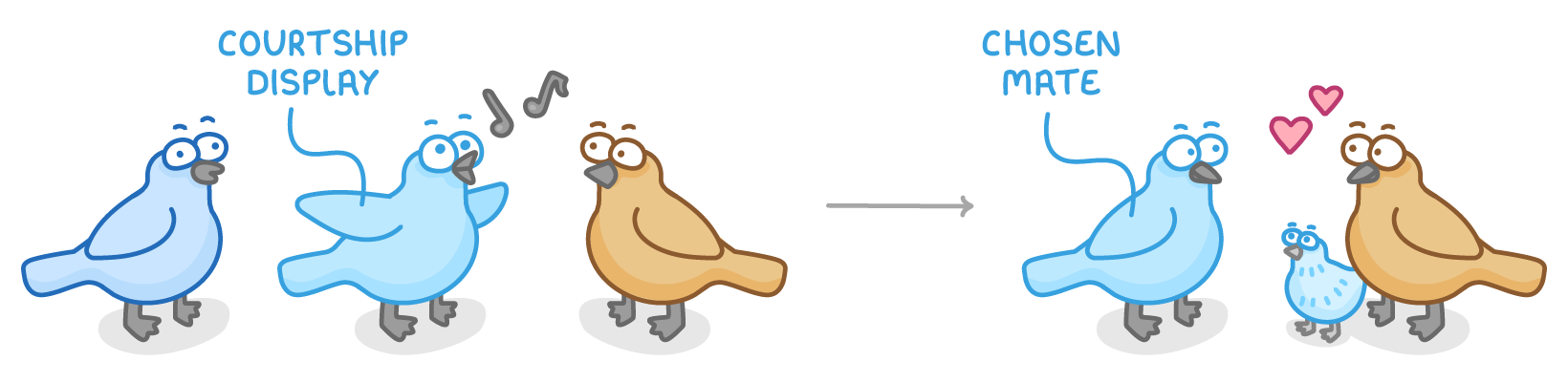
- Many animals do this through courtship - a set of behaviours such as displays, calls, dances, or the offering of gifts performed before mating.
Courtship lets an animal identify a mate that is:
- Of the same species
- Of the opposite sex
- Ready to breed
It also lets each animal judge the quality of a possible mate:
- By performing a courtship display, an animal advertises its own quality - its health, strength, or fitness - to a potential mate.
- Choosing a high-quality mate improves the chance that offspring will inherit useful characteristics and survive, so courtship helps an animal breed successfully.
Mating strategies
Animals follow different mating strategies. The strategy an animal uses is itself a behaviour that helps it pass on its genes:
- Take a single mate for life and raise young together year after year.
- Have several mates over a lifetime.
- Take one mate for a single breeding season, then choose a different mate the next season.
- Have several mates within one breeding season.
Parental care
- Parental care is special behaviour that protects and raises offspring after they are born or hatch.
- Examples include feeding the young, keeping them warm, and defending them against predators.
Why parental care is a successful strategy
- By looking after its young, a parent increases the chance the offspring survive to become adults.
- Surviving offspring can themselves reproduce, passing on the parents' genes to the next generation.
- So parental care increases both offspring survival and the chance of the parental genes being passed on.
- Animals that care for their young tend to leave more surviving offspring, so natural selection can favour parental care.
The risks to the parent
- Defending the young against a predator can put the parent itself in danger.
- Gathering food for the offspring uses up the parent's energy and time, and can leave less food for the parent.
- Staying with the young can expose the parent to predators or disease.
Parental care is therefore a trade-off: the benefit of raising surviving young is balanced against the cost and risk to the parent.
Types of animal behaviour
- Animal behaviour can be innate or learned.
- Innate behaviour is inherited and present from birth - the animal performs it without learning, and every member of the species behaves the same way.
- Examples: a newborn mammal suckling, or a spider spinning a web for the first time.
- Learned behaviour develops through experience during the animal's life.
Types of learned behaviour
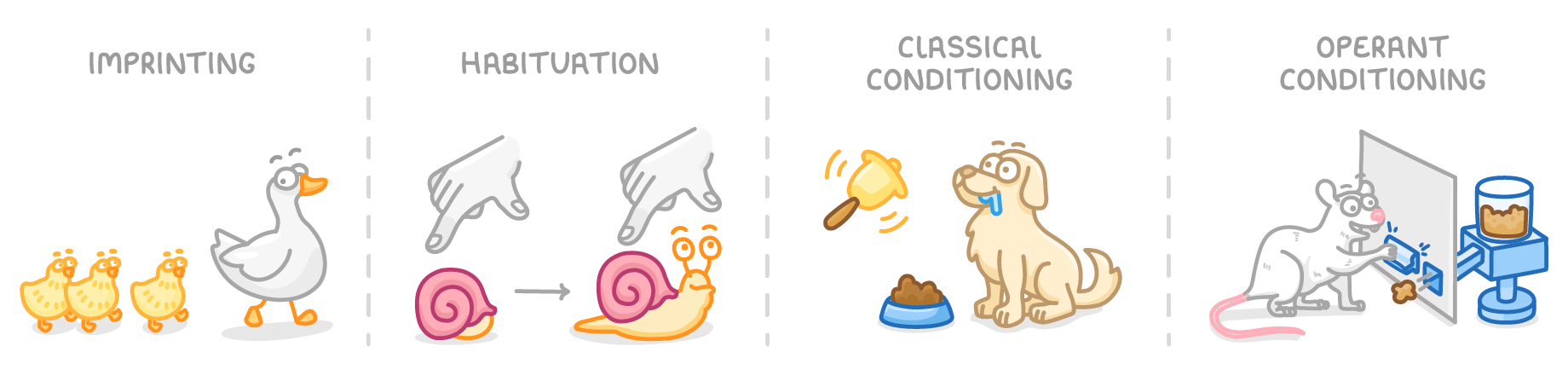
- Imprinting - A young animal, during a short sensitive period soon after birth or hatching, forms a strong attachment to the first large moving object it sees (usually its parent) and then follows it. Ducklings following the first moving thing they see after hatching are the classic example.
- Habituation - An animal learns to stop responding to a stimulus that is repeated many times and turns out to be neither harmful nor rewarding. A snail that first withdraws into its shell when touched stops withdrawing after being touched repeatedly with no harm.
- Classical conditioning - An animal learns to associate a new, originally neutral stimulus with an important one, and comes to respond to the new stimulus alone. In Pavlov's experiment, dogs given food just after a bell was rung began to salivate at the sound of the bell alone.
- Operant conditioning - An animal learns to associate one of its own behaviours with a reward or a punishment. Rewarded behaviour is repeated and punished behaviour is avoided, so the animal learns by trial and error. A rat given food each time it presses a lever soon learns to press the lever.
Training animals using conditioning
- Humans use conditioning to train captive animals to do useful jobs.
- Most animal training uses operant conditioning:
- A desired behaviour is rewarded (for example with food or praise), so the animal learns to repeat it.
- Unwanted behaviour is not rewarded, so it dies away.
- Over many repetitions, the animal reliably performs the behaviour on cue.
Examples of trained working animals
- Sniffer dogs - Trained to detect particular scents, such as explosives or drugs. The dog is rewarded whenever it correctly finds and signals the target scent, so it learns to search for that scent and signal when it finds it.
- Police horses - Trained to stay calm and obedient in noisy, crowded situations. They are gradually exposed to crowds, flags, and loud noises and rewarded for staying calm - through a mix of habituation and reward-based conditioning they learn not to panic.
In both cases, conditioning turns a natural ability into a trained, dependable behaviour that is useful to people.
Animal communication
- Animals communicate by sending signals to one another.
- Communication lets animals:
- Attract a mate
- Warn others of danger
- Defend or mark out a territory
- Coordinate the behaviour of a group
Three types of signal
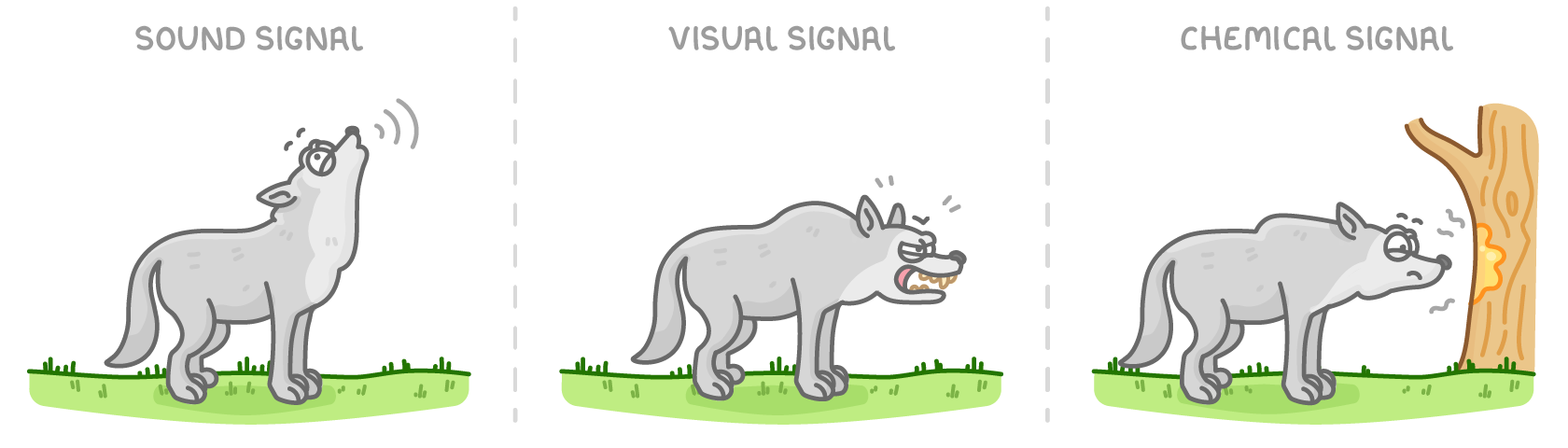
- Sound signals - Calls and songs, such as a bird's song to attract a mate or defend territory, a wolf's howl, or an alarm call warning the group of a predator
- Chemical signals - Scents and pheromones, such as an ant laying down a scent trail for others to follow, or a mammal marking the edge of its territory with scent
- Visual signals - Displays, postures, movements and colours, such as a peacock's tail spread in courtship, a bee's waggle dance telling other bees where food is, or the body language a wolf uses to show it is threatening or submissive
Different signals suit different situations
- Sound and visual signals - Can be sent and changed quickly, and work over a distance
- Chemical signals - Can last a long time after the animal has moved on, which makes them useful for marking territory
TermDefinition
CourtshipA set of behaviours performed by animals to attract and select a suitable mate.
Parental careBehaviour that protects and raises offspring after they are born or hatch.
Innate behaviourBehaviour that is inherited and performed correctly from birth without needing to be learned.
Learned behaviourBehaviour that develops and changes through an animal's experience during its life.
ImprintingA learned behaviour where a young animal forms a strong attachment to the first large moving object it sees.
HabituationA learned behaviour where an animal stops responding to a repeated stimulus that is neither harmful nor rewarding.
Classical conditioningA learned behaviour where an animal learns to associate a neutral stimulus with an important one and responds to the neutral stimulus alone.
Operant conditioningA learned behaviour where an animal learns to associate its own actions with a reward or a punishment.