6.3 - Lamarck
Lamarck's rejected hypothesis
- Darwin wasn't the only person to suggest how evolution might happen. Earlier, Jean-Baptiste Lamarck put forward a rival hypothesis.
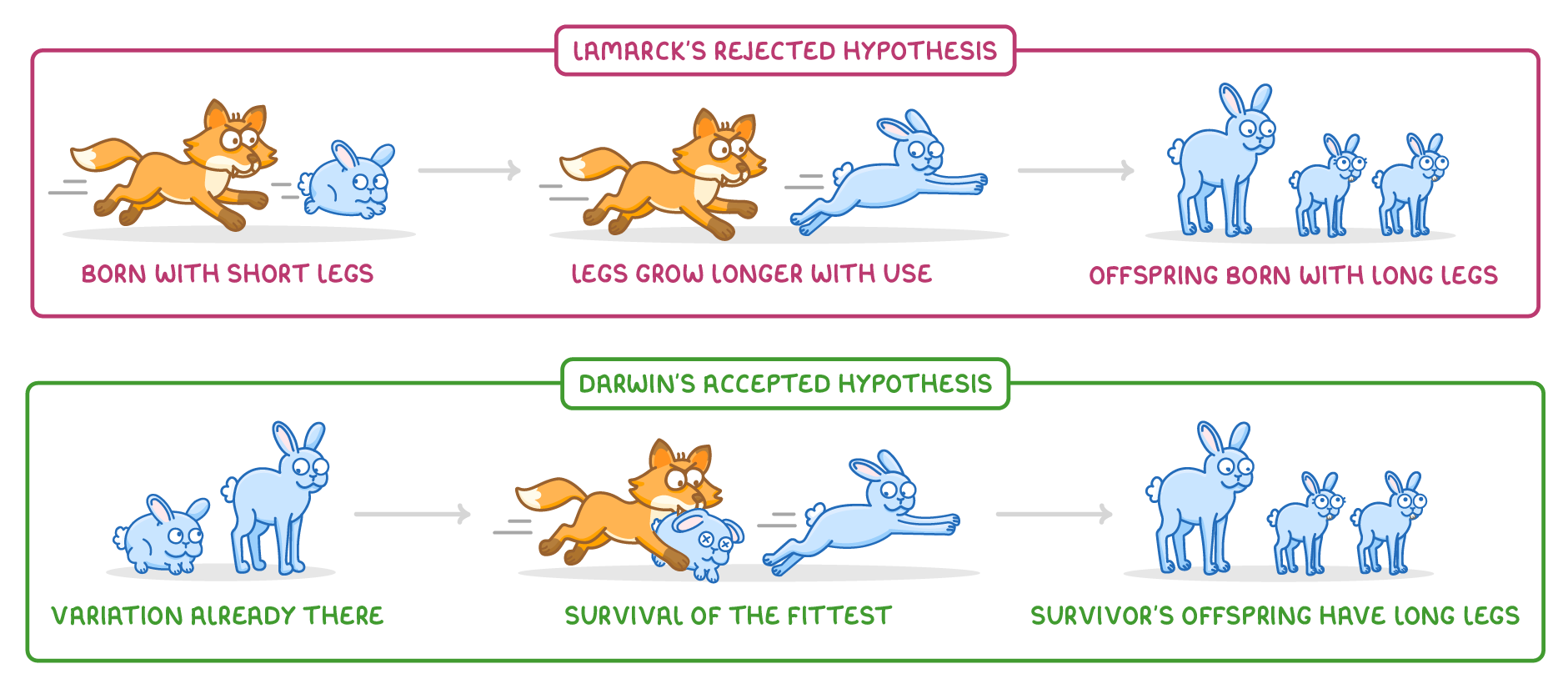
- Lamarck's idea: characteristics an organism acquires during its lifetime are passed on to its offspring.
- If a feature was used a lot, it would become more developed during the organism's life.
- That more-developed feature would then be inherited by the offspring.
- Example: Lamarck reasoned that if a rabbit used its legs a lot to run from predators, its legs would grow longer, and its offspring would be born with longer legs.
Why Lamarck's hypothesis was rejected
- Experiments didn't support it - a characteristic gained during life is not passed on.
- For example, if you dyed an animal's fur a different colour, its offspring would still be born with the normal colour, because the new feature isn't inherited.
Why Darwin's hypothesis was accepted
- The later discovery of genetics explained how organisms born with beneficial characteristics can pass them on through their genes.
- Further evidence supported it:
- The fossil record showed how organisms changed slowly over time.
- Bacteria evolving resistance to antibiotics gave an observable example of natural selection at work.
What this tells us about how science develops
- Scientists can form different hypotheses from similar observations, partly because they bring different beliefs and influences to the same evidence.
- The way to decide between competing hypotheses is to look for evidence that supports or disproves each one.
- Over time, the weight of evidence settled the question in Darwin's favour and against Lamarck's.