4.1 - Ecosystems & Competition
Ecology vocabulary and levels of organisation
In ecology, organisms are studied at several levels of organisation, building up from the smallest to the largest.
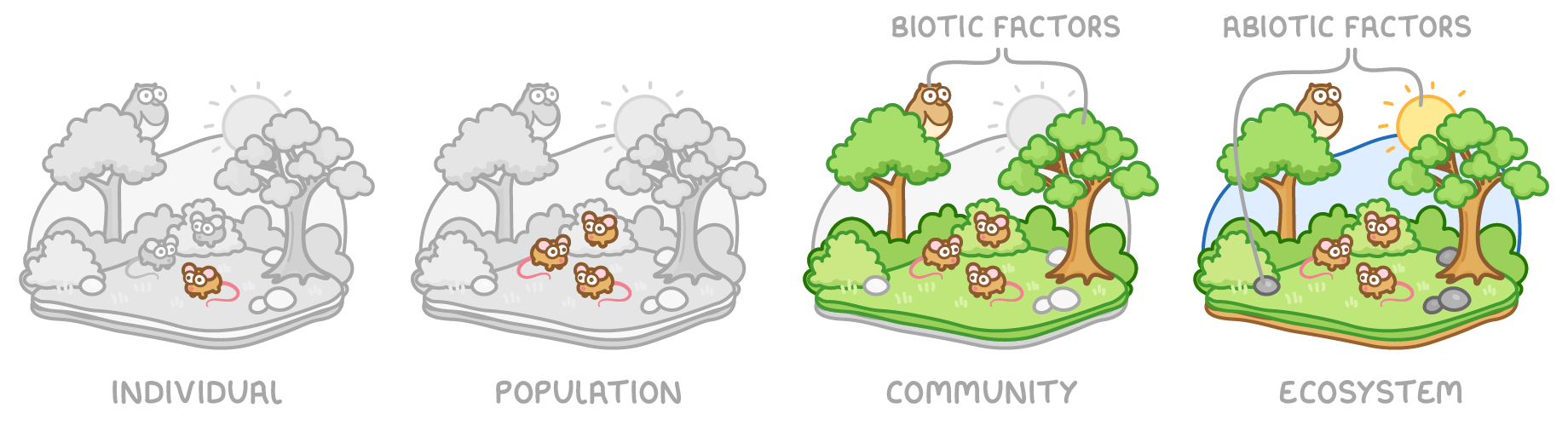
The levels, from smallest to largest
- Individual organism - A single living thing, such as one mouse
- Population - All the organisms of one species living together in the same place at the same time, e.g. all the mice in a field
- Habitat - The place where an organism lives, such as a field, a forest, or a rocky shore
- Community - All the populations of different species living and interacting together in one habitat or ecosystem - not just the mice, but the owls, the plants, and every other species there
- Ecosystem - The interaction of a community of living organisms with the non-living parts of their environment
The variety of all the different species of organisms on Earth, or within an ecosystem, is called biodiversity.
Biotic and abiotic factors
- Biotic factors - The living parts of the environment
- Abiotic factors - The non-living parts of the environment
An ecosystem brings together the habitat, the community that lives in it, and the biotic and abiotic factors that act on it.
An organism's niche
- The niche is the particular role an organism plays within its community.
- It covers:
- The resources it needs, such as light and nutrients
- The conditions it can tolerate, such as temperature
- Its interactions with other organisms, including competition and predation
Competition as a factor on population size
- Whether a population grows, shrinks or stays steady depends on several factors acting together.
- Competition is one of these factors. When a resource organisms need is in short supply, they have to compete for it.
- This competition limits population size: if there isn't enough of a resource to go round, some individuals won't survive or reproduce, so the population stops growing.
Other factors affecting population size
- Predation - How many of the organisms are eaten by predators
- Disease - Can spread through a crowded population and reduce its numbers
- Food supply - A plentiful supply allows a population to grow, while a shortage holds it back
These factors interact, so a population settles at a size that the available resources and conditions can support.
TermDefinition
PopulationAll the organisms of one species living together in the same place at the same time.
HabitatThe place where an organism lives.
CommunityAll the populations of different species living and interacting together in one habitat or ecosystem.
EcosystemThe interaction of a community of living organisms with the non-living parts of their environment.
Biotic factorA living part of the environment that affects organisms, such as predators or competition.
Abiotic factorA non-living part of the environment that affects organisms, such as temperature or light intensity.
NicheThe particular role an organism plays within its community.
BiodiversityThe variety of all the different species of organisms on Earth, or within an ecosystem.