6.13 - Cystic Fibrosis & Gene Therapy
Cystic fibrosis, a recessive inherited disorder
- Cystic fibrosis is a genetic disorder of the cell membranes, caused by the mutation of a single gene.
- The faulty protein this gene makes can no longer properly control the movement of salt and water into and out of cells.
- As a result, the body produces a lot of thick, sticky mucus that builds up in:
- The air passages of the lungs (the bronchioles)
- The pancreas
- This leads to frequent, serious lung infections and to problems with digesting food.
A recessive allele
- The disorder is caused by a recessive allele, usually written as a lowercase f.
- Because the allele is recessive, a person only has cystic fibrosis if they inherit two copies of it - so an affected person is homozygous recessive (ff).
- A person with just one copy (Ff) does not have the disorder, because the normal dominant allele still works. They are called a carrier and can pass the faulty allele on.
- The recessive allele is fairly common - about 1 person in 25 carries it, so many carriers have no idea they could pass it on.
Inheriting cystic fibrosis
- For a child to be born with cystic fibrosis, both parents must each pass on a recessive allele - so both must be carriers or have the disorder themselves.
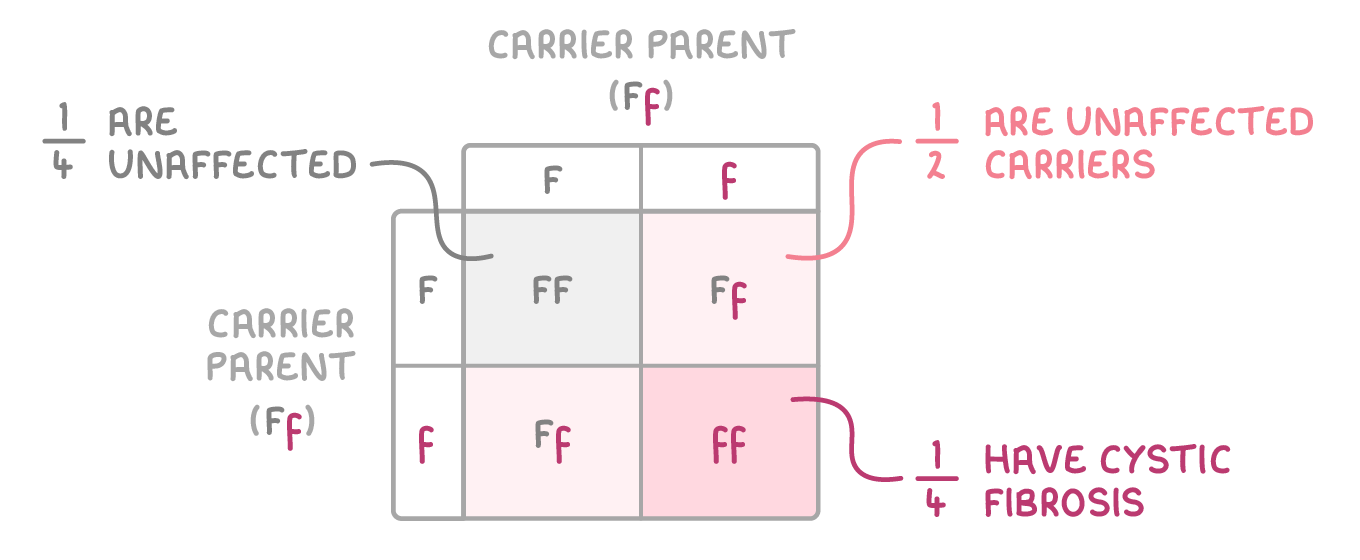
- Crossing two carriers (Ff × Ff) gives four equally likely combinations: FF, Ff, Ff and ff.
For any one child, the chances of each outcome are:
Gene therapy for cystic fibrosis
- Gene therapy attempts to treat a genetic disorder by altering a person's genes, replacing or adding a working version of the faulty allele.
- It's being developed as a possible treatment for cystic fibrosis.
- The idea: insert copies of the working, non-mutated allele into the cells lining the lungs, so those cells make the correct protein and the airways produce less thick mucus.
- The treatment can be delivered straight to the lung tissue using an inhaler.
Why it's not yet a reliable cure
- It's hard to get the new alleles into the correct cells and make them work normally to produce the protein.
- Even when it works, the effect doesn't last - the body gradually replaces the treated cells with new ones that still carry the faulty allele, so the treatment has to be repeated.
- It does nothing to stop the disorder being passed on: the alleles in the person's gametes (sperm or egg cells) aren't changed, so any children could still inherit cystic fibrosis.
- Alongside these limitations, there are questions about how far we should go in altering a person's genes.
TermDefinition
Cystic fibrosisA genetic disorder of the cell membranes caused by a recessive allele. It makes the body produce thick, sticky mucus.
CarrierA person who has one copy of a recessive allele. They do not show the characteristic it causes, but can pass the allele on to their children.
Gene therapyA treatment for an inherited disorder that inserts a working copy of a gene into a person's cells.