6.7 - Protein Synthesis
The genetic code
- A gene is a section of DNA. The order of the bases along the gene is a code for building a protein.
- A protein is a chain of small molecules called amino acids. What makes one protein different from another is the number of amino acids and the order they're joined in.
- The order of the bases in the gene sets the order of the amino acids, so the base sequence decides which protein is made.
Reading the code in threes
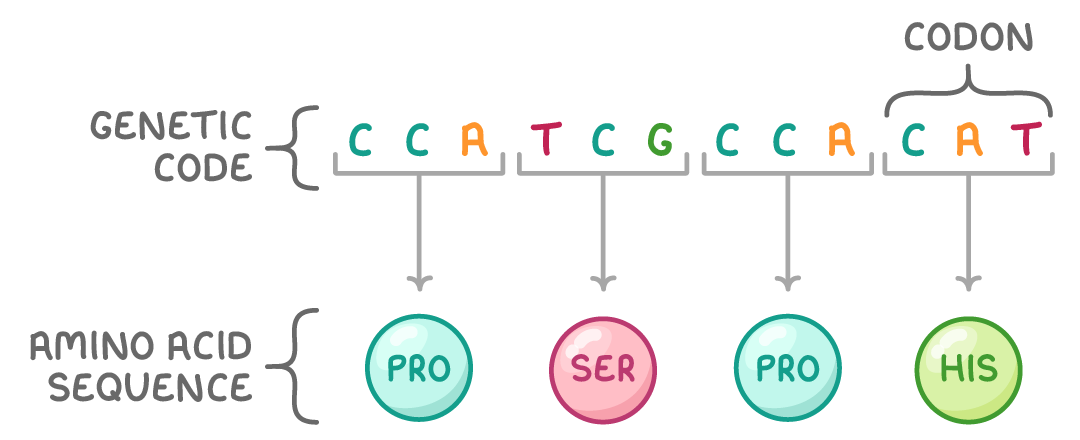
- The bases are read in groups of three. Each set of three bases is called a base triplet (also called a codon).
- Each triplet codes for one amino acid. The triplets are read one after another, with no overlapping - the first triplet fixes the first amino acid, the next triplet the next, and so on along the whole gene.
- Only about 20 different amino acids are used, but they can be arranged into the many thousands of proteins a body needs - like a small alphabet spelling a huge number of words.
- Four bases read three at a time give 4 × 4 × 4 = 64 possible triplets. That's more triplets than amino acids, so some amino acids are coded for by more than one triplet.
From chain to protein
- Once the amino acids are joined in the order the gene sets, the chain folds into a particular 3D shape.
- It's this shape that lets the finished protein do its specific job.
- A different base sequence gives a different amino-acid sequence, which folds into a differently shaped protein - so each gene makes its own specific protein.
Jobs that proteins do
- Structural proteins - Such as collagen, they give tissues their shape and strength
- Enzymes - Speed up chemical reactions
- Hormones - Such as insulin, they carry signals around the body
- Antibodies - Help defend against pathogens
- Receptors - Sit on the cell surface and let the cell detect chemical signals
TermDefinition
GeneA section of DNA on a chromosome that codes for a particular sequence of amino acids, to make a specific protein.
CodonA sequence of three bases that codes for one amino acid.