Acids & Bases - exam practice
Acids & Bases
Question 1 of 6
Lead nitrate is a salt.
A student produces lead nitrate using an acid and a base.
Which acid should the student use to produce lead nitrate?
Which of the the following is a base the student could use to produce lead nitrate?
Lead nitrate solution mixed with sodium sulfate solution forms lead sulfate as a precipitate.
Pb(NO3)2 + Na2SO4 ➔ PbSO4 + 2NaNO3
The method used to make the lead sulfate is:
- Pour 100 cm3 lead nitrate solution into a beaker.
- Add drops of sodium sulfate solution until a precipitate is seen.
- Allow the precipitate to settle to the bottom of the beaker.
- Pour off the liquid.
- Use a spatula to transfer the solid lead sulfate onto a filter paper.
State and explain two ways of improving this experimental method in order to increase the amount and quality of lead sulfate that could be obtained from 100 cm3 of lead nitrate solution.
Ammonium nitrate and potassium chloride are both salts.
They can be made by neutralisation reactions.
Complete the word equations below.
ammonia + ➔ ammonium nitrate + water
potassium hydroxide + hydrochloric acid → potassium chloride +
Calcium chloride (CaCl2) is a soluble salt.
Calcium chloride can be made by reacting dilute hydrochloric acid with either calcium oxide or calcium carbonate.
Write a balanced symbol equation for the reaction of dilute hydrochloric acid with calcium oxide.
A student carried out two investigations.
- In one beaker, the student added solid calcium oxide to dilute hydrochloric acid.
- In another beaker, the student added solid calcium carbonate to dilute hydrochloric acid.
Describe one difference between the two reactions that the student would be able to observe.
Describe how crystals of calcium chloride can be made from calcium carbonate and dilute hydrochloric acid.
Soluble salts are formed by reacting metal oxides with acids.
Give one other type of substance that can react with an acid to form a soluble salt.
Copper sulfate contains the ions Cu2+ and SO42-.
Give the formula of copper sulfate.
Describe a method to make pure, dry crystals of copper sulfate, from a metal oxide and a dilute acid.
A student makes copper sulphate, CuSO4, by the following general reaction.
acid + base ➔ salt + water
What type of reaction is represented in the equation above?
The student used copper oxide as the base in the reaction to produce copper sulfate.
Name and give the chemical formula of the acid used.
Explain the purpose of following steps in the student's method.
"Warm the acid."
"Add copper oxide until it is in excess."
A scientist produces zinc iodide (ZnI2) by following the method below.
- Weigh 1.00 g of iodine.
- Dissolve the iodine in ethanol.
- Add an excess of zinc.
- Stir the mixture until there is no further change.
- Filter off the excess zinc.
- Evaporate off the ethanol.
Ethanol is flammable.
Suggest how the scientist could evaporate off the ethanol safely.
Explain why the scientist adds excess zinc rather than excess iodine.
The equation for the reaction is:
Zn + I2 ➔ ZnI2
Calculate the minimum mass of zinc that needs to be added to 1.00 g of iodine so that the iodine fully reacts.
(You may need to use a periodic table)
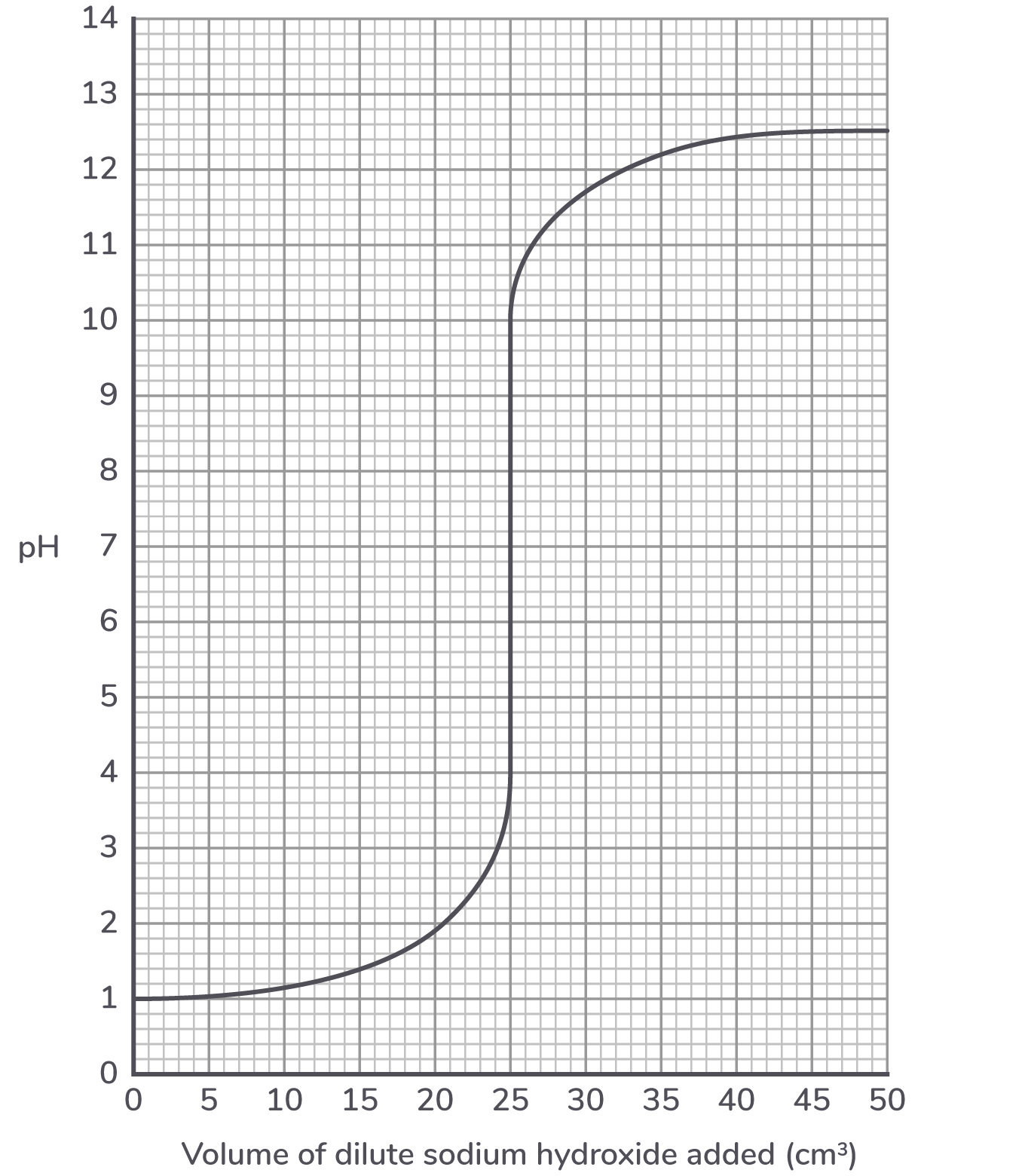
A student investigates how the pH changes when dilute sodium hydroxide reacts with dilute hydrochloric acid.
He places 20.0 cm3 of dilute hydrochloric acid in a beaker.
He adds dilute sodium hydroxide to the acid, 1.0 cm3 at a time.
He uses a pH meter to measure the pH after each addition of sodium hydroxide.
The image below shows a graph plotted with the student's results.
The student writes an ionic equation for the reaction.
H+ + OH– ➔ H2O
Use the ionic equation and values from the graph to explain how the pH changes during the reaction.
The student started with 20.0 cm3 of dilute hydrochloric acid in the beaker.
Explain how his results show that the acid is more concentrated than the dilute sodium hydroxide.
What mass of sodium hydroxide would be needed to make 46.8 g of sodium chloride?
(You may need to use a periodic table)