4.10 - Extracting Aluminium by Electrolysis
Why aluminium needs electrolysis
- Aluminium sits above carbon in the reactivity series, so heating its oxide with carbon doesn't work - aluminium holds its oxygen more tightly than carbon can pull it away.
- It must be extracted using electrolysis.
Preparing the ore
- The ore is bauxite. It's purified to give aluminium oxide, Al2O3 (also called alumina).
- The ions (Al3+ and O2-) must be free to move, so the oxide has to be molten.
Dissolving the oxide in cryolite
- Aluminium oxide melts at over 2,000 °C, which takes an enormous amount of energy to melt and keep molten.
- Dissolving aluminium oxide in molten cryolite solves this:
- The mixture has a much lower melting point than pure aluminium oxide, so the cell runs at only around 900 to 1,000 °C and far less energy is needed.
- It makes the mixture conduct better than molten aluminium oxide would on its own.
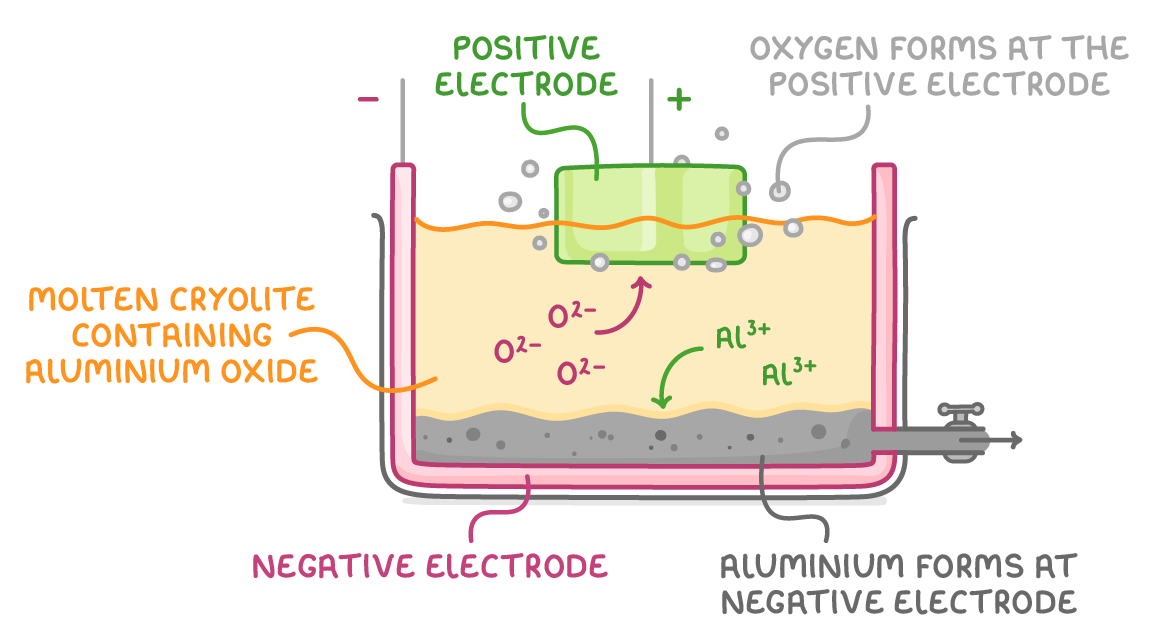
- The electrolyte is aluminium oxide dissolved in molten cryolite.
The aluminium cell and its products
The electrodes are made of carbon (graphite):
- The cell lining acts as the negative electrode.
- Carbon blocks dipping into the mixture from above act as the positive electrodes.
What happens at each electrode
- Aluminium ions (Al3+) are attracted to the negative electrode and gain electrons to become aluminium atoms. Liquid aluminium sinks to the bottom of the cell and is tapped off.
- Oxide ions (O2-) are attracted to the positive electrodes and lose electrons to form oxygen gas.
- The overall reaction:
- aluminium oxide → aluminium + oxygen
- 2Al2O3(l) → 4Al(l) + 3O2(g)
Why the positive electrodes wear away
The hot oxygen reacts with the carbon anodes to form carbon dioxide:
C + O2 → CO2
The positive electrodes burn away and must be replaced regularly, which adds to the cost.
Why aluminium is expensive to extract
Large amounts of electrical energy are needed to keep the mixture molten and to drive the high current through the cell.
The half equations at the electrodes
The reactions at each electrode can be written as half equations (or ion-electron equations).
At the negative electrode - Reduction
Aluminium ions gain electrons to become aluminium atoms (reduction):
Al3+ + 3e- → Al
At the positive electrodes - Oxidation
Oxide ions lose electrons to form oxygen molecules (oxidation):
2O2- → O2 + 4e-
TermDefinition
BauxiteThe main ore of aluminium, which is purified to give aluminium oxide.
CryoliteA compound that aluminium oxide is dissolved in for electrolysis. The mixture has a much lower melting point than pure aluminium oxide, so less energy is needed, and it conducts electricity better.
Key points to remember
How were these notes?