2.1 - States of Matter & Changing State
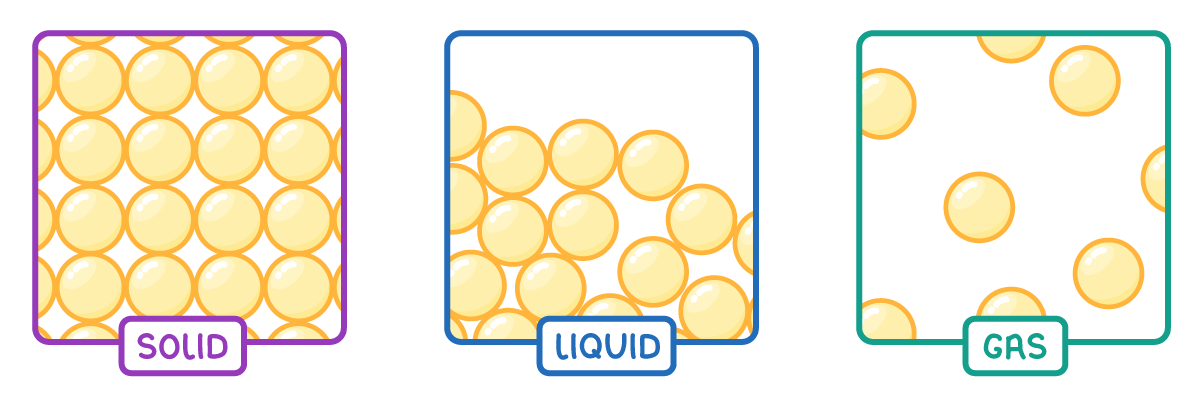
The particle model of solid, liquid and gas
- Everything is made of tiny particles (atoms, ions or molecules), drawn as small solid spheres.
- The state of a substance - solid, liquid or gas - depends on how strongly its particles are held together.
Solids
- Particles are held close together in fixed positions by strong forces of attraction, in a regular pattern.
- Particles can't move from their positions, so a solid has a definite shape and definite volume.
- Particles vibrate about their fixed positions - the hotter the solid, the more they vibrate, so solids expand slightly on heating.
Liquids
- Forces of attraction are weaker than in a solid.
- Particles are free to move past one another, so a liquid has no fixed shape and flows to fill the bottom of its container.
- Particles stay close together, giving a definite volume.
- Particles move randomly - faster as the liquid heats up, so liquids expand slightly on heating.
Gases
- Forces of attraction are so weak that particles are essentially free of each other.
- Particles move randomly in straight lines at high speed, only interacting when they collide, and spread far apart.
- A gas fills whatever shape and volume its container offers.
- Heating makes the particles move faster, increasing either volume or pressure.
Changes of state
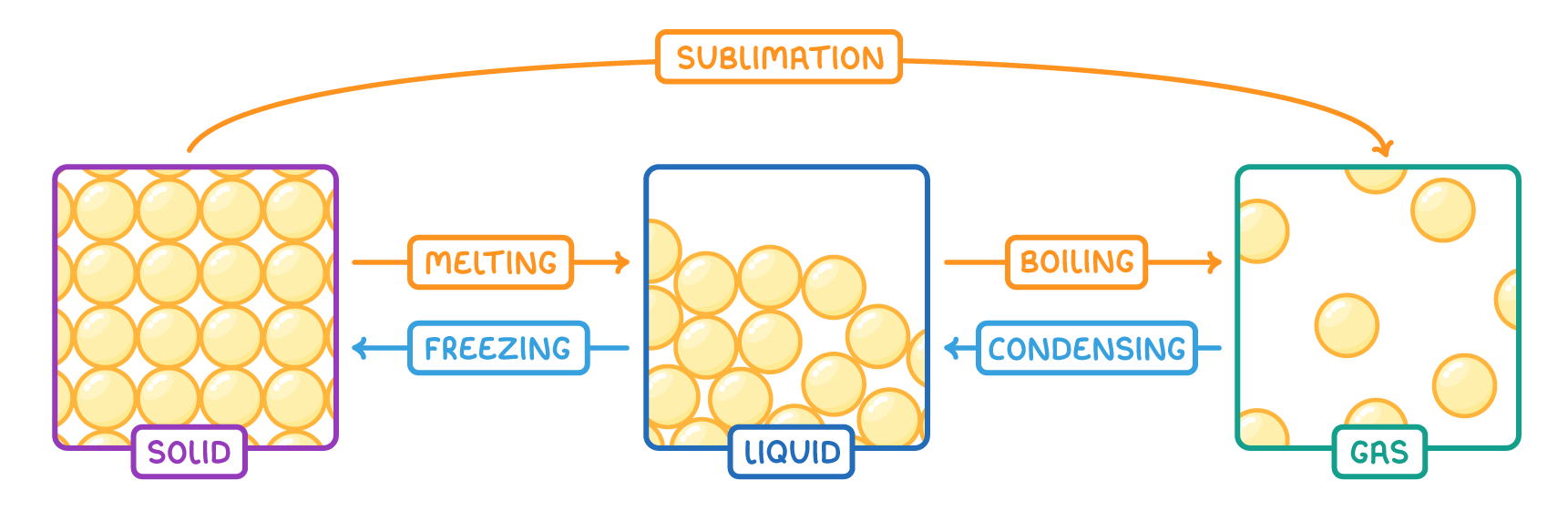
- Melting - Solid to liquid
- Freezing - Liquid to solid
- Boiling or evaporating - Liquid to gas (evaporation happens only at the surface, below the boiling point)
- Condensing - Gas to liquid
- Subliming (sublimation) - Solid straight to gas, skipping the liquid stage (e.g. solid iodine turning directly into a purple gas)
How heating and cooling drive changes of state
- Heat a solid and its particles vibrate more, weakening the forces holding them in place. At the melting point, they have enough energy to break free and form a liquid.
- Heat the liquid further and the particles move faster. At the boiling point, they overcome the forces of attraction completely and form a gas.
- Cooling runs this in reverse: particles lose energy, forces between them strengthen, a gas condenses at its boiling point, and a liquid freezes at its melting point.
Why substances melt and boil at different temperatures
- The energy needed for a change of state depends on the strength of the forces between particles.
- Weak forces need little energy to overcome, giving low melting and boiling points.
- Strong forces need much more energy to overcome, giving high melting and boiling points.
Heating and cooling curves
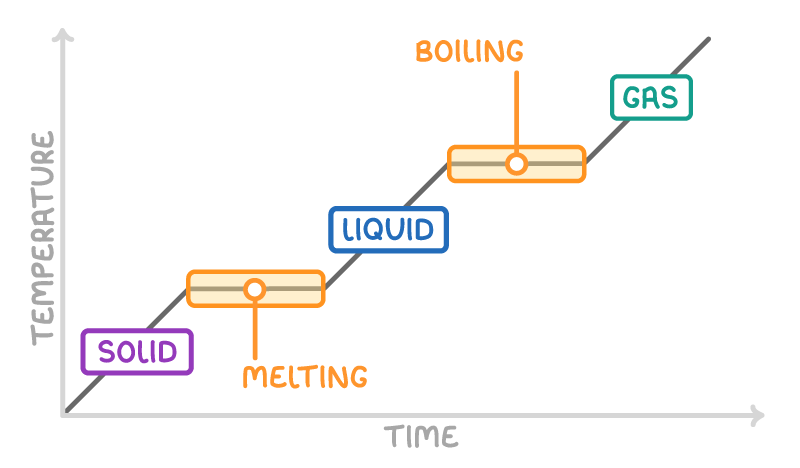
- Plotting temperature against time while heating or cooling a substance steadily produces a heating or cooling curve.
- Sloped sections - The substance is warming up or cooling down; temperature changes as particles gain or lose kinetic energy.
- Flat sections - A change of state is taking place; temperature stays constant even though energy is being transferred.
Why temperature stays constant during a change of state
- During melting or boiling, energy transferred to the substance is used to break or weaken the forces of attraction between particles, rather than raising the temperature.
- During freezing or condensing, energy is released as bonds/forces form between particles, keeping the temperature steady until the change of state is complete.
Predicting state from melting and boiling data
- Melting point and boiling point are bulk properties that depend on how large numbers of particles interact. A single particle does not have a melting point.
- Given a substance's melting and boiling points, its state at a given temperature is:
- Below the melting point - Solid
- Between the melting and boiling points - Liquid
- Above the boiling point - Gas
Worked example - Which substance is a liquid at 150 °C?
| Substance | Melting point | Boiling point |
|---|---|---|
| Ethanoic acid | 17 °C | 118 °C |
| Sulfur | 115 °C | 445 °C |
| Tin | 232 °C | 2,602 °C |
Step 1 - Rule out ethanoic acid
Boils at 118 °C, which is below 150 °C, so at 150 °C it is a gas.
Step 2 - Rule out tin
Melts at 232 °C, which is above 150 °C, so at 150 °C it is still a solid.
Step 3 - Check sulfur
Melts at 115 °C and boils at 445 °C. 150 °C falls between the two, so sulfur is the liquid.
Limitations of the simple particle model
- Particles are drawn as solid spheres, but real particles are atoms, ions or molecules with complex shapes and are mostly empty space.
- It assumes spheres are inelastic, ignoring how particles interact during collisions.
- It does not show the forces between particles, so it cannot show how strong those forces are or why different substances have different melting and boiling points.
TermDefinition
SolidA state of matter where particles are held close together in fixed positions by strong forces of attraction.
LiquidA state of matter where particles are free to move past one another but stay close together.
GasA state of matter where the particles are far apart, with almost no forces between them, and move randomly at high speed.
SublimationThe process of a solid turning directly into a gas, skipping the liquid stage.
Melting pointThe temperature at which a substance melts.
Boiling pointThe temperature at which a liquid changes into a gas throughout the liquid, not only at its surface.
Key points to remember
How were these notes?