9.1 - The Earth's Atmosphere
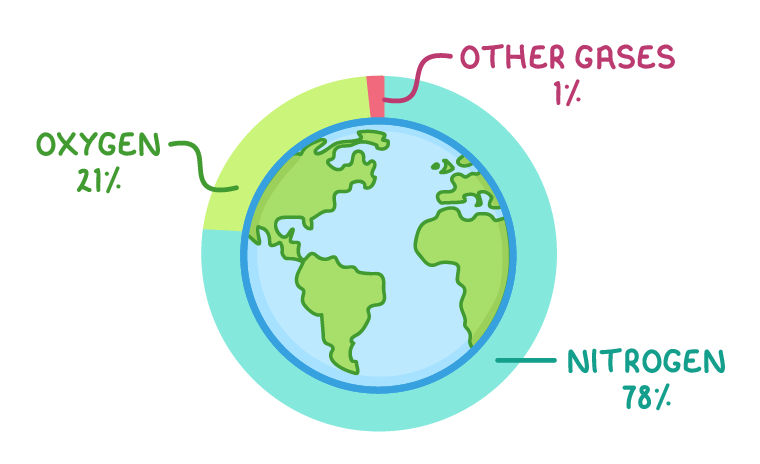
Today's atmosphere
- The atmosphere is a mixture of gases held around the Earth by gravity.
- Today it's made up of two main gases:
- About 78% nitrogen (roughly four-fifths)
- About 21% oxygen (roughly one-fifth)
- The remaining 1% or so is a mixture of other gases in far smaller proportions:
- Carbon dioxide
- Water vapour
- The noble gases - an unreactive group that make up a small but constant part of the air
The early atmosphere's formation
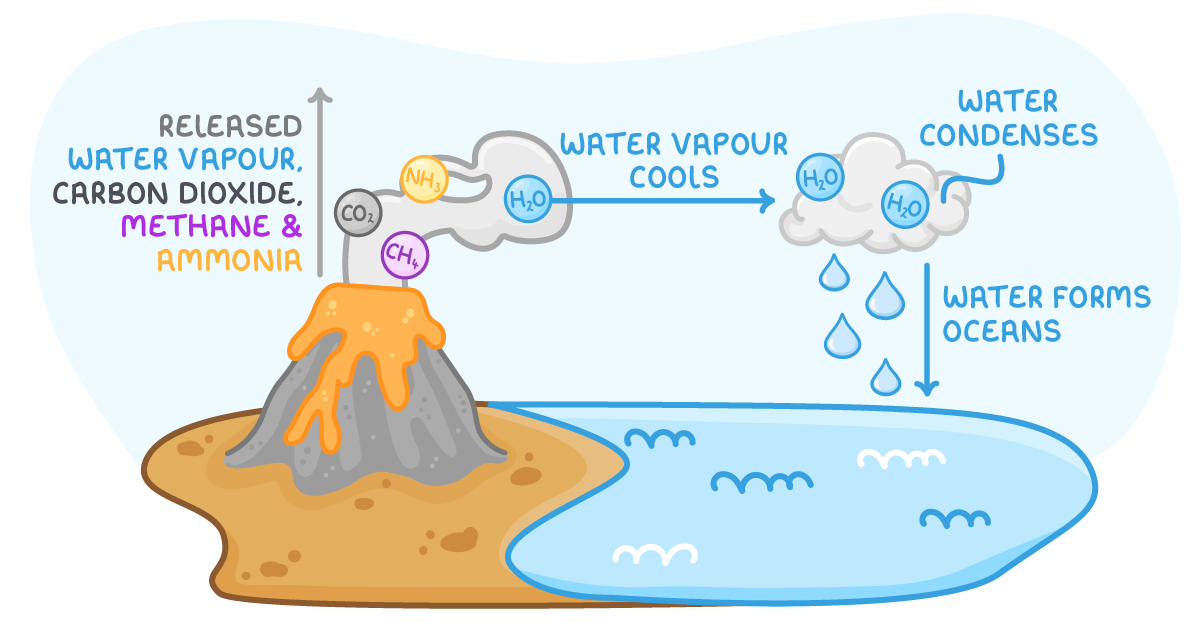
- For roughly the first billion years of Earth's history, the surface was covered in volcanoes, which released large amounts of gas into the young atmosphere.
- Most of what the volcanoes released was carbon dioxide and water vapour, alongside smaller amounts of methane and ammonia.
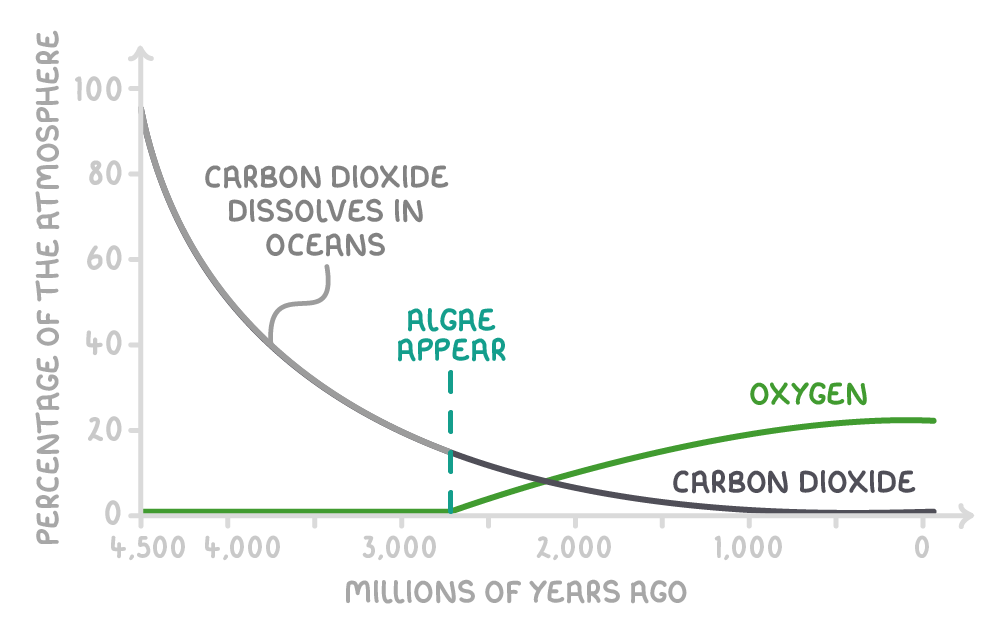
- So the early atmosphere was mostly carbon dioxide, with little or no oxygen - a composition much like that of Mars or Venus today.
How nitrogen built up
- Nitrogen was also released by volcanic activity, but only slowly, a little at a time over a very long period.
- Because nitrogen is very unreactive, almost none of it was removed once in the air, so it gradually accumulated until it became the most abundant gas in the atmosphere.
How the oceans formed
As the Earth's surface cooled, the water vapour condensed into liquid water, forming the Earth's oceans.
Evidence for this account
Evidence for the early atmosphere is limited because it covers a time scale of around 4.6 billion years, over which very little direct evidence has survived.
How the atmosphere changed over time
- Around 2.7 billion years ago, algae began to evolve in the oceans, later joined by the first green plants.
- Both photosynthesise, using light energy to take in carbon dioxide and water and produce glucose and oxygen:
- carbon dioxide + water → glucose + oxygen
- 6CO2 + 6H2O → C6H12O6 + 6O2
As algae and plants photosynthesised over the next billion years, atmospheric oxygen slowly built up, eventually reaching a level high enough for animals to evolve.
Photosynthesis wasn't the only reason carbon dioxide fell. It also:
- Dissolved into the oceans, where much of it precipitated out as carbonate sediment on the seabed.
- Became locked away as dead algae and plants were buried in sediment, which compressed into sedimentary rock over millions of years.
Deposits that locked carbon away
- Limestone - Formed from carbonate sediment, much of it the shells and skeletons of sea creatures that took their carbon from carbon dioxide dissolved in the sea.
- Coal - Formed from plant remains buried in swamps before they could decay, compressed and heated over millions of years.
- Crude oil and natural gas - Formed from tiny marine organisms buried in mud on the seabed, compressed and heated in the absence of oxygen.
Today, respiration, combustion and photosynthesis all change the levels of oxygen and carbon dioxide, and burning fossil fuels is now releasing carbon dioxide faster than it is removed.
Key points to remember
How were these notes?