1.10 - Development of the Periodic Table
Classifying elements by atomic weight
- Before protons, neutrons, and electrons were discovered, elements were arranged in order of atomic weight (now called relative atomic mass).
- Arranging elements by atomic weight revealed a pattern: elements with similar properties appeared at regular intervals, placing them into vertical columns.
Why the early arrangement was unreliable
- Early tables were incomplete because many elements hadn't yet been discovered.
- Following strict atomic-weight order placed some elements in groups with elements they didn't resemble.
Mendeleev's table (1869)
- Mendeleev arranged known elements mainly in order of atomic weight, but sorted them into groups by their chemical and physical properties.
- Where the order contradicted properties, he switched neighbouring elements so they stayed in groups with similar behaviour.
- For example, he placed tellurium before iodine (even though iodine has a smaller atomic weight) so iodine sat with chlorine and bromine, which it resembles.
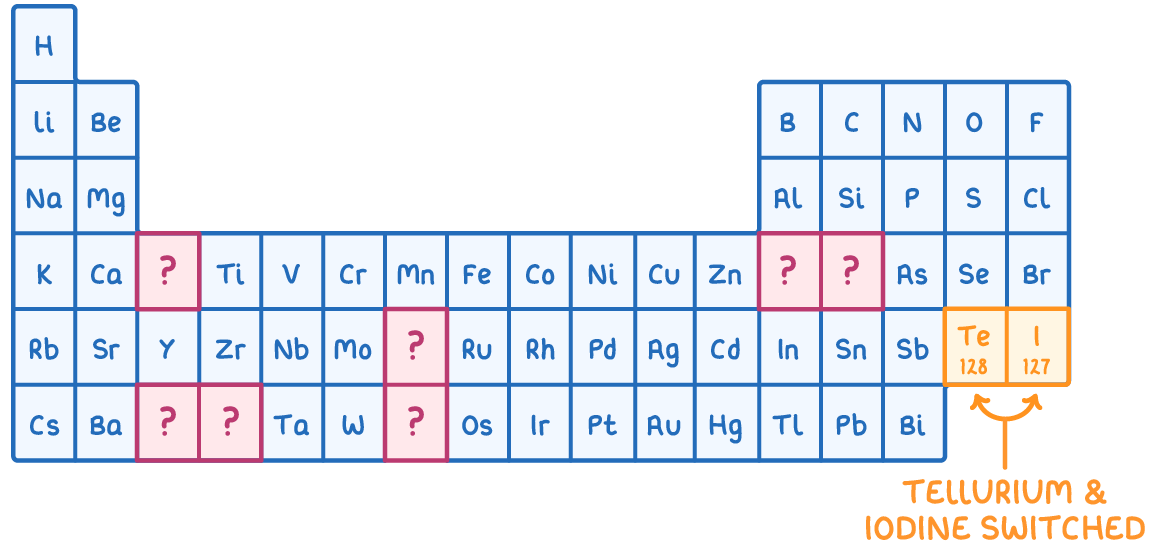
The question marks are gaps Mendeleev left for elements not yet discovered.
The gaps Mendeleev left and his predictions
- Mendeleev realised some elements hadn't been discovered yet, so he left gaps in his table rather than forcing elements into the wrong groups.
- Each gap represented an undiscovered element.
Predicting the missing elements
- Elements in the same group have similar properties that change steadily down the column.
- Mendeleev used the elements on either side of a gap to predict the physical and chemical properties of the missing elements.
- For example, he predicted the properties of ekasilicon, which closely matched the measured properties of germanium when it was later discovered.
Confirming the arrangement
When newly discovered elements matched Mendeleev's predictions, it proved his periodic table was a sound arrangement.
From Mendeleev's table to the modern table
- Once protons were discovered, elements could be arranged by atomic number (the number of protons in the nucleus).
- Atomic number gives each element a unique, whole-number position.
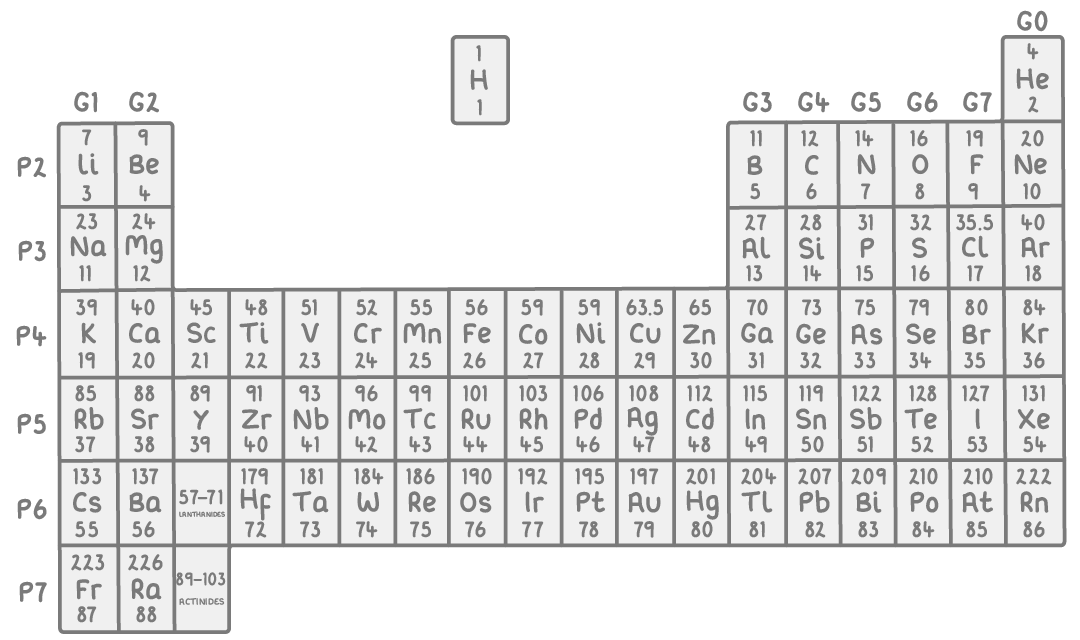
Each box gives the relative atomic mass above the symbol and the atomic number below.
Ordering by atomic number
- Arranging elements by increasing atomic number resolved the anomalies in Mendeleev's table.
- Swapped pairs, such as tellurium and iodine, fell into the correct order without needing manual adjustment.
- Newly discovered elements filled the gaps Mendeleev had left.
Why atomic weights had misled - Isotopes
- The discovery of isotopes explained why atomic weight order didn't always match the pattern of properties.
- Isotopes are atoms of the same element with the same number of protons but different numbers of neutrons.
- Atomic weight is an average mass across an element's isotopes based on their abundance.
- An element with a high abundance of heavy isotopes (such as tellurium) can have a higher atomic weight than the next element (iodine), despite having a lower atomic number.
What the two tables share
- Both set out elements in order of an increasing sequence.
- Both place elements with similar properties into the same vertical column (groups).
How the two tables differ
- The modern table is arranged by atomic number; Mendeleev's was arranged mainly by atomic weight.
- The modern table contains more elements and has no gaps; Mendeleev's had gaps.
- The modern table contains the noble gases (Group 0); Mendeleev's table had none, because none had been discovered.
- The modern table has a separate block of transition metals; Mendeleev's table included these metals but placed them within his groups.
TermDefinition
Atomic numberThe number of protons in the nucleus of an atom.
IsotopeOne of two or more forms of the same element whose atoms have the same number of protons but different numbers of neutrons.
Key points to remember
How were these notes?