1.5 - Chemical Equations
What a chemical reaction is
- A chemical reaction changes the starting substances into one or more new substances.
- The starting substances are the reactants, and the substances made are the products.
Signs a reaction has happened
- Colour change
- Temperature change - Energy is given out to or taken in from the surroundings.
- Effervescence - Bubbling when a gas is produced.
Word equations and symbol equations
- A word equation represents a reaction using the names of the substances.
- Reactants go on the left and products go on the right, separated by an arrow pointing from reactants to products.
- A plus sign separates multiple reactants or products.
- carbon + oxygen → carbon dioxide
- magnesium + hydrochloric acid → magnesium chloride + hydrogen
Symbol equations
A symbol equation replaces the names with chemical formulae:
| Word equation | Symbol equation |
|---|---|
| carbon + oxygen → carbon dioxide | C + O2 → CO2 |
| magnesium + hydrochloric acid → magnesium chloride + hydrogen | Mg + HCl → MgCl2 + H2 (not yet balanced) |
- In a chemical reaction, no atoms are created or destroyed - atoms are simply rearranged.
- The number of atoms of each element must be the same on both sides of the arrow for an equation to be balanced.
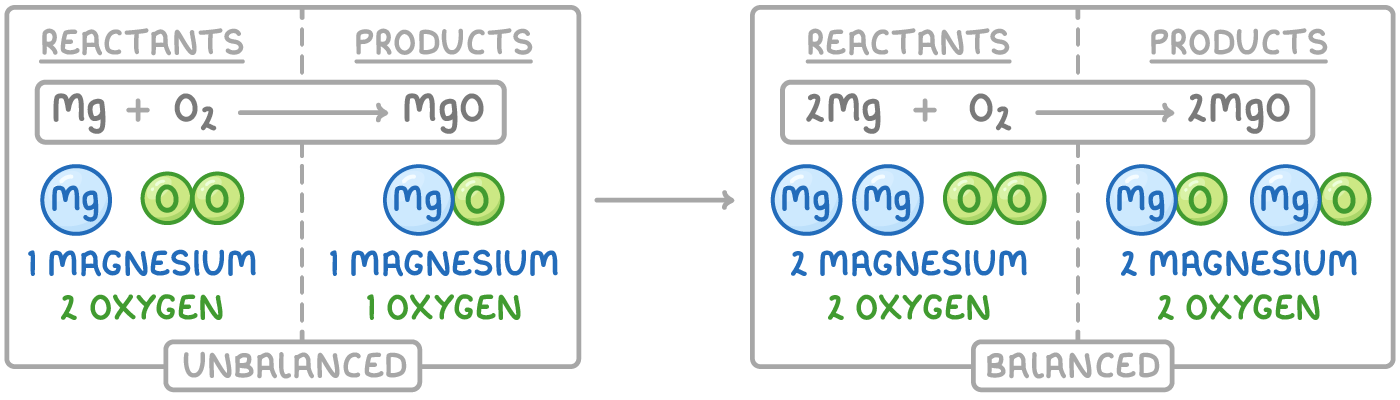
Balancing an equation
Balancing is done by putting a large number in front of a formula:
- Never change a subscript, only the large number in front. Changing a subscript changes the substance itself (e.g. O2 vs O3).
- The large numbers must be whole numbers.
How numbers in formulae work
- A large number in front multiplies the whole formula:
- 2H2O contains 4 hydrogen atoms and 2 oxygen atoms.
- 3Na2SO4 contains 6 sodium, 3 sulfur, and 12 oxygen atoms.
- A subscript applies only to the symbol or bracket immediately before it - the 4 in Na2SO4 applies only to oxygen.
Method
- Count the atoms of each element on both sides.
- Change one large number in front of a formula.
- Count again, repeating until both sides match.
Tips:
- Start with an element that appears in the fewest formulae.
- Recount everything at the end to make sure no other element was disturbed.
Worked example - Balancing magnesium and acid
Balance the equation for magnesium reacting with hydrochloric acid:
Mg + HCl → MgCl2 + H2
Step 1 - Count the atoms on each side
| Element | Left | Right |
|---|---|---|
| Mg | 1 | 1 |
| H | 1 | 2 |
| Cl | 1 | 2 |
Step 2 - Find what does not match
Magnesium is balanced. Hydrogen and chlorine both have 1 on the left and 2 on the right.
Step 3 - Balance with a large number
Putting a 2 in front of HCl balances both hydrogen and chlorine:
Mg + 2HCl → MgCl2 + H2
Step 4 - Count again to check
| Element | Left | Right |
|---|---|---|
| Mg | 1 | 1 |
| H | 2 | 2 |
| Cl | 2 | 2 |
Every element matches, so the equation is balanced.
Worked example - Balancing acid and alkali
Balance the equation for sulfuric acid reacting with sodium hydroxide:
H2SO4 + NaOH → Na2SO4 + H2O
Step 1 - Count the atoms on each side
| Element | Left | Right |
|---|---|---|
| H | 3 | 2 |
| S | 1 | 1 |
| O | 5 | 5 |
| Na | 1 | 2 |
Step 2 - Deal with the hydrogen
Put a 2 in front of H2O on the right:
H2SO4 + NaOH → Na2SO4 + 2H2O
Step 3 - Recount
- Left: 3 H, 1 S, 5 O, 1 Na
- Right: 4 H, 1 S, 6 O, 2 Na
Step 4 - Deal with the sodium
Put a 2 in front of NaOH on the left:
H2SO4 + 2NaOH → Na2SO4 + 2H2O
Step 5 - Recount everything to check
| Element | Left | Right |
|---|---|---|
| H | 4 | 4 |
| S | 1 | 1 |
| O | 6 | 6 |
| Na | 2 | 2 |
Every element matches, so the equation is balanced.
State symbols
A state symbol shows the physical state of a substance in an equation. It is written in brackets after the formula.
The four state symbols
- (s) - Solid
- (l) - Liquid (a pure liquid, such as pure water, H2O(l))
- (g) - Gas
- (aq) - Aqueous (dissolved in water, such as acids, alkalis, and soluble salts)
Adding them to an equation
State symbols are added once the equation is balanced and never affect the balancing.
2HCl(aq) + CaCO3(s) → CaCl2(aq) + H2O(l) + CO2(g)
Worked example - Adding state symbols
Add state symbols to the balanced equation:
Mg + 2HCl → MgCl2 + H2
Step 1 - Magnesium
Magnesium is a solid metal at room temperature → (s).
Step 2 - Hydrochloric acid
Hydrochloric acid is hydrogen chloride dissolved in water → (aq).
Step 3 - Magnesium chloride
Magnesium chloride is a soluble salt dissolved in the water → (aq).
Step 4 - Hydrogen
Hydrogen is a gas that bubbles off → (g).
Step 5 - Answer
Mg(s) + 2HCl(aq) → MgCl2(aq) + H2(g)