11.4 - Temperature Changes in Reacting Solutions
The experiment
Aim
To follow the temperature of a solution as a second reactant is added in stages, and find how the amount added affects the temperature change.
Background
- A reaction either gives out energy (exothermic), which warms the solution, or takes energy in (endothermic), which cools it.
- You can't measure that energy directly, but you can measure the temperature change it causes.
- So in this practical you measure the temperature change, and use it to work out how much energy was given out or taken in.
- The reaction can be a solid dissolving in water, an acid neutralising an alkali, a more reactive metal displacing a less reactive one from a solution of its salt, or an acid reacting with a metal or a carbonate.
Variables
- Independent variable - The volume (or mass) of the second reactant added.
- Dependent variable - The highest (or lowest) temperature reached.
- Control variables - The volume and concentration of the first solution, the starting temperature, and the insulated cup and lid.
Method
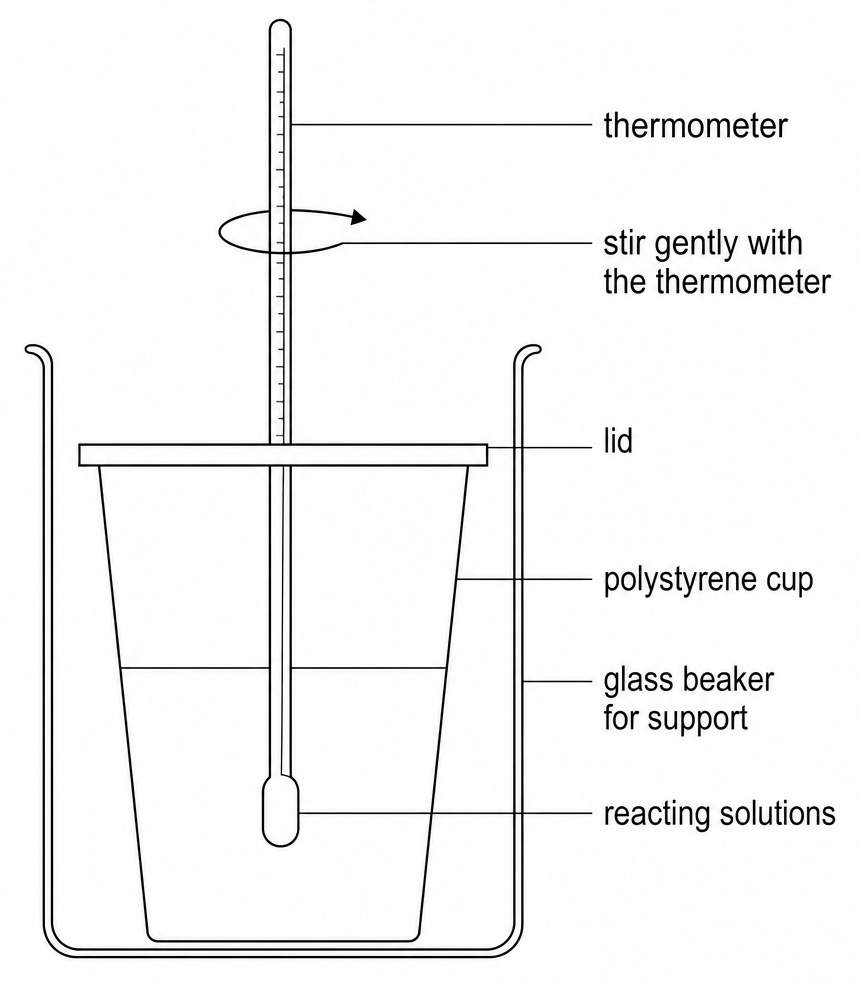
- Measure the first solution - Pour a fixed volume into a polystyrene cup with a measuring cylinder, and stand the cup in a beaker so it can't tip over.
- Take the starting temperature - Put the thermometer through the lid and record the reading.
- Add the second reactant - Add a measured volume, replace the lid and stir gently.
- Record the highest (or lowest) temperature - Once the reading stops changing.
- Repeat with different volumes - Keeping everything else the same, and do each volume three times so an anomalous result can be spotted and a mean found.
Safety
- Eye protection - Acids and alkalis are irritant, and a concentrated alkali is corrosive.
- Stir gently - A glass thermometer can snap.
Worked example - Neutralisation temperature graph
A student measured 25 cm3 of dilute hydrochloric acid at 20.0 °C into an insulated cup. They added sodium hydroxide solution 5 cm3 at a time, and recorded the highest temperature reached after each addition.
| Volume of alkali added in cm3 | 0 | 5 | 10 | 15 | 25 | 30 | 35 | 40 |
|---|---|---|---|---|---|---|---|---|
| Highest temperature in °C | 20.0 | 24.0 | 28.0 | 32.0 | 34.0 | 32.0 | 30.0 | 28.0 |
Find the volume of alkali needed for complete neutralisation, and the maximum temperature reached.
Step 1 - Plot the graph
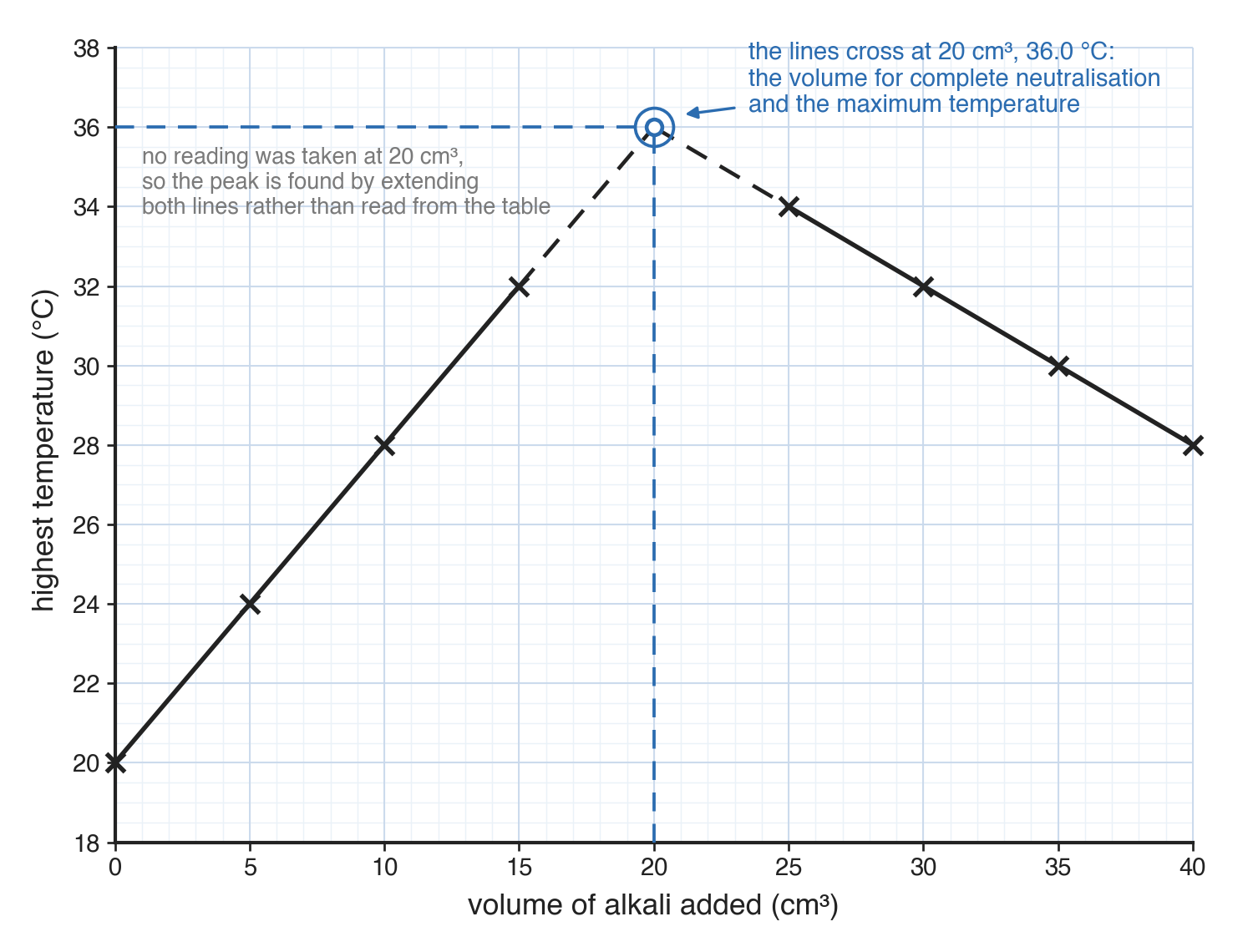
Plot the highest temperature against the volume of alkali added. The points rise while the acid is still reacting, then fall once it has all been neutralised.
Step 2 - Draw two lines of best fit
Draw a straight line through the rising points and another through the falling points, and extend both until they cross. No reading was taken at the exact volume where the reaction finished, so the crossing point is how you find it.
Step 3 - Read off the crossing point
The two lines cross at 20 cm3 and 36.0 °C. So 20 cm3 of alkali is needed for complete neutralisation, and the maximum temperature is 36.0 °C, a rise of 16.0 °C from the 20.0 °C start.
Common exam questions
Question 1
Why is the reaction done in a polystyrene cup with a lid, rather than an open glass beaker?
Polystyrene is a poor conductor of heat and the lid stops energy escaping from the top, so less energy is exchanged with the surroundings and the temperature change is closer to the true value.
Question 2
Why is the highest (or lowest) temperature recorded, rather than the temperature after a fixed time?
The reaction may not have finished by a fixed time, or may already have started cooling. The highest or lowest reading is the point where the most energy has been transferred.
Question 3
Why does the temperature stop rising and start to fall after a certain volume has been added?
One reactant has been used up, so the reaction has stopped. The extra solution only cools and dilutes the mixture.
Question 4
Why is the measured temperature change usually smaller than the true value?
Some energy is always lost to the cup, the thermometer and the air, however well the cup is insulated. This is a systematic error, so repeating the experiment doesn't correct it.
Question 5
Why is each volume tested three times?
So an anomalous result can be spotted and left out, and a mean found from the rest. "To make it accurate" scores nothing. Say what repeating lets you do.