6.3 - Rate Factors & Collision Theory
Collision theory
- A reaction can only happen when reacting particles collide with each other.
- Collision theory explains reaction rates in terms of these collisions.
- A collision that results in the particles reacting is a successful collision.
Two factors determine the rate of a reaction
- Collision frequency - How often reacting particles collide. More collisions per second means more chances to react, giving a faster reaction.
- Energy of the collision - Particles must collide with enough energy to react. The minimum energy needed is the activation energy; collisions with less energy than this do not produce a reaction.
Factors that affect reaction rate
Temperature
Increasing the temperature increases the rate for two reasons:
- The particles move faster, so they collide more often.
- The particles have more energy, so a greater proportion of collisions have the activation energy.
Concentration and pressure
- Increasing the concentration of a reactant in solution puts more particles into the same volume, so they collide more often.
- Increasing the pressure of a reacting gas squeezes the particles into a smaller volume, so they collide more often.
- For many reactions, rate is directly proportional to concentration (rate ∝ concentration).
Surface area
- Breaking a solid into smaller pieces increases its surface area to volume ratio.
- This exposes more of the solid to the other reactant, so collisions happen more often.
Catalyst
- Adding a catalyst increases the rate of reaction.
- A catalyst speeds a reaction up without being used up in the process.
Catalysts
- A catalyst is a substance that speeds up a chemical reaction without being used up in the process.
- It remains chemically unchanged, so its mass is the same at the start and end of the reaction.
- A catalyst doesn't appear in the balanced equation for the reaction.
- Enzymes are biological catalysts.
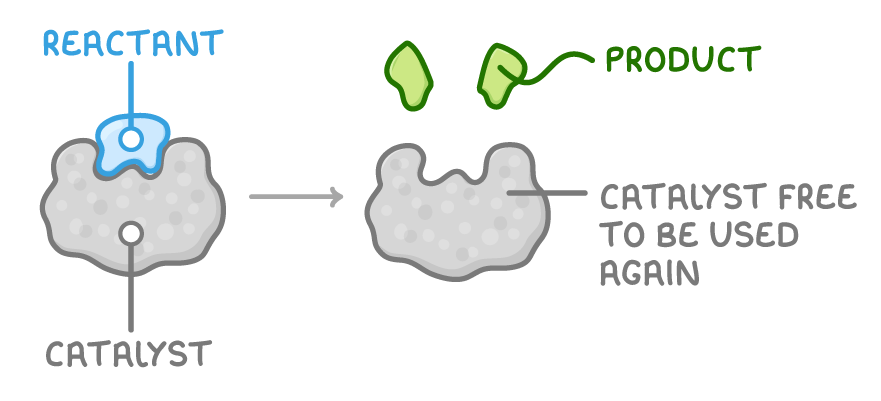
How a catalyst works
- A catalyst provides an alternative reaction pathway with a lower activation energy.
- A greater proportion of colliding particles have enough energy to react, so there are more successful collisions per second.
Catalysts in industry
- Catalysts allow reactions to run at lower temperatures and pressures.
- This reduces energy costs and burns less fossil fuel, making processes cheaper and more sustainable.
Example - Decomposing hydrogen peroxide
Hydrogen peroxide decomposes very slowly on its own. Adding solid manganese(IV) oxide speeds up the reaction:
hydrogen peroxide → water + oxygen
2H2O2(aq) → 2H2O(l) + O2(g)
Enzymes as biological catalysts
- Enzymes are biological catalysts - they speed up chemical reactions in living organisms without being used up.
- Enzymes are specific to the reactions they catalyse.
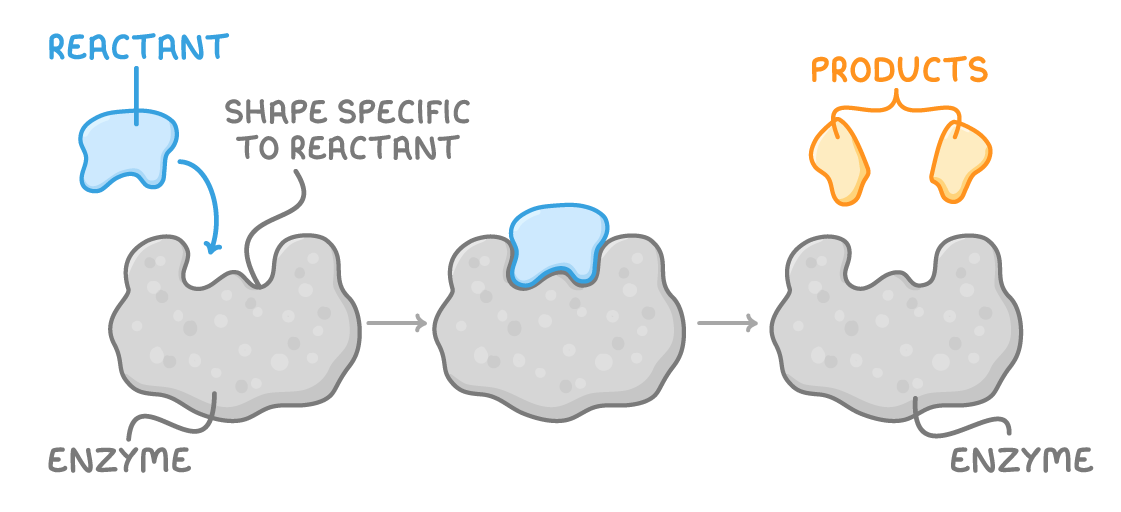
Optimum conditions
- Enzymes work fastest at an optimum temperature and optimum pH.
- Away from these optimum conditions, enzyme activity decreases.
Uses of enzymes
- Inside living cells - In processes such as respiration and photosynthesis.
- In industry - Yeast enzymes convert sugar into alcohol during fermentation.
Reaction profiles with a catalyst
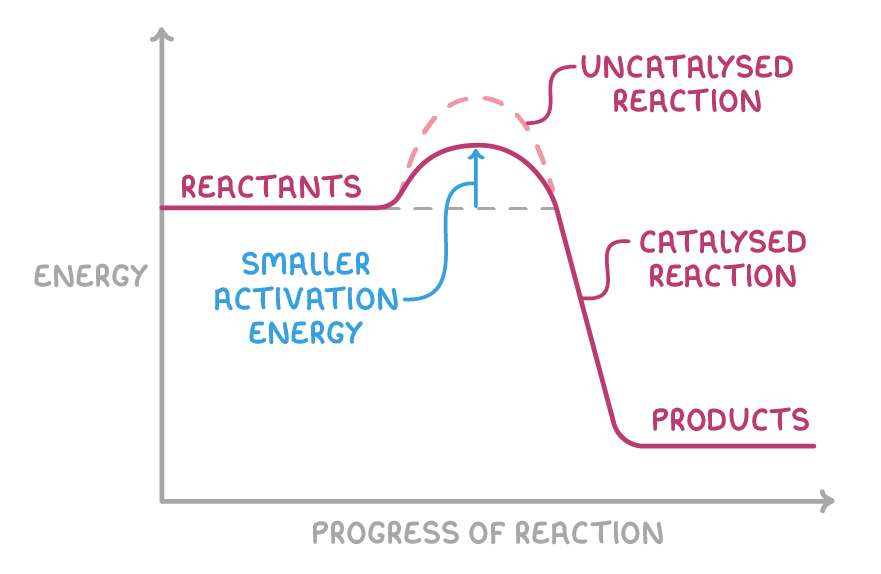
- A reaction profile can compare an uncatalysed reaction with a catalysed reaction on the same axes.
- Both curves start at the same reactant energy level and end at the same product energy level, so the overall energy change is unchanged.
- The catalysed reaction has a lower activation energy peak, because the catalyst provides an alternative pathway with a lower activation energy.
TermDefinition
Activation energyThe minimum amount of energy that colliding particles must have to react.
CatalystA substance that speeds up a chemical reaction without being changed or used up.
EnzymeA biological catalyst that speeds up a specific chemical reaction without being changed or used up.
Key points to remember
How were these notes?