17.2 - Preparation & Properties of Gases
Choosing a way to collect a gas
- Two properties of a gas decide how it's collected:
- Whether it dissolves in water
- If it does dissolve, whether it's denser or less dense than air
- Ask about solubility first:
- A gas that does not dissolve in water (or only slightly) is collected over water, regardless of density.
- A gas that does dissolve in water is collected by displacement of air, where density decides the method.
A gas with a low solubility in water - Collection over water
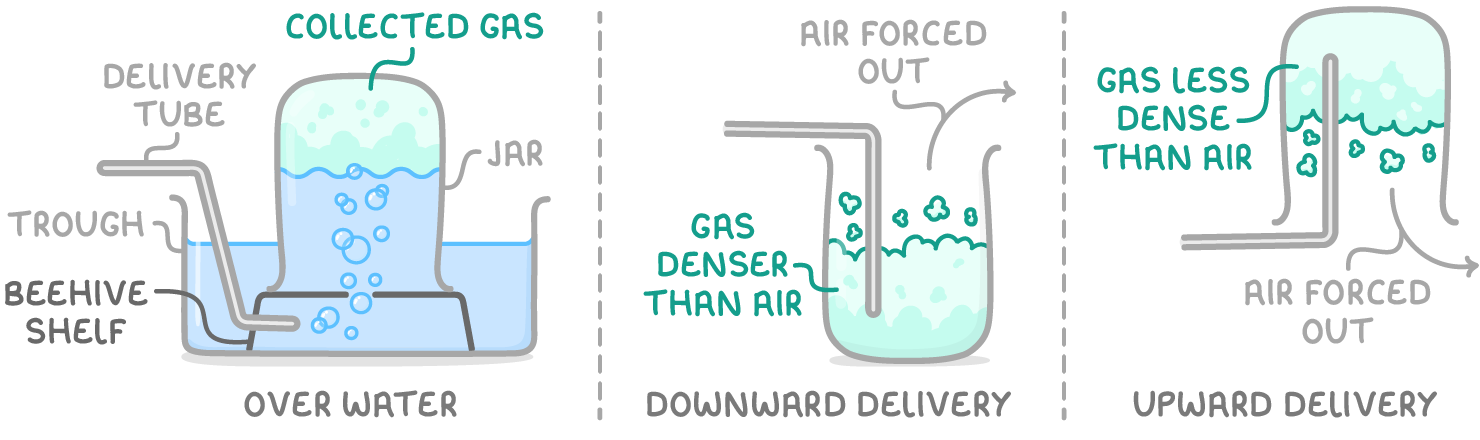
- A gas jar or measuring cylinder is filled with water and inverted in a trough of water over a beehive shelf.
- The delivery tube runs into the trough and under the shelf, so the gas bubbles up through the shelf into the mouth of the jar.
- As gas bubbles into the jar, it displaces the water downwards.
A soluble gas that is denser than air
- The gas jar stands upright with the delivery tube reaching near the bottom.
- The gas sinks to the bottom and pushes the less dense air up and out.
- This is called downward delivery (or upward displacement of air).
- Used for sulfur dioxide and hydrogen chloride.
A soluble gas that is less dense than air
- The gas jar is held upside down with the delivery tube pointing up into it.
- The gas rises to the top and pushes the denser air down and out of the mouth.
- This is called upward delivery (or downward displacement of air).
- Used for ammonia.
Hydrogen
- Colourless, odourless gas.
- Insoluble in water and less dense than air.
- Diatomic, so its molecules are H2.
Preparing hydrogen
Made by reacting a metal with dilute hydrochloric acid. Zinc is normally used:
Zn(s) + 2HCl(aq) → ZnCl2(aq) + H2(g)
Magnesium works too and gives the same gas:
Mg(s) + 2HCl(aq) → MgCl2(aq) + H2(g)
Magnesium reacts more vigorously than zinc and is harder to control, so zinc is the better choice for a steady preparation. Hydrogen is insoluble in water, so it's collected over water.

What hydrogen is used for
- Meteorological (weather) balloons - It's less dense than air, so the balloon rises.
- Hardening oils - Liquid oils are turned into solid fats used in margarines and spreads.
- Clean fuel - Burning it gives only water, which is not a pollutant:
- 2H2(g) + O2(g) → 2H2O(l)
Oxygen
- Colourless, odourless gas.
- Only slightly soluble in water and slightly denser than air.
- Diatomic, so its molecules are O2.
Preparing oxygen
- Made by the catalytic decomposition of hydrogen peroxide.
- Manganese(IV) oxide (manganese dioxide) is added as a catalyst to speed up the reaction:
- 2H2O2(aq) → 2H2O(l) + O2(g)
Oxygen is collected over water because of its low solubility in water.

What oxygen is used for
- Medicine - To supply patients who can't take in enough oxygen through normal breathing.
- Welding - Burned with a fuel gas to produce a flame hot enough to melt metal.
Carbon dioxide
- Colourless, odourless gas.
- Low solubility in water and denser than air.
Preparing carbon dioxide
Made by reacting calcium carbonate (marble chips) with dilute hydrochloric acid:
CaCO3(s) + 2HCl(aq) → CaCl2(aq) + CO2(g) + H2O(l)
Because its solubility is low, carbon dioxide is collected over water.
Carbon dioxide and limewater
Limewater is a solution of calcium hydroxide. Bubbling carbon dioxide through it turns it milky because insoluble calcium carbonate forms as a white precipitate:
CO2(g) + Ca(OH)2(aq) → CaCO3(s) + H2O(l)
With excess carbon dioxide, the milkiness clears. The calcium carbonate reacts further with water and excess gas to form soluble calcium hydrogencarbonate:
CaCO3(s) + CO2(g) + H2O(l) → Ca(HCO3)2(aq)

What carbon dioxide is used for
- Carbonated drinks - Dissolved under pressure; when opened, the gas escapes and the drink fizzes.
- Fire extinguishers:
- It does not support combustion.
- It's denser than air, so it smothers the fire and keeps oxygen away.
Nitrogen
- Colourless, odourless, and tasteless gas.
- Insoluble in water.
- Diatomic, so its molecules are N2.
Why nitrogen is so unreactive
- The two nitrogen atoms in an N2 molecule are held together by a strong triple covalent bond (three shared pairs of electrons).
- A large amount of energy is required to break this bond, so nitrogen is very unreactive.

What nitrogen is used for
- Coolant - Liquid nitrogen is extremely cold and chills substances rapidly.
- Food packaging - Provides an unreactive atmosphere that stops food from spoiling.