13.7 - Alcohols
The alcohols
- An alcohol is a compound that carries an -OH group, the hydroxyl group, joined to a carbon atom.
- That group is the alcohols' functional group - the reactive part that decides how the compound behaves.
- The stem of the name shows how many carbon atoms are in the chain, and the ending -ol shows it's an alcohol.
The general formula
Every saturated, straight-chain alcohol fits the pattern:
CnH2n+1OH
n is the number of carbon atoms:
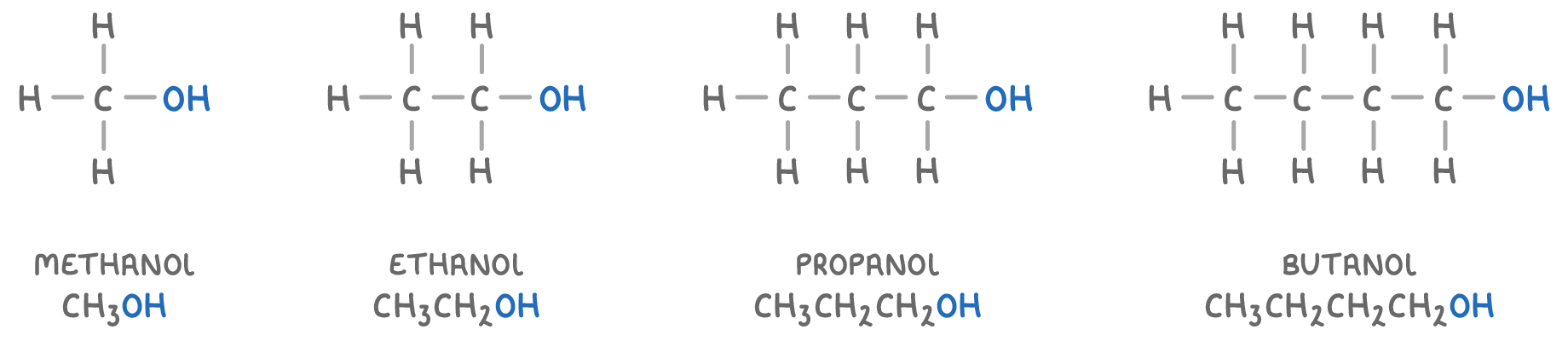
- n = 1: CH3OH, methanol
- n = 2: C2H5OH, ethanol
- n = 3: C3H7OH, propanol
- n = 4: C4H9OH, butanol
The number in the name
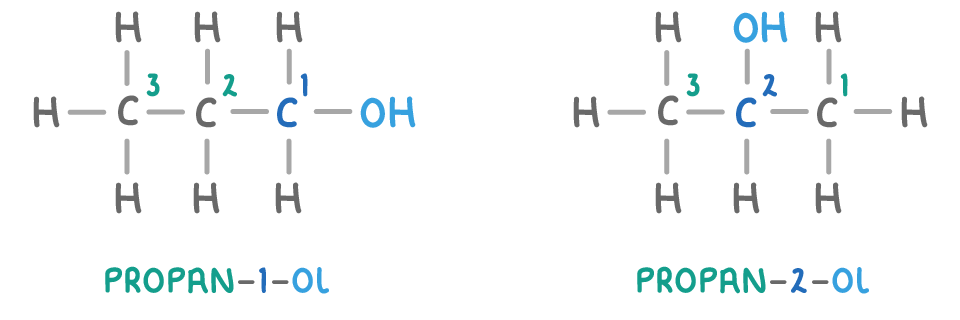
- The position of the -OH group along the carbon chain can vary:
- In propan-1-ol, the -OH is on the first carbon, at the end of the chain.
- In propan-2-ol, it's on the middle carbon.
- The chain is numbered from the end that gives the lower number.
Methanol, ethanol, propan-1-ol, propan-2-ol and butanol are all liquids at room temperature and pressure.
Formulae keep the -OH visible on purpose, which is why ethanol is written C2H5OH, never C2H6O. The drawn form is the full structural formula; the condensed form along the chain is the shortened structural formula.
Trends along the series
- Mixing with water - Methanol, ethanol and propanol are miscible with water (they mix in any proportion). From butanol onwards, solubility falls off as the carbon chain gets longer.
- Melting and boiling points - Both rise as the molecules get bigger, because the forces between larger molecules are stronger, needing more energy to pull them apart.
How alcohols burn
Alcohols are flammable, and burning them is their most useful reaction.
Burning in plenty of air
- With plenty of air an alcohol undergoes complete combustion.
- The carbon is oxidised to carbon dioxide and the hydrogen is oxidised to water, releasing a good deal of energy.
- ethanol + oxygen → carbon dioxide + water
- C2H5OH + 3O2 → 2CO2 + 3H2O
Balancing the equation
- The alcohol already contains an oxygen atom, which must be counted when balancing the equation.
- In the equation above, the right-hand side needs seven oxygen atoms (four in the CO2, three in the H2O). One comes from the ethanol itself, leaving six to come from oxygen gas - so three O2 molecules.
Burning without enough air
- With a limited air supply, combustion is incomplete.
- Not all the carbon is oxidised to carbon dioxide - some is released as carbon in fine solid particles (soot) or as carbon monoxide, making the flame smoky.
- Less energy is released than in complete combustion.
Making ethanol by fermentation
Fermentation is how ethanol is produced for alcoholic drinks.
What is mixed, and what comes out
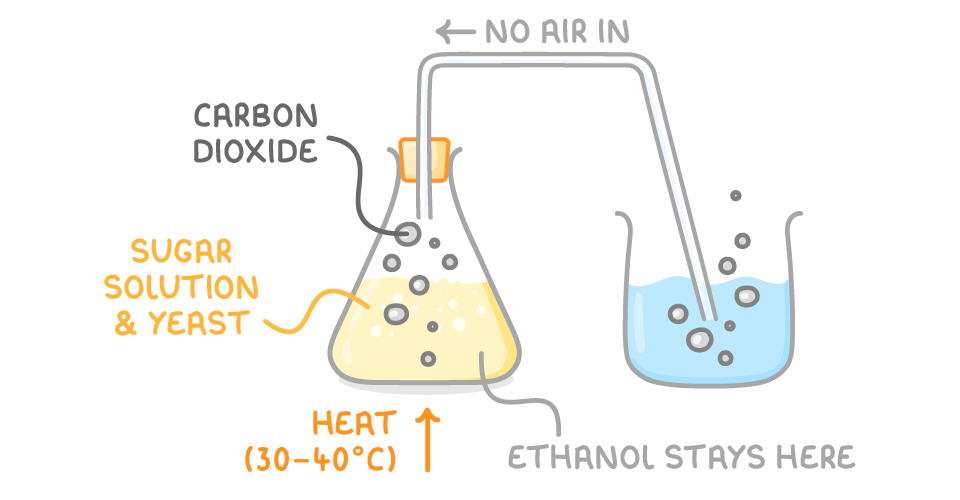
- A solution of sugar (from a crop such as sugar cane) is mixed with yeast in a sealed container and left somewhere warm.
- Enzymes in the yeast convert the sugar into ethanol and carbon dioxide:
- sugar → ethanol + carbon dioxide
The conditions, and why each is needed
- Warm, about 30 to 40 °C - The enzymes work fastest in this range. Higher temperatures denature the enzymes and stop the reaction; lower temperatures slow it down.
- Slightly acidic - Provides the optimum pH for the enzymes.
- No air (anaerobic) - If air gets in, the ethanol is oxidised to ethanoic acid (vinegar).
Concentrating the product
- Fermentation stops at around 12 to 15% ethanol, because the alcohol kills the yeast.
- To produce higher concentrations, the mixture is separated by fractional distillation.
TermDefinition
AlcoholAn organic compound containing the -OH functional group joined to a carbon atom.
Functional groupAn atom or group of atoms in a molecule that determines how the molecule reacts.
FermentationThe process in which enzymes in yeast convert sugar into ethanol and carbon dioxide without oxygen.