3.1 - Chemical Formulae
Chemical symbols and formulae
- Every element has its own chemical symbol - a shorthand of one or two letters standing for one atom of that element.
- The first letter is always a capital and the second is lower case: Co is cobalt, but CO is carbon monoxide (one carbon atom joined to one oxygen atom).
- Most symbols come from the element's English name (e.g. H for hydrogen, C for carbon, Ca for calcium).
- Some come from older Latin names:
- Na (sodium), K (potassium), Fe (iron), Cu (copper), Pb (lead)
Diatomic elements
- Seven elements exist as molecules of two atoms joined together and are described as diatomic:
- Hydrogen (H2), nitrogen (N2), oxygen (O2), fluorine (F2), chlorine (Cl2), bromine (Br2), iodine (I2)
- Oxygen gas is always written O2, never O. It's still an element because it contains only one type of atom.
Reading a formula
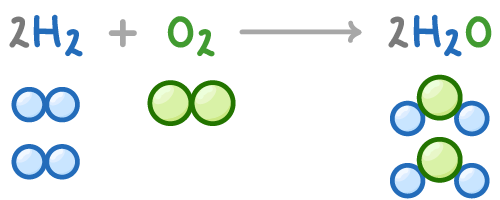
- A chemical formula shows which elements a substance contains, and how many atoms of each.
- Numbers are written as subscripts and apply only to the symbol immediately in front of them (a symbol with no subscript means one atom):
- H2O = two hydrogen atoms, one oxygen atom
- CO2 = one carbon atom, two oxygen atoms
- H2SO4 = two hydrogen atoms, one sulfur atom, four oxygen atoms (seven atoms in total)
- For a substance made of separate molecules, this is called the molecular formula.
Brackets in formulae
Brackets are used when a group of atoms is repeated. The subscript after the bracket multiplies everything inside it:
- Ca(OH)2 = one calcium, two oxygen, two hydrogen atoms
- Mg(NO3)2 = one magnesium, two nitrogen, six oxygen atoms
Formulas from diagrams
- In a molecular diagram, each circle represents an atom, identified by a key.
- You can write the formula by counting the atoms of each element:
- In a molecular substance, the formula describes one molecule.
- In a giant network, the formula gives the simplest whole-number ratio of the atoms or ions.
TermDefinition
Chemical symbolA shorthand of one or two letters standing for one atom of an element.
Diatomic moleculeA molecule made of two atoms covalently bonded together, such as H2, O2 or Cl2.
Chemical formulaA set of symbols and numbers that shows which elements a substance contains, and how many atoms of each.