3.5 - Thermal Decomposition of Carbonates
Thermal decomposition of metal carbonates
- Thermal decomposition is when a substance breaks down on heating.
- When a metal carbonate is heated, it decomposes into a metal oxide and carbon dioxide:
- metal carbonate → metal oxide + carbon dioxide
Decomposing copper(II) carbonate
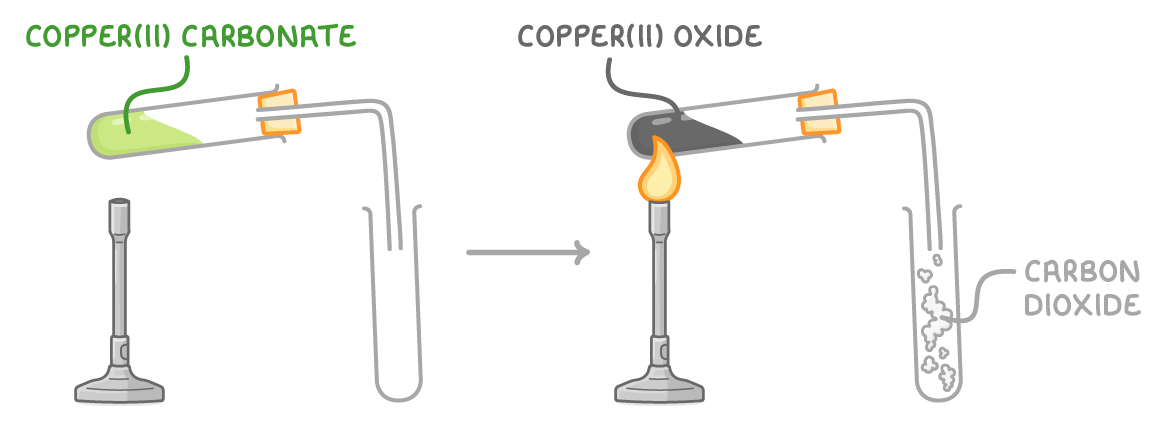
- Copper(II) carbonate is a green powder that decomposes easily on heating to form black copper(II) oxide and carbon dioxide gas.
- The visible colour change is from green to black.
- copper(II) carbonate → copper(II) oxide + carbon dioxide
- CuCO3(s) → CuO(s) + CO2(g)
How readily carbonates decompose
- How readily a carbonate decomposes depends on how reactive its metal is: the more reactive the metal, the more stable its carbonate, and the more heat is needed to decompose it.
- Carbonates of magnesium, copper, zinc, calcium, and lithium all break down on heating:
- Copper(II) carbonate decomposes with gentle heating.
- Calcium carbonate must be heated strongly for several minutes before it breaks down.
- Other Group 1 carbonates, such as sodium and potassium carbonate, are far more stable and need temperatures higher than a Bunsen burner can reach to decompose.
TermDefinition
Thermal decompositionThe breaking down of a substance into two or more simpler substances by heating it.