10.11 - Polymers
What holds a polymer together
A polymer is a material made of very large molecules, each built from many small repeating units joined into a long chain by covalent bonds.
Bonds along and between the chains
- Along a chain, atoms are held together by strong covalent bonds. These do not break when a polymer melts.
- Between chains, there are only weak intermolecular forces.
- Because the chains are so long, the large number of intermolecular forces adds up to a strong overall attraction. This is why almost all polymers are solids at room temperature.
- The total attraction is still weaker than the bonding in giant covalent or ionic structures, so polymers have lower melting points.
How the chains lie sets the properties
- Chains close together - More intermolecular forces between them, so the material is stiffer, harder, stronger, and has a higher melting point.
- Chains further apart - Chains slide over one another easily, so the material is flexible, softer, and melts at a lower temperature.
- Longer chains - Greater surface contact, leading to stronger total intermolecular forces.
Thermosoftening and thermosetting polymers
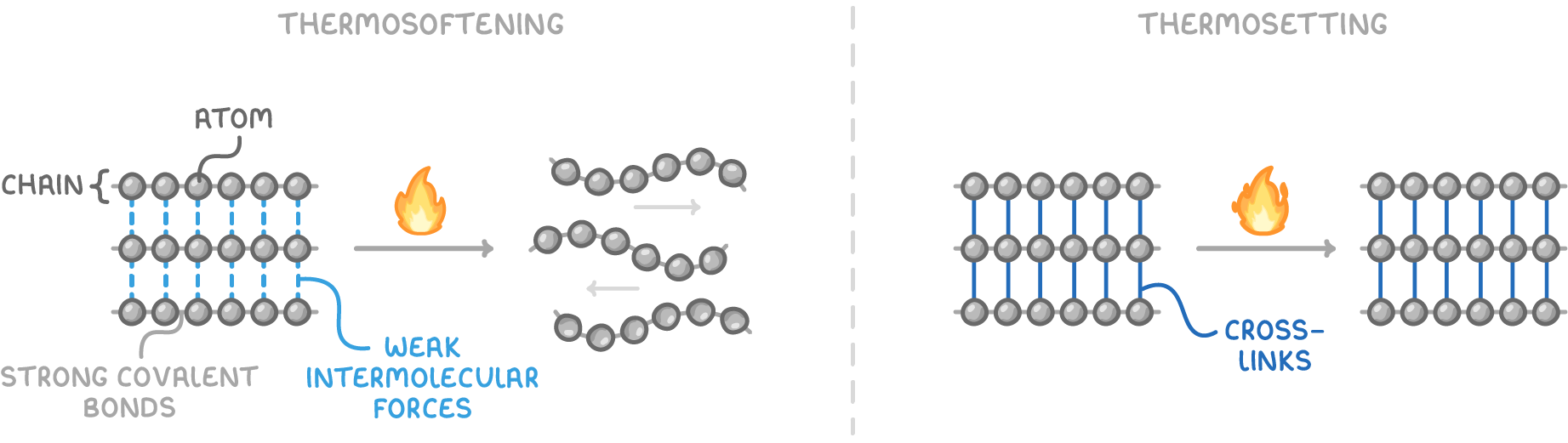
- Thermosoftening polymers - Consist of tangled chains held only by weak intermolecular forces. Heating allows the chains to slide past one another, so the material softens and melts. It can be melted and remoulded repeatedly.
- Thermosetting polymers - Have cross-links (covalent bonds) between the chains, fixing them into a rigid network. Heating does not break these bonds, so the material does not melt or soften when heated, remaining strong, hard and stiff.
What decides a polymer's properties
Two factors determine the properties of a polymer:
- The monomer used - Determines the atoms along the chain and the intermolecular forces between chains.
- The reaction conditions - Temperature, pressure, and catalysts determine chain length and how closely the chains pack together.
LD and HD poly(ethene)
Both are made from ethene under different conditions:
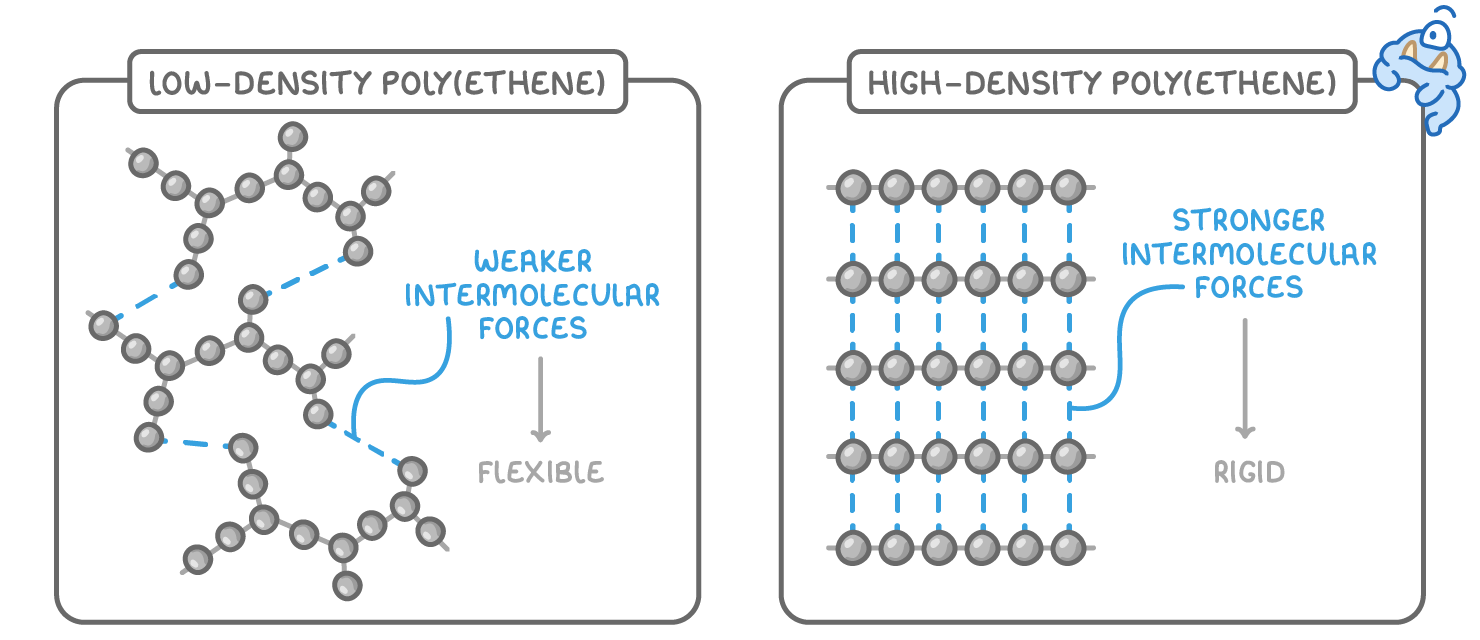
- Low-density (LD) poly(ethene) - Made at moderate temperatures and high pressure. Chains are branched and cannot pack closely together, resulting in weaker intermolecular forces. It's flexible and used for plastic bags and squeezy bottles.
- High-density (HD) poly(ethene) - Made at lower temperatures and pressures with a catalyst. Chains are straighter and pack tightly, resulting in stronger intermolecular forces. It's rigid and used for water tanks and drainpipes.
New uses for polymers
- Packaging materials
- Waterproof coatings for fabrics
- Dentistry polymers
- Wound dressings
- Hydrogels - Absorb and hold large amounts of water
- Shape-memory polymers - Return to their original shape when heated
Polymers that do not break down
Most addition polymers are inert because the carbon-to-carbon bonds along their chains are strong and there are no reactive groups.
Why being inert is useful in use
- Polymer containers can store food, water, or corrosive chemicals without reacting with them.
- Polymer pipes and sheets do not corrode when exposed to air and water.
Problems with disposal
- Microbes cannot break down the strong carbon chains, making addition polymers non-biodegradable.
- Landfill - Polymer waste does not rot and permanently occupies space in landfill sites.
- Incineration - Burning polymers destroys the solid waste but releases carbon dioxide and potentially toxic gases.
Polymers that do break down
A biodegradable polymer can be broken down by microorganisms in the environment.
Cornstarch plastic bags
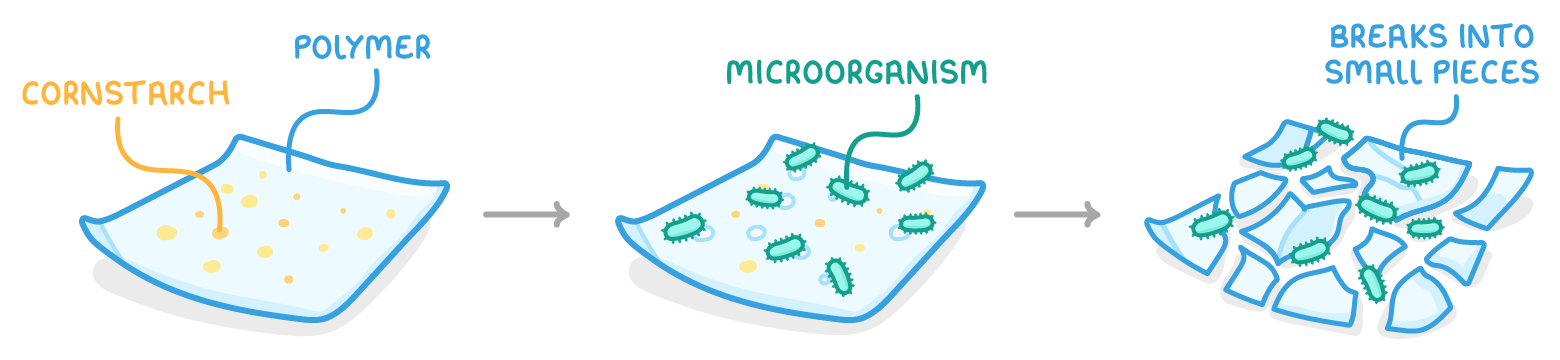
- Made by mixing polymer chains with cornstarch.
- Microorganisms digest the cornstarch, causing the plastic to break into small pieces and decompose much faster than ordinary plastics.
Biopolyesters
Biopolyesters are polyesters that can be broken down and decomposed by bacteria and other organisms over time, reducing long-term environmental pollution.
TermDefinition
PolymerA very large molecule built from many small repeating units joined into long chains.
Cross-linkA covalent bond joining one polymer chain directly to another.
Thermosoftening polymerA polymer made of tangled chains held together only by weak intermolecular forces, so it can be melted and remoulded.
Thermosetting polymerA polymer with cross-links between its chains, fixing them into a rigid network that does not melt when heated.
BiodegradableAble to be broken down by microorganisms in the environment.