7.8 - Tests for Cations
The flame test
- A cation is a positively charged ion.
- When a metal compound is heated in a flame, it gives off a characteristic colour that identifies the metal ion.
Carrying out the test
-
Clean the wire. Dip a nichrome or platinum wire loop in hydrochloric acid, then hold it in a blue Bunsen flame until it burns with no colour. Any residue left from an earlier test would mask the sample's colour. Hydrochloric acid is used because chloride ions give no flame colour. A fresh damp wooden splint can be used instead of the wire and discarded after one test.
-
Pick up the sample. Dip the clean wire loop or damp splint into the solid sample so a little clings to it.
-
Hold it in the flame and record the colour. Use the roaring blue flame (air hole open), which is the hottest part and won't add any yellow colour of its own.
Flame colours
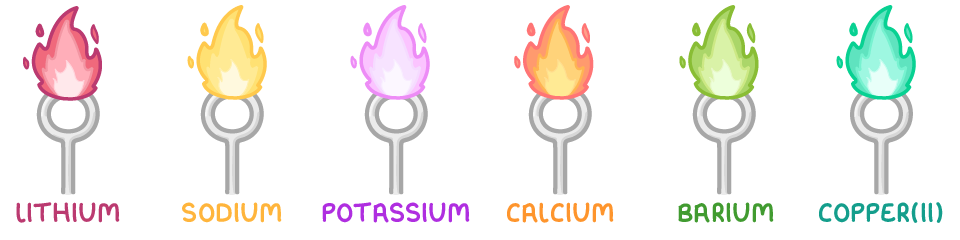
| Metal ion | Flame colour |
|---|---|
| Lithium, Li+ | crimson (red) |
| Sodium, Na+ | yellow (yellow-orange) |
| Potassium, K+ | lilac |
| Calcium, Ca2+ | orange-red (brick red) |
| Barium, Ba2+ | light green (green or apple green) |
| Copper(II), Cu2+ | blue-green |
Where a question describes lithium's flame as crimson, a flame it calls simply red is calcium's.
What the test cannot do
- A flame test only works reliably on a single metal ion.
- If a sample contains a mixture of ions, the colours blend and a strong colour masks a weaker one (e.g. sodium's yellow completely masks potassium's lilac).
TermDefinition
CationA positively charged ion, which moves towards the cathode during electrolysis.