1.7 - Conservation of Mass
The law of conservation of mass
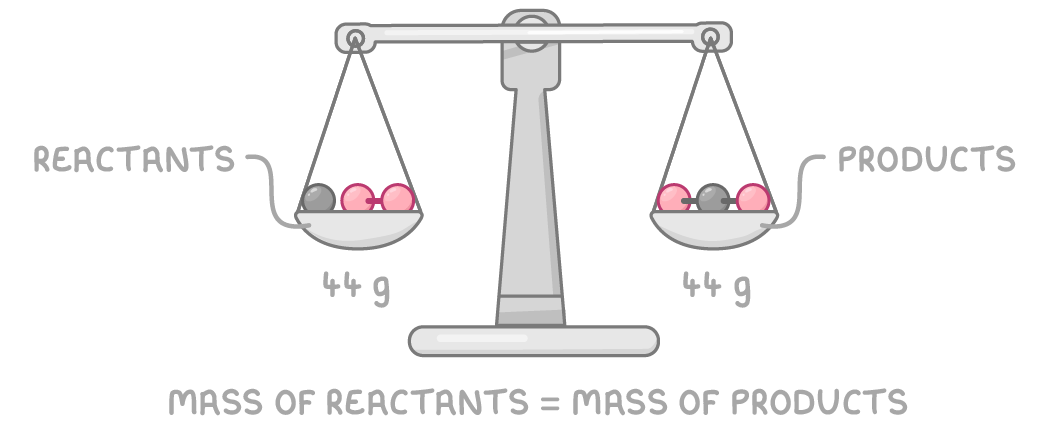
- In any chemical reaction, the total mass of the products equals the total mass of the reactants.
- This is the law of conservation of mass, and it holds for every reaction.
- No atoms are created or destroyed; they're only rearranged into new substances. Because every starting atom is present in the products, total mass cannot change.
Calculating an unknown mass
- Conservation of mass lets you calculate a missing mass by arithmetic.
- If 12 g of carbon reacts completely with 32 g of oxygen, the mass of carbon dioxide produced must be 12 + 32 = 44 g.
Demonstrating conservation in a closed system
- A closed system is a sealed container that no substances can enter or leave.
- When a precipitation reaction is carried out in a closed flask on a balance, an insoluble solid (precipitate) forms, but the mass reading on the balance does not change:
- CuSO4(aq) + 2NaOH(aq) → Cu(OH)2(s) + Na2SO4(aq)
Checking an equation by total relative formula mass
- You can check a balanced equation against the law of conservation of mass by calculating the total relative formula mass (Mr) on each side.
- Multiply each Mr by the balancing number in front of the formula, then add them up for each side:
Working with the numbers
- The balancing number in front multiplies the entire formula (e.g. 2LiF means two lots of LiF).
- A subscript is already included in that formula's own Mr (e.g. O2 is one molecule of two oxygen atoms, counted once).
- Keep decimals in the working if a relative atomic mass includes one (e.g. Cl = 35.5).
Worked example - Total Mr on each side
Sodium burns in chlorine to form sodium chloride. Use relative formula masses to show that mass is conserved.
2Na + Cl2 → 2NaCl
Relative atomic masses: Ar(Na) = 23, Ar(Cl) = 35.5
Step 1 - Total the relative formula masses on the left
There are two sodium atoms and one Cl2 molecule (two chlorine atoms).
Mr(Cl2) = 2 × 35.5 = 71
Total for reactants = (2 × 23) + 71 = 117
Step 2 - Total the relative formula masses on the right
One NaCl is one sodium atom and one chlorine atom, and there are two of them.
Mr(NaCl) = 23 + 35.5 = 58.5
Total for products = 2 × 58.5 = 117
Step 3 - Compare the two totals
Both sides total 117, so they're equal and mass is conserved.
TermDefinition
Law of conservation of massThe rule that no atoms are created or destroyed in a chemical reaction, so the total mass of the products equals the total mass of the reactants.
Closed systemA system in which no substances can enter or leave, although energy can be transferred.
PrecipitateAn insoluble solid that forms in a solution during a chemical reaction, usually when two solutions are mixed.