10.7 - Ceramics, Polymers & Composites
Glass and clay ceramics
- A ceramic is a solid that is not a metal and is not built from carbon compounds, and has a high melting point.
- Ceramics are stiff, hard-wearing, brittle, and insulators of heat and electricity.
- They do not corrode or rot.
The two main types are glass and clay ceramics:
- Glass - Usually transparent, can be shaped while hot, and brittle when thin.
- Clay ceramics - Include pottery and bricks. A clay brick has a high compressive strength, so it can support heavy loads without breaking.
How they are made
- Soda-lime glass - Made by heating sand, sodium carbonate (soda) and limestone until it melts, then cooling it.
- Borosilicate glass - Made from sand and boron trioxide. Melts at a higher temperature than soda-lime glass.
- Clay ceramics - Made by shaping wet clay and then firing it in a furnace to harden permanently.
Composites
- A composite is made of one material embedded in another:
- The reinforcement - Fibres or fragments of the first material.
- The matrix (or binder) - A second material surrounding them and holding them in place.
- The combination has properties neither material has on its own, allowing composites to be designed for specific uses.
- Their main drawback is cost.
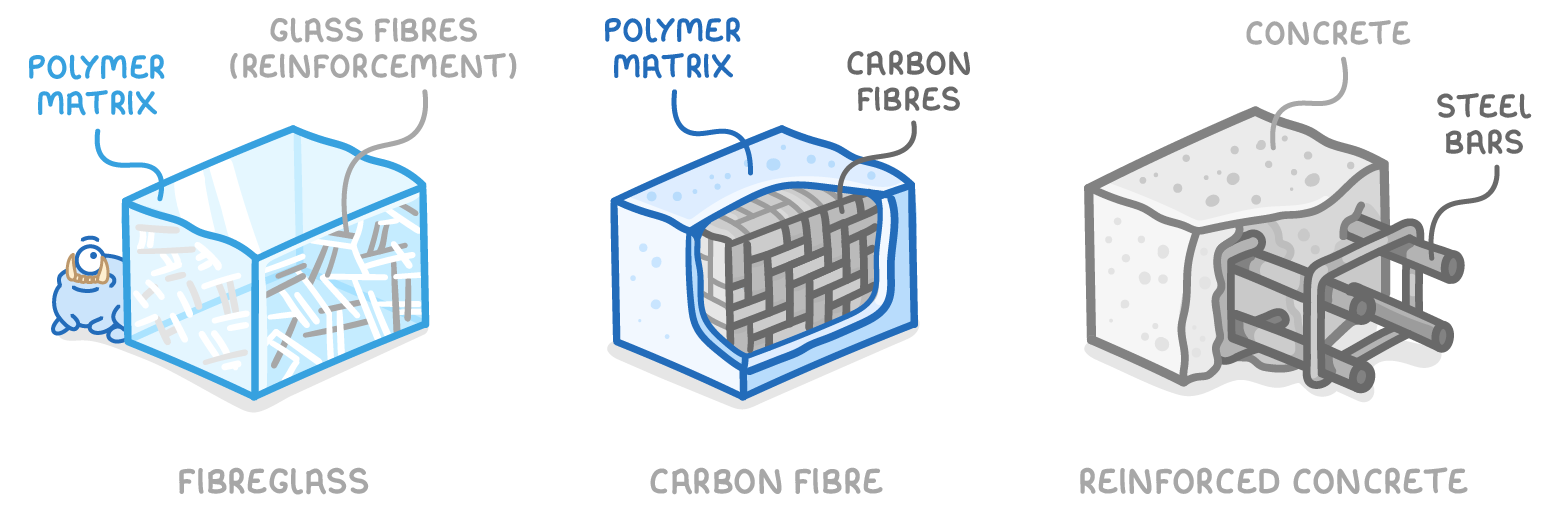
| Composite | Made of | Properties and uses |
|---|---|---|
| Fibreglass | Glass fibres in a polymer matrix | Low density and strong - boats, skis, surfboards |
| Carbon fibre | Carbon fibres in a polymer matrix | Very strong and light - aircraft and sports cars |
| Reinforced concrete | Steel bars set into concrete | Strong in both compression and tension - building construction |
What holds a polymer together
- A polymer is a material made of very large molecules, each built from many small repeating units joined into a long chain by covalent bonds.
- In most polymers, individual chains are held together only by weak intermolecular forces.
- In some polymers, chains are joined together by covalent bonds called cross-links.
Thermosoftening and thermosetting polymers
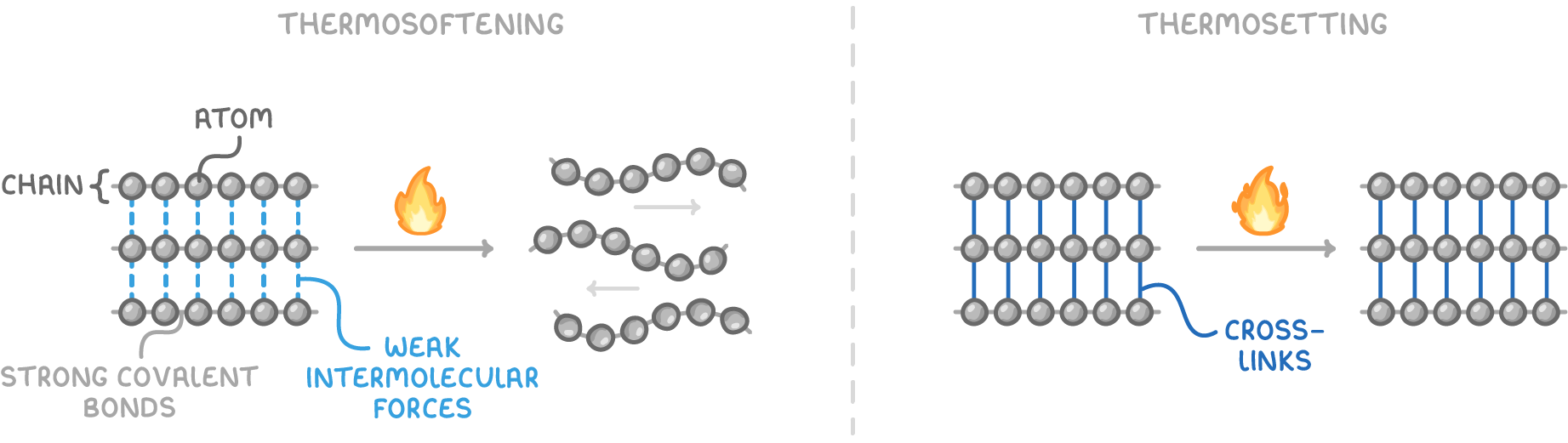
- Thermosoftening polymers - Consist of tangled chains held only by weak intermolecular forces. Heating allows the chains to slide past one another, so the material softens and melts. It can be melted and remoulded repeatedly.
- Thermosetting polymers - Have cross-links between the chains, fixing them into a rigid network. Heating does not break these bonds, so the material does not melt or soften when heated, remaining strong, hard and stiff.
What decides a polymer's properties
Two factors determine the properties of a polymer:
- The monomer used - Determines the atoms along the chain and the intermolecular forces between chains.
- The reaction conditions - Temperature, pressure, and catalysts determine chain length and how closely the chains pack together.
LD and HD poly(ethene)
Both are made from ethene under different conditions:
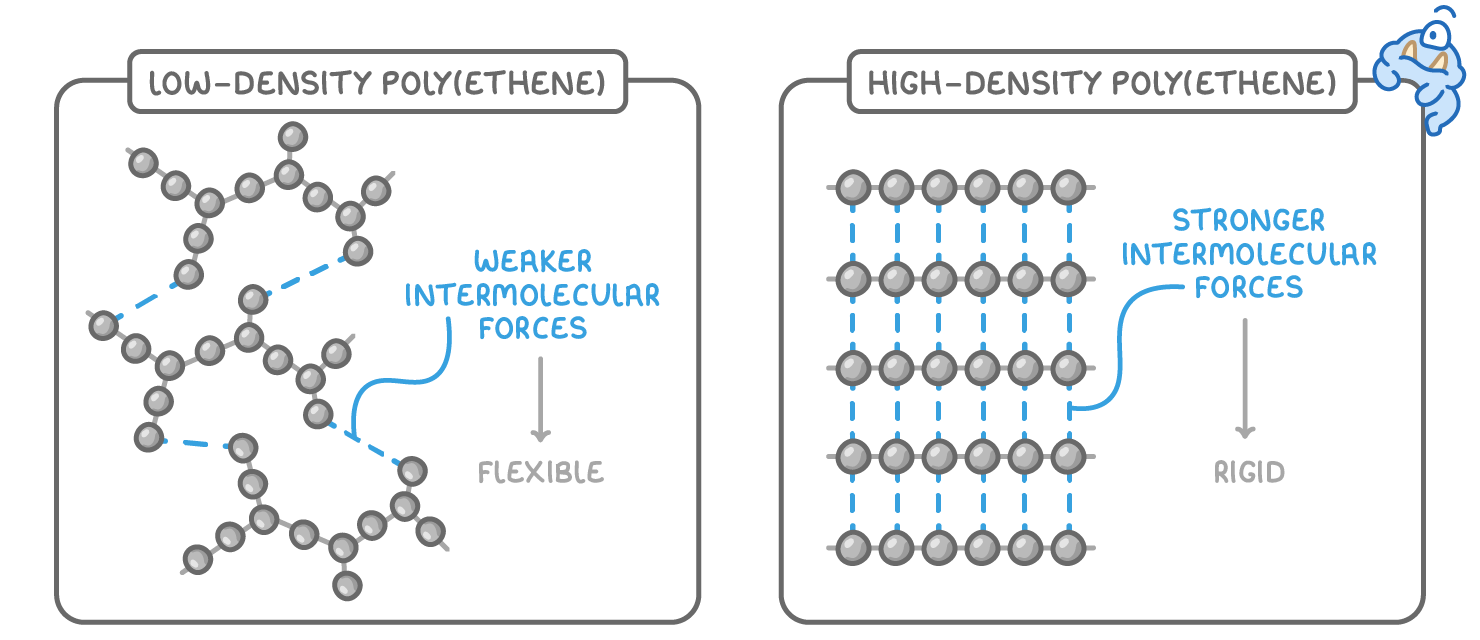
- Low-density (LD) poly(ethene) - Made at moderate temperatures and high pressure. Chains are branched and cannot pack closely together, resulting in weaker intermolecular forces. It's flexible and used for plastic bags and squeezy bottles.
- High-density (HD) poly(ethene) - Made at lower temperatures and pressures with a catalyst. Chains are straighter and pack tightly, resulting in stronger intermolecular forces. It's rigid and used for water tanks and drainpipes.
TermDefinition
CeramicA hard, non-metal solid with a high melting point that is not made from carbon compounds, such as glass or brick.
CompositeA material made of one material embedded in another, combining properties neither has on its own.
PolymerA very large molecule built from many small repeating units joined into long chains.
Cross-linkA covalent bond joining one polymer chain directly to another.
Thermosoftening polymerA polymer made of tangled chains held together only by weak intermolecular forces, so it can be melted and remoulded.
Thermosetting polymerA polymer with cross-links between its chains, fixing them into a rigid network that does not melt when heated.