2.7 - Graphene
Graphene
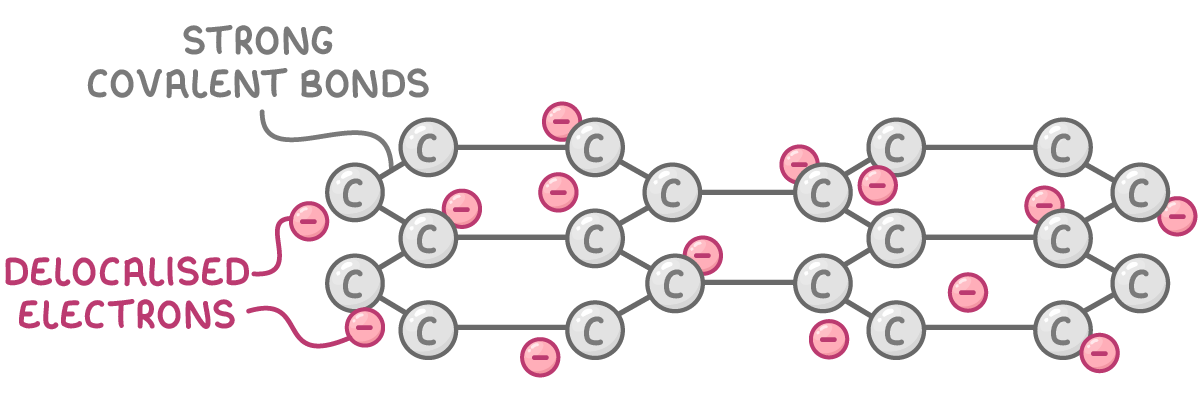
- Graphene is a single layer of graphite, just one atom thick, making it a two-dimensional form of carbon.
- Within the layer, each carbon atom is joined to three neighbours by strong covalent bonds in a repeating pattern of hexagons.
Properties
- Very strong and light - Held together by strong covalent bonds throughout the sheet.
- Transparent - Being one atom thick allows light to pass straight through.
- Excellent conductor of electricity and heat - each carbon atom has one delocalised electron free to move across the whole sheet.
Uses
- Composite materials - Reinforces other materials to improve strength without adding much weight.
- Electronics - Its thinness and high conductivity make it valuable in miniature circuits.
- Batteries and solar cells - Used in batteries to make them lighter and faster to recharge, and in solar cells, where it lets light through and conducts electricity.
TermDefinition
GrapheneA single layer of graphite, one atom thick, consisting of carbon atoms arranged in hexagons.
FullereneA molecule of carbon atoms with a hollow shape, such as a sphere or a tube.
BuckminsterfullereneA hollow spherical fullerene molecule with the formula C60.
Carbon nanotubeA cylindrical fullerene molecule with a very high length-to-diameter ratio (it is very long compared with its width).