15.4 - Reuse & Recycling
Why we reduce, reuse and recycle
- Most manufactured goods come from raw materials taken from the Earth, which are in limited supply (finite), such as metal ores.
- Extracting raw materials is damaging and expensive:
- Uses large amounts of energy to extract and process them, mostly from burning fossil fuels.
- Damages the environment through quarrying and mining, which scar the landscape, destroy habitats, and produce waste.
Three ways to conserve raw materials
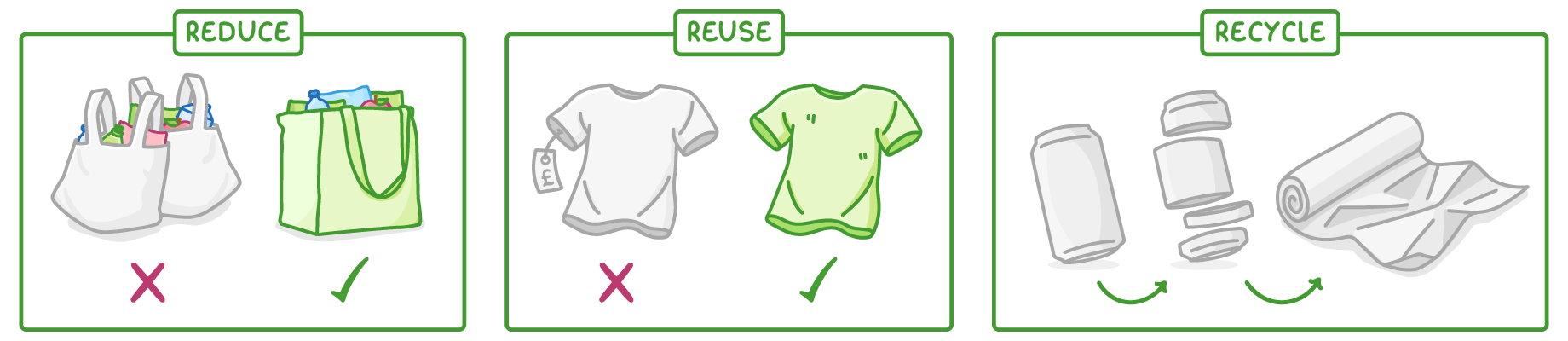
- Reducing - Using less of a material in the first place, saving raw resources, energy, and environmental damage.
- Reusing - Using a product again in its current form, requiring far less energy than recycling because it isn't broken down or reprocessed.
- Recycling - Breaking down a used product into its raw material to make something new.
All three approaches conserve finite resources, save energy, and reduce waste sent to landfill.
The economic case
- Processes that use less energy cost less to run, especially for materials that are expensive to extract.
- Recycling is an industry that creates jobs in collecting, sorting, and reprocessing waste.
- Recycling isn't always worth doing: the cost of collecting and reprocessing must be weighed against the cost of making the material from scratch.
Recycling metals, and reusing glass
- Extracting metals from ores requires large amounts of energy and causes environmental damage.
- Recycling metals avoids most of this:
- Uses a fraction of the energy needed for extraction.
- Conserves limited supplies of ores.
- Cuts down on waste sent to landfill.
How metals are recycled
- Sort the scrap metal.
- The sorting required depends on the product: items requiring a pure metal must be carefully separated, while others can use a mixture.
- Melt it down.
- Scrap steel can be added directly to the molten iron from a blast furnace, reducing the amount of iron that needs extracting from iron ore.
- Cast or reform it into new products.
Aluminium
- Extracting aluminium requires mining about 4 tonnes of ore for every tonne of metal, followed by electrolysis using large amounts of electricity.
- Recycling aluminium uses only about 5% of that energy, saving roughly 95% of the energy, four kilograms of ore per kilogram of metal, and substantial waste.
- This makes aluminium one of the most cost-effective metals to recycle.
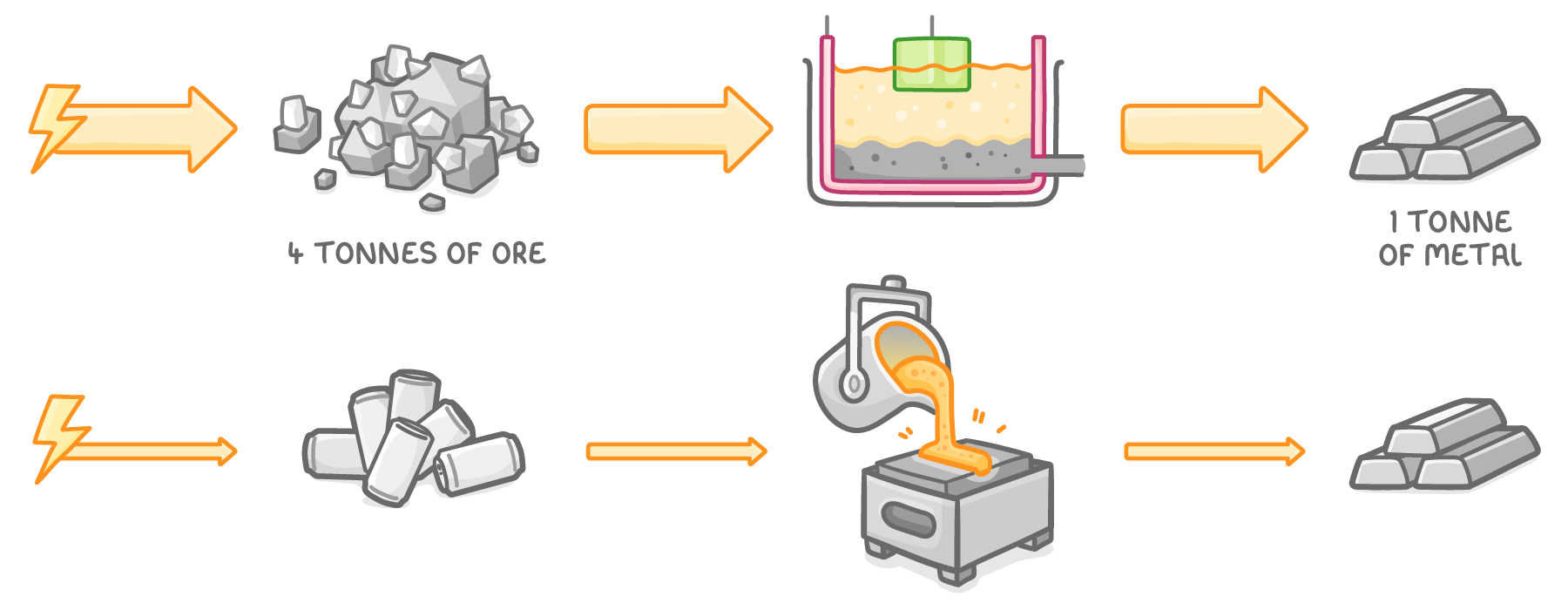
Top: extracting aluminium from ore. Bottom: recycling cans, using far less energy.
Glass - Reused or recycled
- Reuse - Glass bottles can be collected, washed, and refilled without being melted down, using almost no energy.
- Recycling - Glass that can't be reused is:
- Separated by colour and type.
- Crushed and melted to be remoulded into new bottles, jars, or glass wool for insulation.
The problem with plastic waste
- Addition polymers are chemically unreactive and cannot be broken down by microbes; they are non-biodegradable.
- Because they don't rot, discarded plastics persist in the environment for centuries.
Three main problems
- Landfill - Large volumes of plastic are buried because mixed plastics are difficult and expensive to separate. They occupy valuable space indefinitely.
- Accumulation in oceans - Plastic litter washed into rivers and seas accumulates, harming marine ecosystems and wildlife.
- Toxic gases from burning - Burning plastics releases useful energy, but it can produce toxic and polluting gases unless carefully controlled.
Landfill vs incineration
Disposing of plastic waste in bulk involves either burying it in landfill or burning it at high temperatures (incineration).
| Method | Advantages | Disadvantages |
|---|---|---|
| Landfill | Local disposal reduces transport costs; sites can eventually be landscaped and repurposed. | Uses up land; waste doesn't biodegrade; risk of polluting local groundwater and giving off polluting gases. |
| Incineration | Drastically reduces waste volume; the heat released can be used to generate electricity. | Releases polluting and greenhouse gases; leaves behind toxic ash that still requires disposal in landfill. |
TermDefinition
Reducing (waste)Using less of a material in the first place.
ReusingUsing a product again in its current form without breaking it down.
RecyclingBreaking down a used product into its raw materials to make something new.
Non-biodegradableNot able to be broken down by microorganisms in the environment.
IncinerationDisposing of waste by burning it at high temperatures.