11.3 - Rate Factors & Collision Theory
Catalysts
- A catalyst is a substance that speeds up a chemical reaction without being used up in the process.
- It remains chemically unchanged, so its mass is the same at the start and end of the reaction.
- A catalyst doesn't appear in the balanced equation for the reaction.
- Enzymes are biological catalysts.
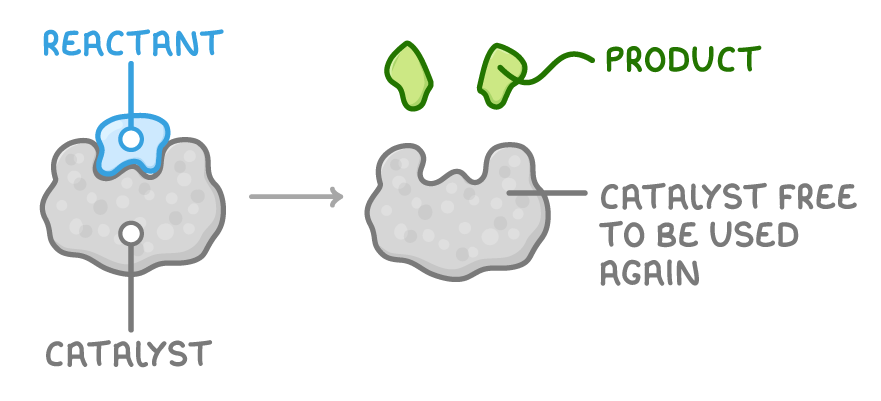
How a catalyst works
- A catalyst provides an alternative reaction pathway with a lower activation energy.
- A greater proportion of colliding particles have enough energy to react, so there are more successful collisions per second.
Catalysts in industry
- Catalysts allow reactions to run at lower temperatures and pressures.
- This reduces energy costs and burns less fossil fuel, making processes cheaper and more sustainable.
Example - Decomposing hydrogen peroxide
Hydrogen peroxide decomposes very slowly on its own. Adding solid manganese(IV) oxide speeds up the reaction:
hydrogen peroxide → water + oxygen
2H2O2(aq) → 2H2O(l) + O2(g)
TermDefinition
CatalystA substance that speeds up a chemical reaction without being changed or used up.
EnzymeA biological catalyst that speeds up a specific chemical reaction without being changed or used up.
Activation energyThe minimum amount of energy that colliding particles must have to react.