2.11 - Metallic Bonding & Alloys
Alloys
- An alloy is a mixture of a metal with one or more other elements.
- Examples:
- Brass - Copper and zinc.
- Stainless steel - Iron with chromium, nickel and carbon.
- Alloys are generally harder and stronger than the pure metals they're made from.
- Stainless steel is used for cutlery because it is hard and resistant to rusting.
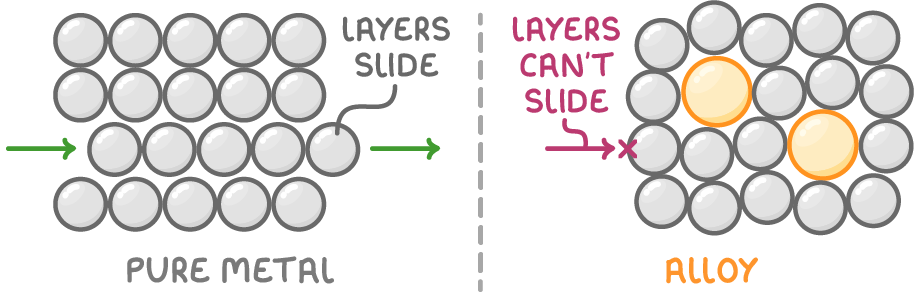
- Pure metals have regular layers of identical atoms that slide smoothly over one another.
- In an alloy, the added atoms are a different size, which distorts the regular layers and makes it harder for them to slide past each other.
Classifying a structure
| Giant ionic | Simple molecular | |
|---|---|---|
| Melting and boiling point | High | Low |
| Conducts as a solid? | No | No |
| Conducts when molten or dissolved? | Yes | No |
| Dissolves in water? | Usually | Usually not |
Identifying the structure
- Giant ionic - High melting point; does not conduct electricity as a solid, but conducts when molten or dissolved because the ions are free to move and carry charge.
- Simple molecular - Low melting point; does not conduct electricity in any state because there are no free ions or delocalised electrons to carry charge.
TermDefinition
AlloyA mixture of a metal with one or more other elements.