10.14 - Esters
Esters, and how one is made
An ester is a compound made when a carboxylic acid and an alcohol react together.
What makes a compound an ester
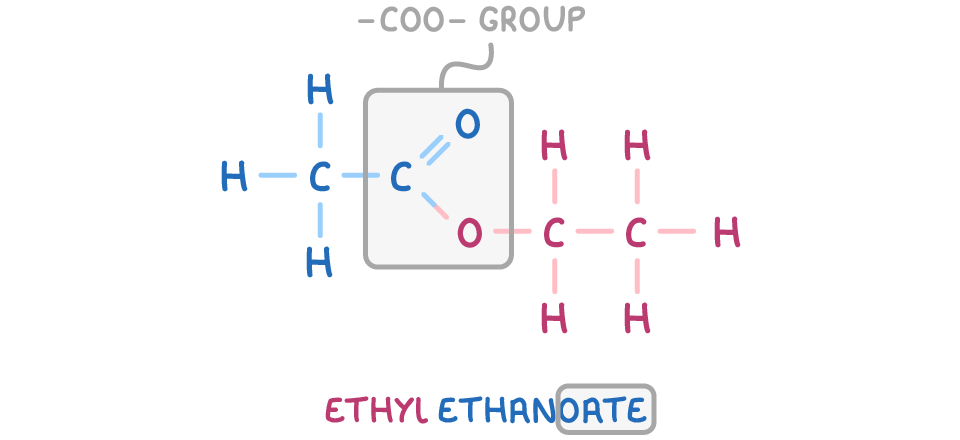
- Every ester contains the -COO- group: a carbon joined to two oxygen atoms, one by a double bond and the other by a single bond, with that singly bonded oxygen joined on to a carbon chain.
- The group sits in the middle of the molecule, with a carbon chain running off each side (in an ester of methanoic acid, such as methyl methanoate, HCOOCH3, a hydrogen atom takes the place of the chain on the acid side).
- You can identify an ester:
- From its structure - Find the -COO- group with a carbon chain joined to its singly bonded oxygen
- From its name - Every ester's name ends in -oate
Making an ester
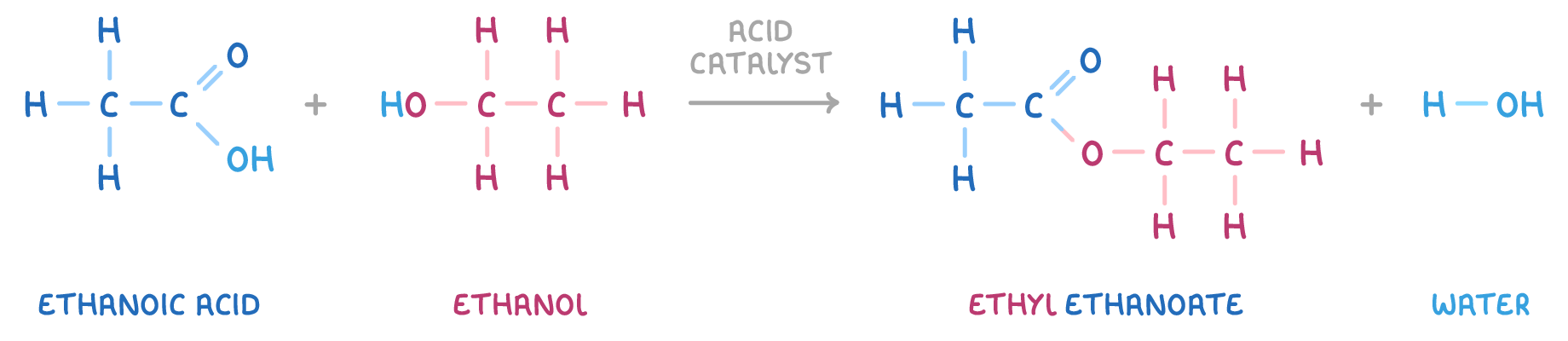
A carboxylic acid and an alcohol are warmed together with an acid catalyst.
carboxylic acid + alcohol → ester + water
When they react:
- The carboxylic acid loses the -OH from its -COOH group
- The alcohol loses the hydrogen from its -OH group
- The remaining parts join together to form the ester, and the lost atoms form water.
Ethyl ethanoate
The ester made from ethanoic acid and ethanol is ethyl ethanoate:
CH3COOH + CH3CH2OH → CH3COOCH2CH3 + H2O
Its structural formula is CH3COOCH2CH3.
Properties and uses of esters
- Esters are volatile (they evaporate easily) and have distinctive, sweet or fruity smells.
- For example, ethyl ethanoate has a characteristic pear-drop smell.
Uses
- Perfumes - Because they're volatile and smell pleasant, esters evaporate easily from the skin to release their scent.
- Food flavourings - Esters are added to foods and drinks to give them fruity flavours and aromas.
TermDefinition
EsterA compound formed when a carboxylic acid reacts with an alcohol.