2.7 - Group 7 - The Halogens
The halogens and their trends
- The elements in Group 7 are non-metals called the halogens.
- Every halogen atom has seven electrons in its outer shell, so they all have similar chemical properties.
- Halogens exist as diatomic molecules (pairs of atoms joined by a single covalent bond): F2, Cl2, Br2, I2.
- All halogens are toxic and are handled in a fume cupboard.
Appearance at room temperature
- Fluorine (F2) - Pale yellow gas.
- Chlorine (Cl2) - Pale yellow-green gas.
- Bromine (Br2) - Red-brown liquid that gives off an orange vapour.
- Iodine (I2) - Dark grey crystalline solid that sublimes to a purple vapour when heated.
Trends going down the group
- Melting and boiling points increase - The state at room temperature changes from gas (fluorine, chlorine) to liquid (bromine) to solid (iodine).
- Relative molecular mass and density increase - Each halogen molecule is heavier than the one above it.
- Colour darkens - From pale yellow to dark grey/black.
- Reactivity decreases - Fluorine at the top is the most reactive, and astatine at the bottom is the least reactive.
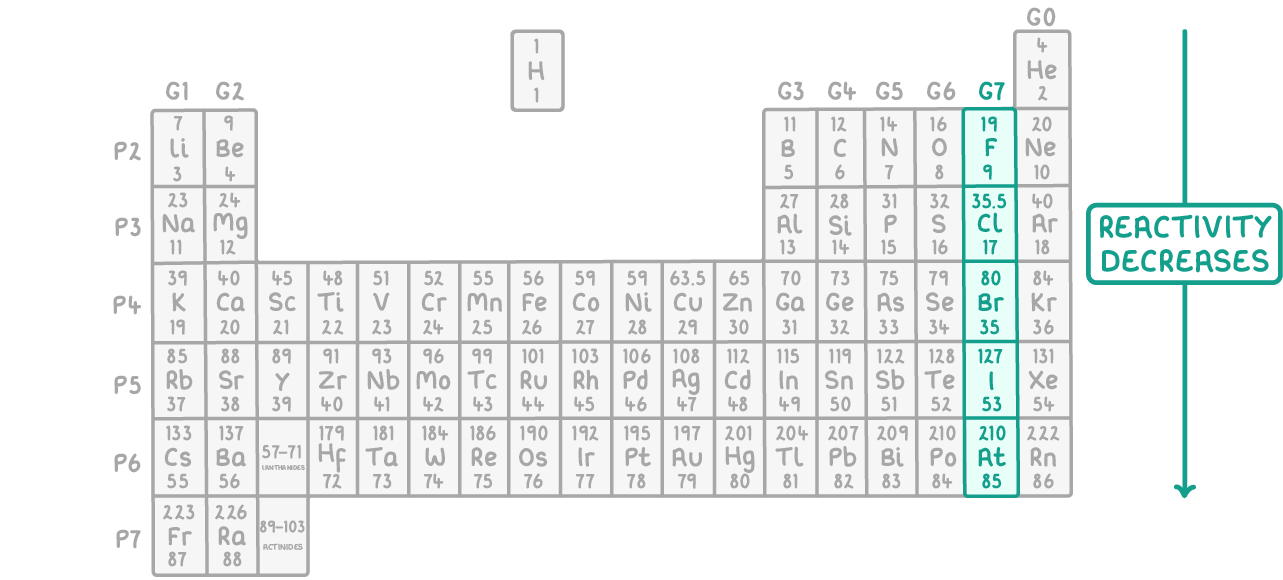
Predicting properties of an unknown halogen
Because properties change steadily down the group, you can predict unknown properties from the trend: Astatine is below iodine, so it is predicted to be a black solid with a higher melting point and lower reactivity than iodine.
The reactions of the halogens
- Halogens react with metals to form metal halides.
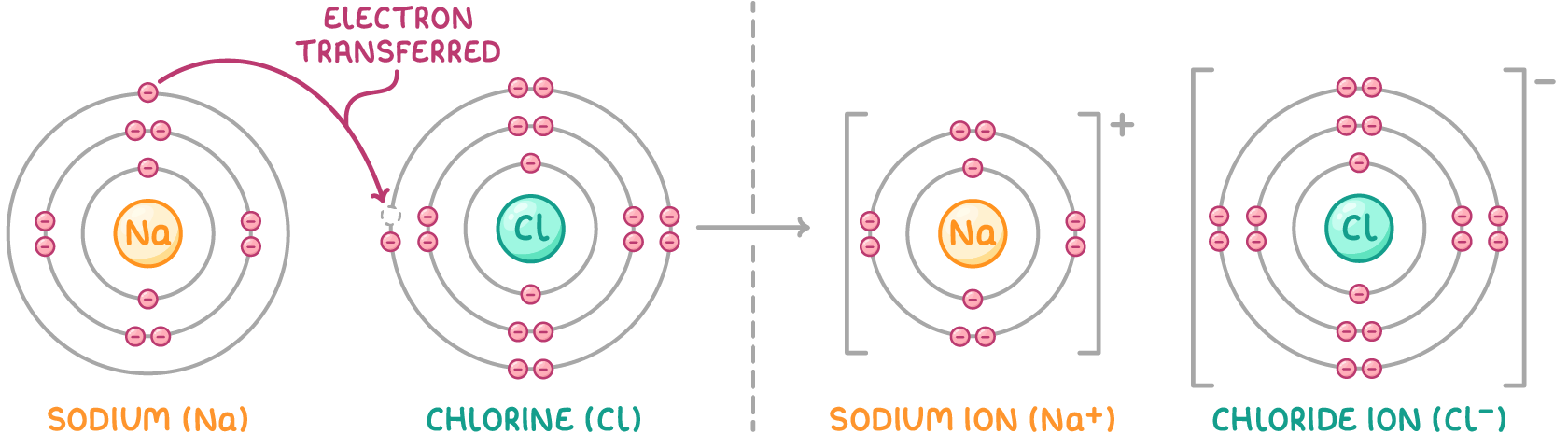
- The halogen atom gains one electron to form a 1- halide ion (F-, Cl-, Br-, I-).
- The metal atom loses electrons to form a positive ion, so the resulting compound is ionic.
- Metal halides are typically white solids.
Reactions with alkali metals
Halogens react vigorously with Group 1 alkali metals to form ionic salts:
2Na(s) + Cl2(g) → 2NaCl(s) sodium + chlorine → sodium chloride
2K(s) + Br2(l) → 2KBr(s) potassium + bromine → potassium bromide
Reactions with other metals
Halogens also react with other metals. For example, iron reacts with chlorine to form iron(III) chloride:
2Fe(s) + 3Cl2(g) → 2FeCl3(s) iron + chlorine → iron(III) chloride
Uses of chlorine and iodine
Chlorine
- Used to sterilise drinking water and swimming pools because it kills harmful bacteria and microorganisms.
- Used in the manufacture of bleach and other disinfectant cleaning products.
Iodine
- Used as an antiseptic on skin before surgery to prevent infection.
- Radioactive isotopes of iodine are used as medical tracers in nuclear medicine.
TermDefinition
HalogensThe non-metal elements in Group 7 of the periodic table, which each have seven electrons in their outer shell.
Diatomic moleculeA molecule made of two atoms covalently bonded together, such as H2, O2 or Cl2.
Halide ionA negative ion with a 1- charge, formed when a halogen atom gains one electron.