3.4 - Earth's Structure & Plate Tectonics
The Earth's structure
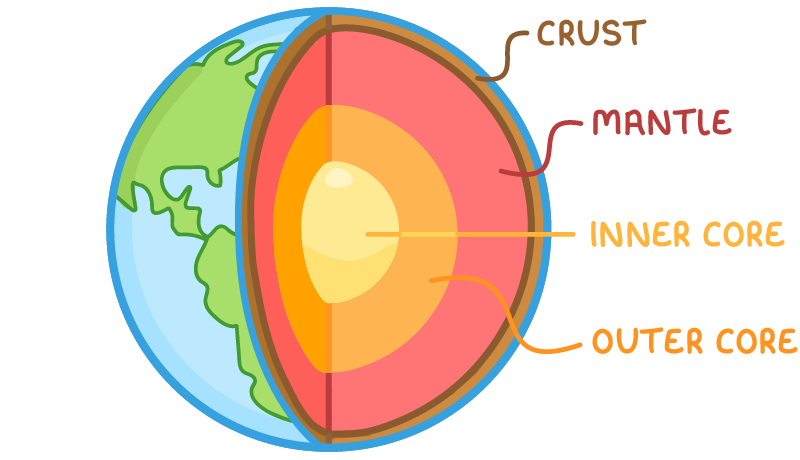
The three layers
- Crust - The thin, solid outer layer of rock, with an average depth of about 20 km.
- Mantle - The semi-solid layer between the crust and core. It's fairly rigid near the crust, but deeper down it becomes hotter, less rigid, and can flow slowly.
- Core - Made mainly of iron, taking up just over half the Earth's radius. It has a solid inner core and a molten outer core.
Tectonic plates and how they move
- Radioactive decay inside the Earth releases heat, driving convection currents in the mantle.
- The crust and rigid uppermost mantle are cracked into tectonic plates (about seven major plates and several smaller ones).
- Convection currents carry the plates along, moving them typically a few centimetres a year.
- Sudden plate movements cause earthquakes.
- Earthquakes and volcanoes happen far more often at plate boundaries than anywhere else.
From continental drift to plate tectonics
Early observations
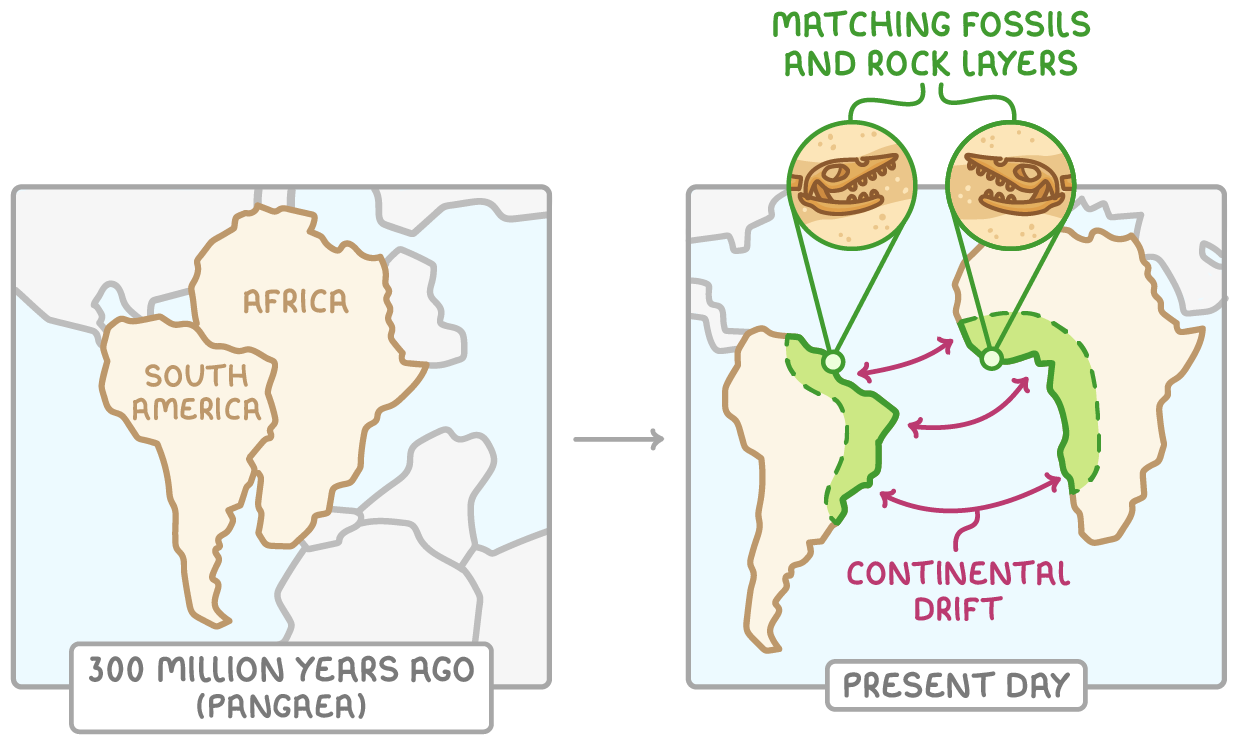
- Coastlines on opposite sides of oceans (such as Africa and South America) fit together like a jigsaw.
- Matching fossils were found on opposite sides of oceans far too wide for those organisms to have crossed.
Wegener's theory of continental drift
- In the early twentieth century, Alfred Wegener proposed that around 300 million years ago all landmasses were joined as one supercontinent, Pangaea, which broke apart and drifted (continental drift).
- Alongside matching coastlines and fossils, he showed that rock layers of the same age and type matched across separated continents.
Why the theory was rejected at first
- Wegener's explanation of how the continents moved wasn't convincing.
- He suggested tidal forces and the Earth's rotation moved them, which geologists showed was physically impossible.
- With no credible mechanism and no way to detect the movement at the time, most scientists rejected the idea.
The evidence that changed opinion
- 1930s - Scientists suggested convection currents in the mantle could move the plates.
- 1940s - Surveys of the Mid-Atlantic Ridge, where magma rose through the sea floor and solidified symmetrically on each side (sea-floor spreading).
1950s - Magnetic patterns in the rock on either side of the ridge matched in mirror-image bands, confirming that new sea floor was spreading outward.
1960s - The accumulated evidence led to Wegener's theory being widely accepted as the modern theory of plate tectonics.
Plate boundaries
- A tectonic plate carries either continental crust (thicker, beneath land) or oceanic crust (thinner and denser, beneath oceans).
- A plate boundary is where two tectonic plates meet.
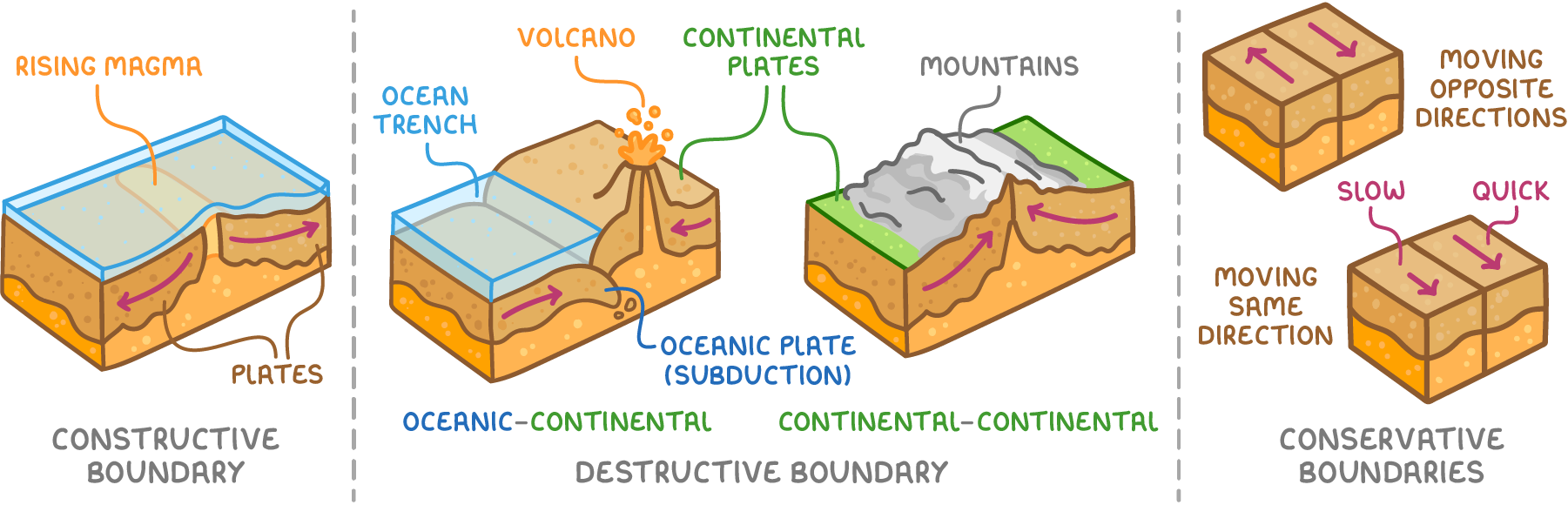
Constructive boundary - Plates move apart
- Two plates move apart, usually along a mid-ocean ridge such as the Mid-Atlantic Ridge.
- Magma rises from the mantle to fill the gap, cooling and solidifying to form new crust made of igneous rock.
- Produces volcanic activity and earthquakes.
Destructive boundary - Plates move together
- Two plates move towards each other.
- Where oceanic crust meets continental crust, the denser oceanic plate is forced down beneath the continental plate into the mantle (subduction).
- The descending plate melts to form magma, which rises to create volcanoes, while the point where the plate sinks forms a deep ocean trench.
- Produces earthquakes.
- Where two continental plates collide, neither subducts, so the ground folds upward to form mountain ranges.
Conservative boundary - Plates move sideways
- Two plates move sideways past each other, or in the same direction at different speeds.
- No crust is created or destroyed, so no volcanoes form.
- The movement produces powerful earthquakes.
TermDefinition
CrustThe thin, solid outer layer of rock that forms the surface of the Earth.
MantleThe semi-solid layer of the Earth between the crust and the core.
CoreThe centre of the Earth, made mainly of iron, with a solid inner part and a molten outer part.
Tectonic plateA large, rigid piece of the Earth's crust and uppermost mantle.
Continental driftThe theory that all landmasses were once joined as one supercontinent and have drifted apart.
Sea-floor spreadingThe process where magma rises at mid-ocean ridges and solidifies to form new crust.
Constructive boundaryA plate boundary where two plates move apart and new crust is formed.
Destructive boundaryA plate boundary where two plates move towards each other and crust is destroyed or folded.
SubductionThe process where a denser oceanic plate is forced down into the mantle beneath another plate.
Conservative boundaryA plate boundary where two plates slide past each other and no crust is created or destroyed.