9.3 - The Contact Process
Making sulfuric acid in three stages
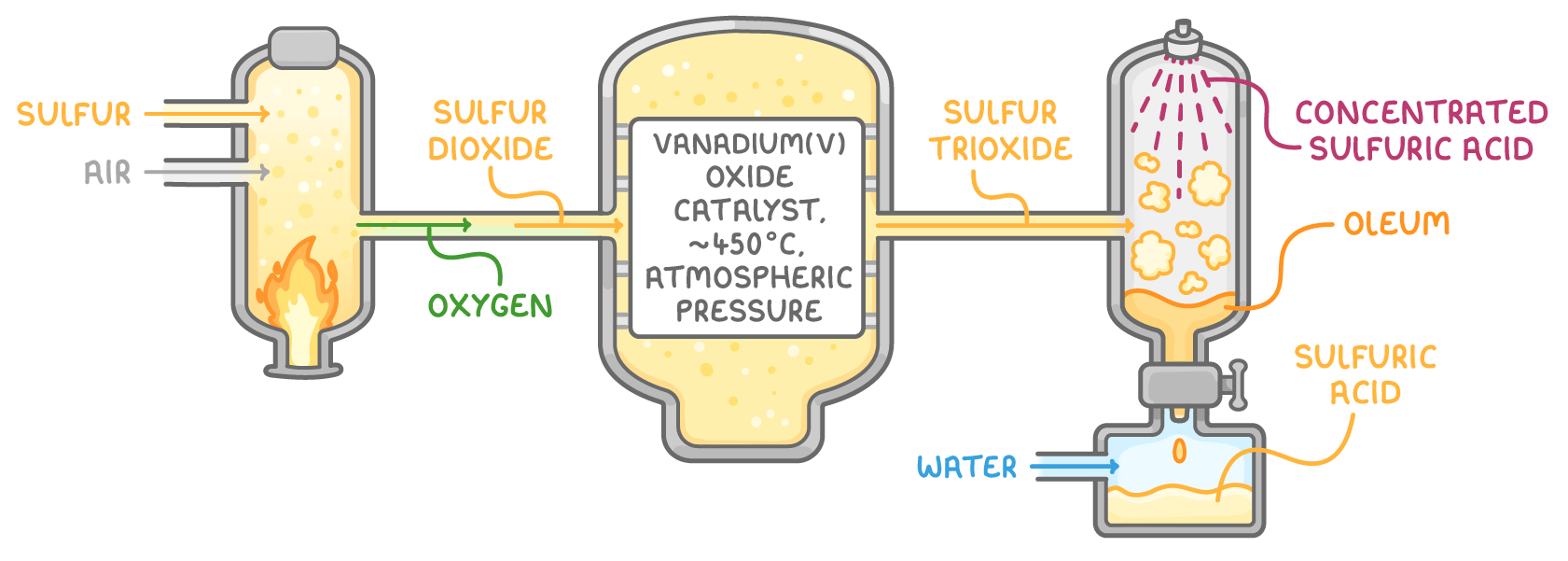
Sulfuric acid is manufactured by the Contact process in three stages.
Stage 1 - Making sulfur dioxide
Sulfur is burned in air to make sulfur dioxide.
sulfur + oxygen → sulfur dioxide
S(s) + O2(g) → SO2(g)
Stage 2 - Making sulfur trioxide
- The sulfur dioxide is mixed with more oxygen and passed over a catalyst, oxidising it to sulfur trioxide.
- This reaction is exothermic and reversible:
- sulfur dioxide + oxygen ⇌ sulfur trioxide
- 2SO2(g) + O2(g) ⇌ 2SO3(g)
Conditions used:
- Temperature - About 450 °C
- Pressure - At or just above atmospheric
- Catalyst - Vanadium(V) oxide, V2O5 (vanadium pentoxide)
Stage 3 - Making sulfuric acid
The overall reaction turns sulfur trioxide and water into sulfuric acid:
sulfur trioxide + water → sulfuric acid
SO3(g) + H2O(l) → H2SO4(aq)
Why it isn't done directly
- Adding sulfur trioxide straight to water releases so much heat that the acid boils, forming a dangerous acidic mist.
- Instead, sulfur trioxide is dissolved in concentrated sulfuric acid to produce oleum:
- sulfur trioxide + concentrated sulfuric acid → oleum
- SO3(g) + H2SO4(l) → H2S2O7(l)
The oleum is then safely diluted with water to make sulfuric acid:
oleum + water → sulfuric acid
H2S2O7(l) + H2O(l) → 2H2SO4(l)
Uses of sulfuric acid
Sulfuric acid is manufactured in huge quantities as an industrial raw material.
Main uses
- Fertilisers - Making phosphate fertilisers and ammonium sulfate (the largest single use).
- Other uses - Making detergents, paints, dyes, plastics, and synthetic fibres.
Concentrated sulfuric acid as a dehydrating agent
Concentrated sulfuric acid is a dehydrating agent: it removes water (or the elements of water) from other substances.
Hydrated and anhydrous salts
- Hydrated salts contain water of crystallisation within their crystal lattice.
- Anhydrous salts have had this water removed.
Hydrated copper(II) sulfate
Concentrated sulfuric acid removes water of crystallisation from blue hydrated copper(II) sulfate, leaving white anhydrous copper(II) sulfate powder:
CuSO4·5H2O(s) → CuSO4(s) + 5H2O(l)
The mixture gets very hot, because the acid gives out a lot of heat as it takes up the water.
Sugar (sucrose)
Concentrated sulfuric acid removes hydrogen and oxygen (as water) from sucrose, leaving behind carbon:
C12H22O11(s) → 12C(s) + 11H2O(l)
The mixture turns black and expands into a steaming black column of carbon as the heat of reaction boils the released water into steam.
