10.10 - Hardness of Water by Titration with Soap Solution
The experiment
Aim
To compare how hard several water samples are, to rank them from softest to hardest, and to find out how much of each sample's hardness is temporary, by measuring how much soap solution each one needs before it produces a lather that lasts.
Background
- Hard water contains dissolved calcium and magnesium ions. They react with soap to form scum, instead of a lather.
- Water only starts to lather once all of those ions have reacted with soap, so the harder the water, the more soap it needs.
- Boiling removes temporary hardness, but leaves permanent hardness as it was.
- You can't see the dissolved ions, but you can measure the volume of soap solution a sample needs before a lather lasts.
- So in this practical you add soap solution to each sample until a lather lasts, and compare the volumes needed before and after boiling.
Variables
- Independent variable - Which water sample is tested, including whether it has been boiled.
- Dependent variable - The total volume of soap solution needed for a lasting lather.
- Control variables - The volume of water, the volume of soap solution added each time, how long the flask is shaken, and how long the lather has to last.
Method
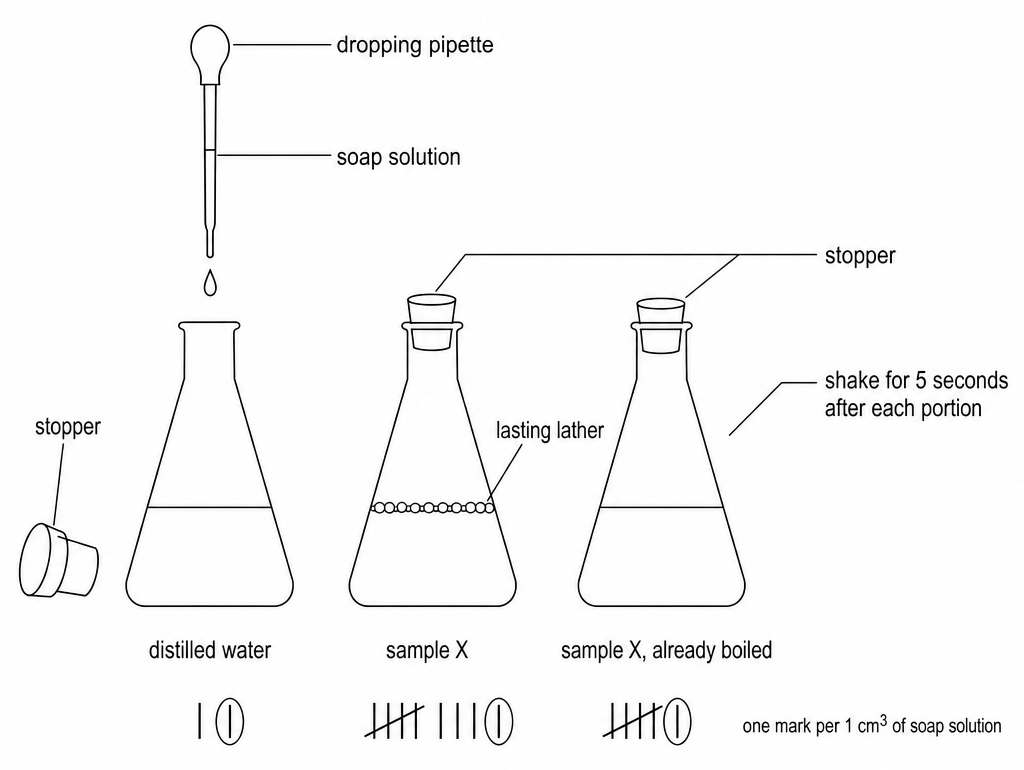
- Measure the water - Measure 50 cm3 of a water sample into a conical flask with a measuring cylinder.
- Add soap solution - Add 1 cm3 of soap solution with a dropping pipette, put the stopper in, and shake the flask for 5 seconds.
- Check for a lasting lather - If a lather doesn't cover the surface for 30 seconds, add another 1 cm3, shake, and check again.
- Record the total volume - Of soap solution needed for the lather to last.
- Test every sample - Repeat with a fresh 50 cm3 of each water sample, both as it is and after it has been boiled and cooled, and with distilled water.
Safety
- Eye protection - Wear it throughout, since shaking can force liquid out past the stopper.
- Soap solution - Soap solution made up in alcohol is flammable and an irritant, so keep it away from flames and off your skin.
Worked example - Comparing water sample hardness
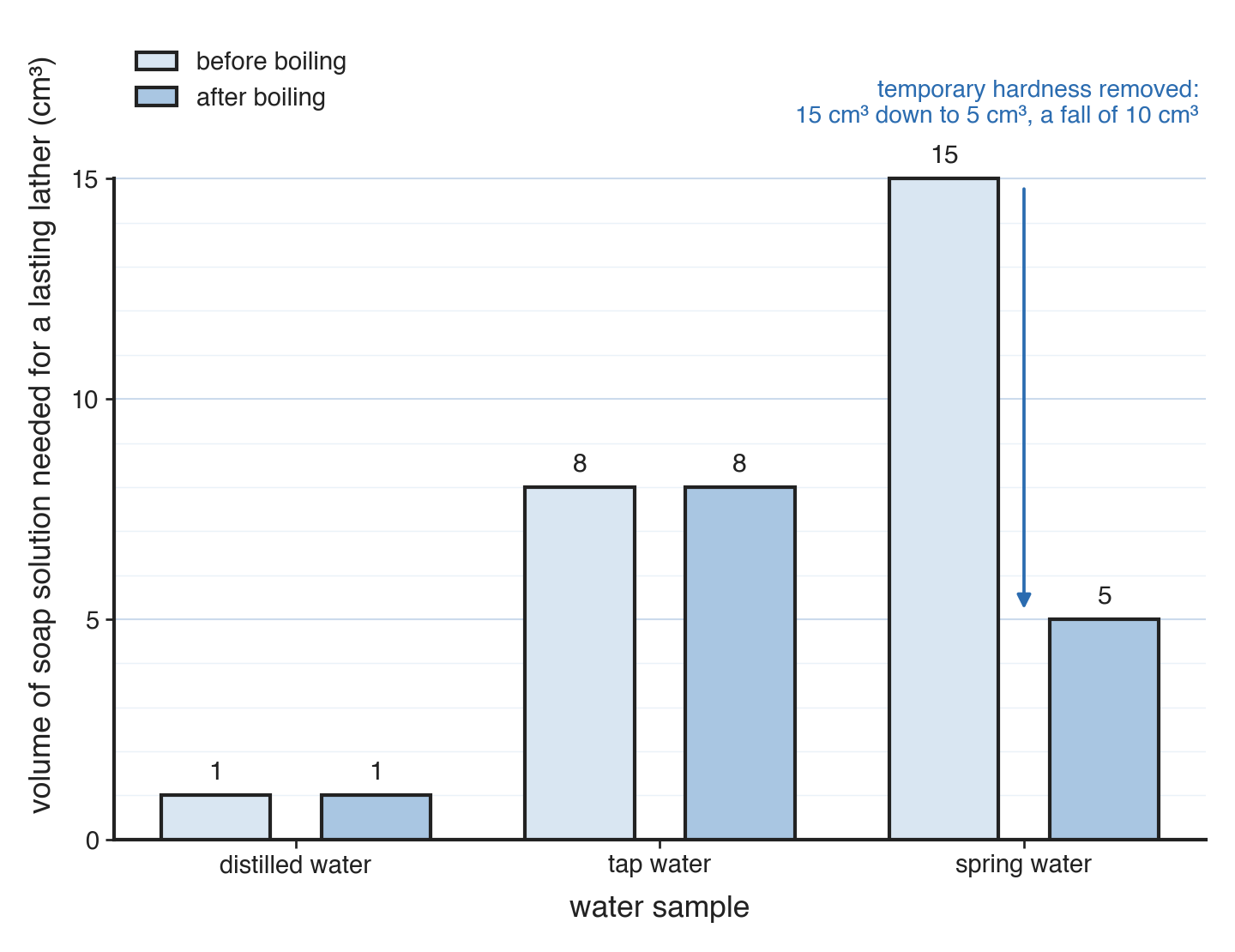
A student tested 50 cm3 samples of tap water and spring water, each before and after boiling, alongside distilled water. The table shows the total volume of soap solution each needed for a lasting lather.
| Water sample | Before boiling (cm3) | After boiling (cm3) |
|---|---|---|
| Distilled water | 1 | 1 |
| Tap water | 8 | 8 |
| Spring water | 15 | 5 |
Which is the softer of the two water samples, and what kind or kinds of hardness does each have?
Step 1 - Allow for the baseline
Distilled water has no hardness, but it still needs 1 cm3 of soap solution to lather. So 1 cm3 of every result is a baseline, not caused by hardness.
Step 2 - Compare the results before boiling
Tap water needs 8 cm3 and spring water needs 15 cm3, so tap water is the softer of the two.
Step 3 - Find the effect of boiling on tap water
Tap water needs 8 cm3 both before and after boiling, so boiling removes none of its hardness. Taking off the baseline, 8 − 1 = 7 cm3, and all of it is permanent hardness.
Step 4 - Find the effect of boiling on spring water
Boiling reduces the volume from 15 cm3 to 5 cm3. The fall, 15 − 5 = 10 cm3, is the temporary hardness that boiling removed. What's left above the baseline, 5 − 1 = 4 cm3, is the permanent hardness.
Step 5 - Say what kind of hardness each sample has
Tap water is the softer sample, and all of its hardness is permanent. Spring water is harder overall, and it has both kinds. Its temporary hardness needed 10 cm3 of soap solution, and its permanent hardness 4 cm3.
Common exam questions
Question 1
Why must the lather last for a set time, such as 30 seconds, rather than counting the first sign of any lather?
A brief lather can appear before all the calcium and magnesium ions have reacted. A lather that lasts shows no more scum is forming.
Question 2
Why is the flask stoppered and shaken, rather than just stirred?
Shaking mixes the soap solution through the whole sample quickly and evenly, and gives the lather a chance to form.
Question 3
Why is the same volume of water sample, such as 50 cm3, used every time?
A bigger sample of the same water contains more calcium and magnesium ions, so it would need more soap even though the water is no harder.
Question 4
Why is the soap solution added 1 cm3 at a time, rather than all at once?
So the point at which a lasting lather first forms can be found, instead of adding far more soap than is needed.