7.9 - Uses of Metals & Polymers
Why a metal suits its job
- A metal is picked for a job because of its properties.
- While all metals conduct heat and electricity and have relatively high strength, they differ in density, conductivity, hardness, and reactivity.
- Melting points: iron 1,538 °C, titanium 1,668 °C, copper 1,085 °C, aluminium 660 °C.
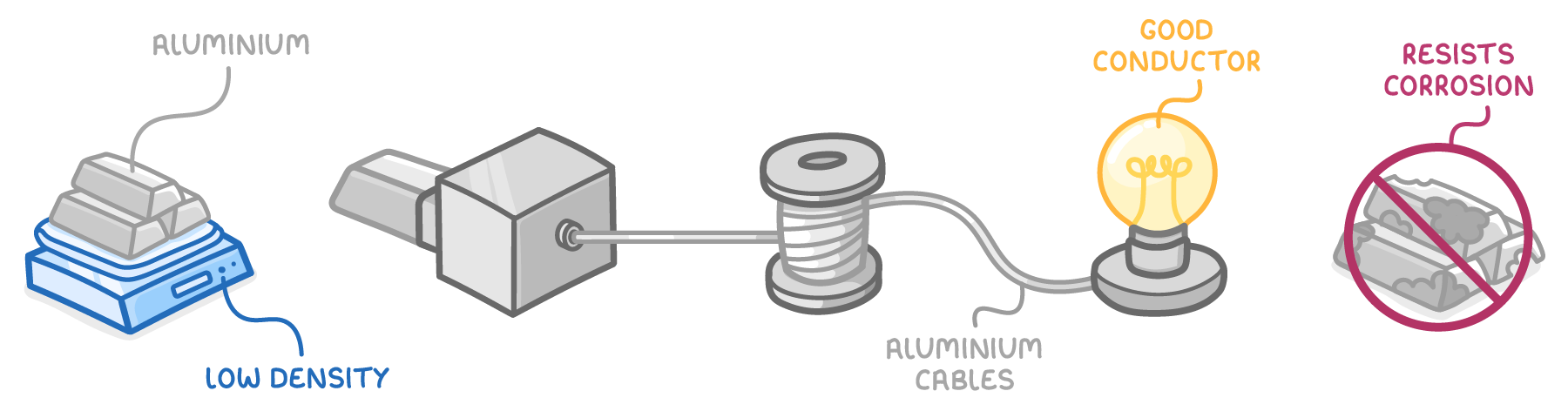
Aluminium - Low density
Aluminium has a low density (light for its size):
- Aircraft and bicycle frames - Low density keeps the mass down.
- Overhead electrical cables - Low density combined with good electrical conductivity allows cables to hang between pylons without breaking under their own weight.
- Food containers and window frames - Resists corrosion from food and weather.
Copper - Conductor and ductile
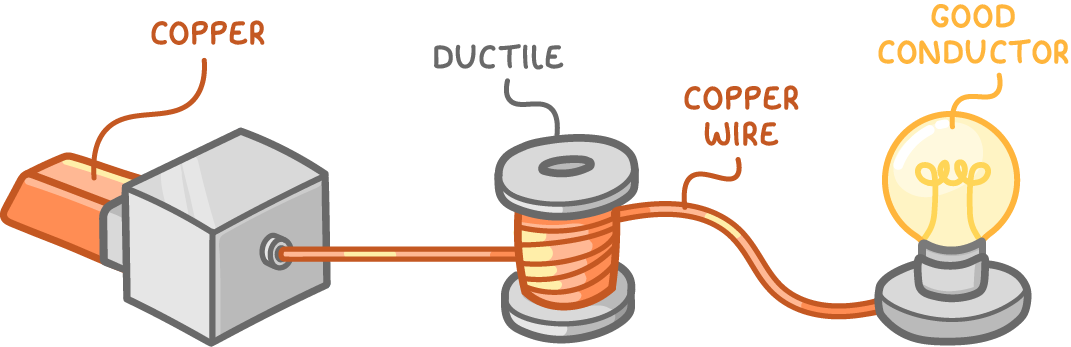
Copper is a very good conductor of heat and electricity, and it's ductile (can be drawn into a wire without snapping):
- Electrical wiring - Good conductivity carries the current efficiently, and ductility allows it to be drawn into thin wires.
- Water pipes and tanks - Malleable enough to bend, hard enough to hold its shape, unreactive with water, and has high thermal conductivity.
- Decorative work - Chosen for its distinctive colour and lustre.
Iron and steel - Cheap and strong
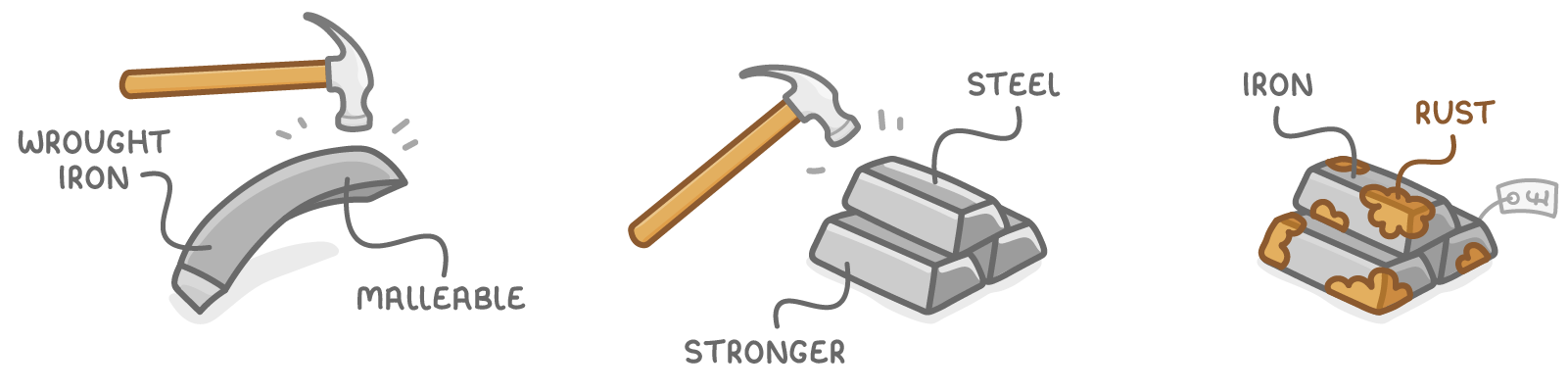
Chosen where high strength is needed and weight isn't a problem:
- Wrought iron is almost pure iron. It's malleable, making it easy to shape for gates and railings.
- Steel is harder and stronger than iron, used for bridges, girders, engine parts, machinery, tools, and car bodies.
- Drawback: iron rusts in damp air.
Titanium - Light, hard and corrosion resistant
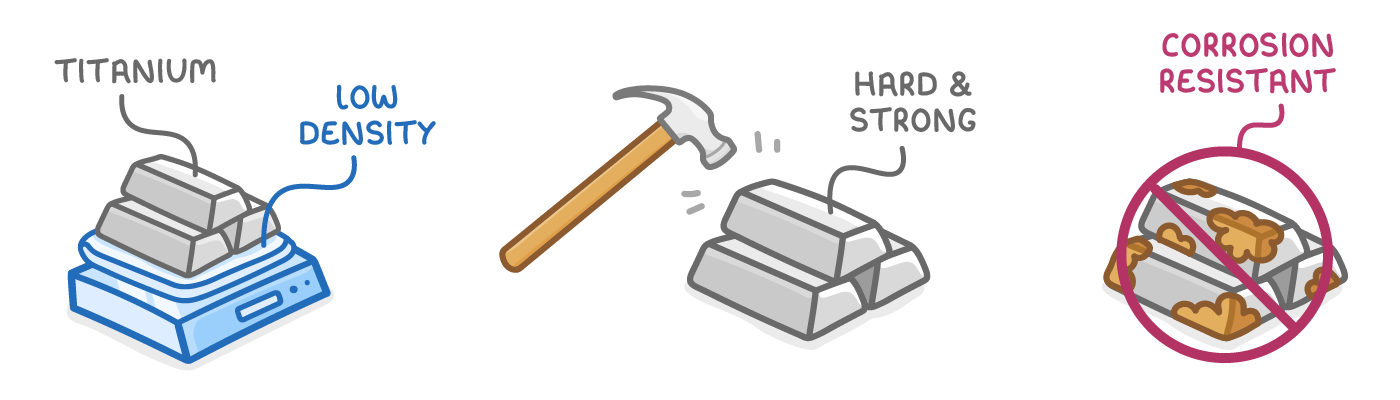
Titanium has a low density, is very hard and strong, and resists corrosion:
Aircraft parts and bicycle frames - low density like aluminium, but harder and more resistant to wear.
Why a polymer suits its job
Plastics are materials made up of polymer molecules, with shared properties that make them widely useful.
Properties polymers share
- Usually cheaper than metals and ceramics.
- Generally strong.
- Low density compared to most metals and ceramics.
- Many are flexible and almost all can be moulded into shape.
- Thermal and electrical insulators.
- Resist corrosion and don't rot.
Individual polymers and their uses
- Poly(ethene) (polythene) - low density, flexible, easy to mould, unreactive, waterproof, and an electrical insulator. Used for carrier bags, bottles, and electrical wire insulation.
- Poly(propene) - Low density, rigid, tough, and easy to mould. Used for packing crates, moulded furniture, and ropes.
- Poly(chloroethene) (PVC) - rigid, hard, strong, unreactive, and fire resistant. Used for drainpipes, water pipes, and window frames.
- Poly(tetrafluoroethene) (PTFE) - tough, strong, high melting point for a polymer, unreactive, and extremely non-stick. Used for non-stick pan coatings, and for waterproof and stain-resistant clothing because water and stains do not stick to it.
TermDefinition
DuctileAble to be drawn into wires.