8.4 - Fuels
Hydrogen as an alternative to petrol
Hydrogen is a non-hydrocarbon fuel that burns in oxygen, releasing large amounts of energy with water as the only product.
The reaction
hydrogen + oxygen → water
2H2 + O2 → 2H2O
Advantages of hydrogen
- No pollutants at point of use - Only water is produced, with no carbon dioxide or particulates.
- Renewable source - It can be obtained from water, unlike crude oil which is finite.
Disadvantages of hydrogen
- Requires an expensive, specially built engine.
- Manufacturing requires energy (for example electricity for the electrolysis of water), which is often generated by burning fossil fuels that release carbon dioxide.
- Storage is difficult - As a gas at room temperature, it requires large, heavy, pressurised tanks.
- Safety risk - It's highly flammable and forms explosive mixtures with air.
- Lack of refuelling infrastructure compared to petrol.
Biofuels
- A biofuel is a renewable fuel made from plant material (biomass).
- Common examples are biodiesel and ethanol.
Making ethanol
- Ethanol is produced by the fermentation of plant sugars (like sugar cane) using yeast at 20 °C to 35 °C.
- Fermentation produces a dilute solution of ethanol in water, which must be concentrated by fractional distillation before use as a fuel.
Benefits of biofuels
- Renewable - Crops can be regrown each season, so supplies won't run out.
- Carbon neutral potential - The carbon dioxide released when burned is roughly equal to the carbon dioxide absorbed by the plants during photosynthesis.
- Economic benefits - Can be cheaper to produce and creates agricultural jobs.
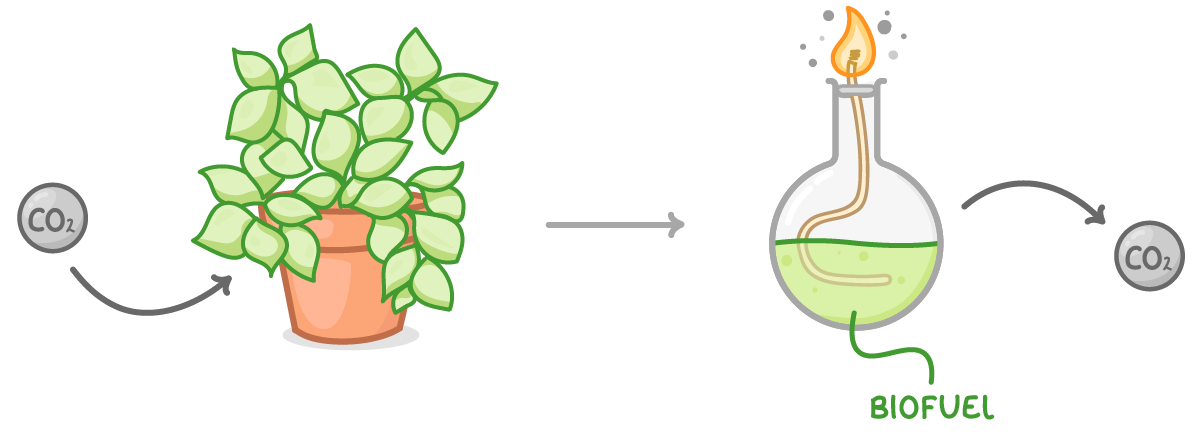
Drawbacks of biofuels
- Land use - Takes up land that could otherwise be used for food crops, potentially driving up food prices.
- Not strictly carbon neutral - Energy used in planting, harvesting, refining, and transporting generates carbon dioxide emissions.
- Weather dependent - Crop yields depend on climate and seasonal weather.
The fire triangle and fighting fires
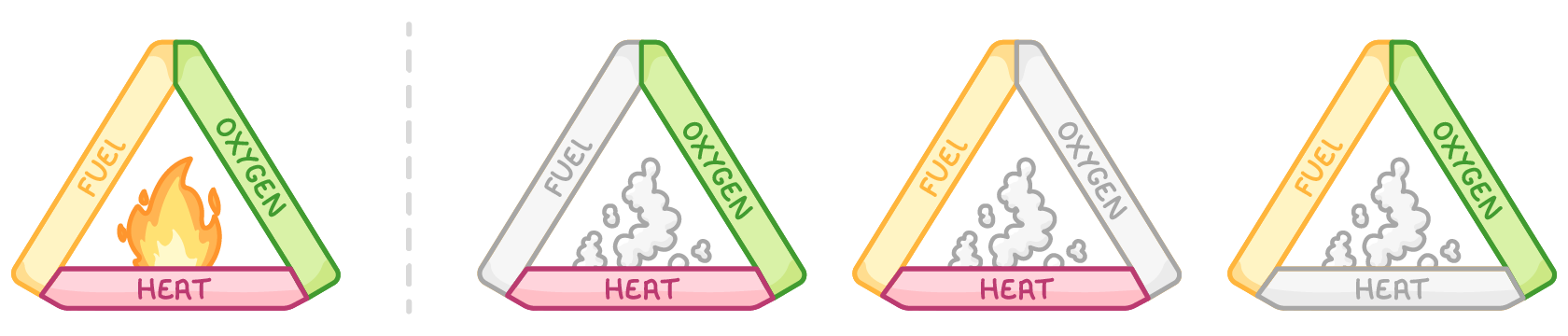
- For a fire to burn, three factors must be present: fuel, oxygen, and heat.
- Removing any one of these three extinguishes the fire or prevents it from starting.
Taking away the fuel
- Using fire-resistant materials rather than flammable ones.
- Creating a firebreak (clearing trees in the path of a forest fire) so the fire runs out of fuel.
Taking away the oxygen
- Smothering with a fire blanket or damp cloth.
- Using foam or powder extinguishers to coat the burning material and block air.
- Using carbon dioxide extinguishers to displace oxygen around the flames.
Taking away the heat
- Cooling the fire with water, lowering the temperature below what's needed for combustion.
- Storing flammable materials away from heat sources.
When not to use water
- Electrical fires - Water conducts electricity, risking electric shock.
- Oil or liquid fires - Burning oil floats on water and spreads the fire.
Measuring energy per gram of fuel
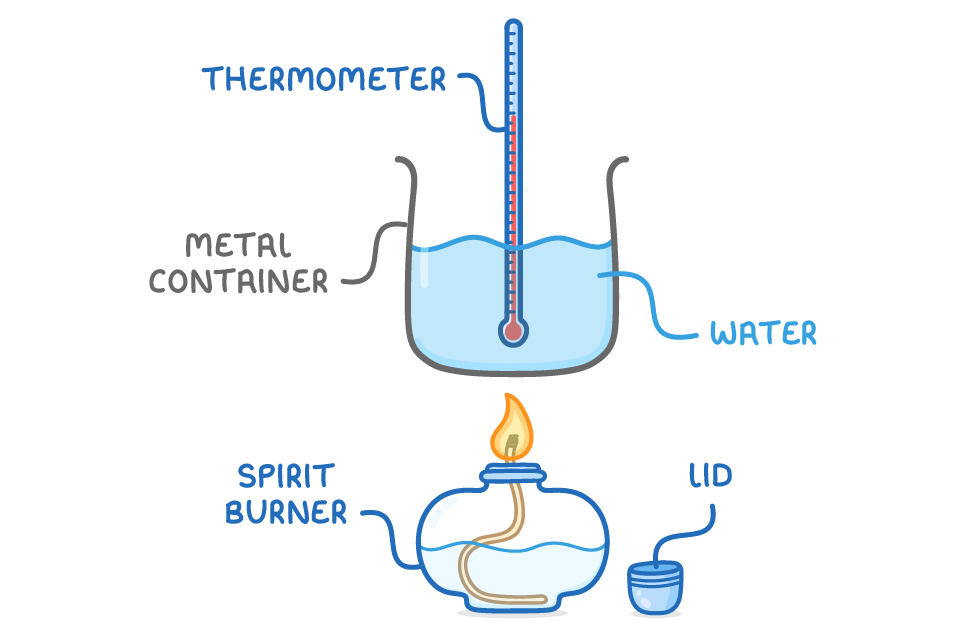
Different fuels can be compared by burning a known mass of each to heat a fixed volume of water and measuring the temperature rise.
Method
- Measure a known volume of water into a metal container and record its starting temperature (1 cm3 of water has a mass of 1 g).
- Weigh the spirit burner containing the fuel (with its lid on).
- Place the burner under the container, light it, and heat the water.
- Extinguish the flame with the burner lid and record the highest temperature reached by the water.
- Reweigh the burner and lid to calculate the mass of fuel burned.
- Calculate the temperature change of the water.
Formula for energy released per gram of fuel
Why experimental values are too low
- Some heat is lost to the surroundings (heating the container, thermometer, and surrounding air).
- Incomplete combustion may occur, releasing less energy.
- Some fuel evaporates from the wick without burning.
Worked example - Energy per gram of fuel
A liquid fuel is burned to heat a container of water. Calculate the energy released per gram of the fuel.
- Volume of water heated = 100 cm3
- Starting temperature = 20.0 °C
- Highest temperature reached = 50.0 °C
- Mass of burner and lid before burning = 82.50 g
- Mass of burner and lid after burning = 81.00 g
- Specific heat capacity of water = 4.2 J/g/°C
Step 1 - Mass of water
1 cm3 of water has a mass of 1 g, so:
Mass of water = 100 g
Step 2 - Mass of fuel burned
82.50 - 81.00 = 1.50 g
Step 3 - Temperature increase
50.0 - 20.0 = 30.0 °C
Step 4 - Energy gained by the water
Multiply mass of water × temperature increase × 4.2:
100 × 30.0 × 4.2 = 12,600 J
Step 5 - Divide by the mass of fuel burned
Energy released per gram = 12,600 ÷ 1.50 = 8,400 J/g
The fuel releases 8,400 J/g, which is 8.4 kJ/g.
TermDefinition
BiofuelA fuel made from living material, such as crop plants, that can be used in place of fossil fuels.
FermentationThe process in which enzymes in yeast convert sugar into ethanol and carbon dioxide without oxygen.
FirebreakA gap created by clearing trees or vegetation to stop a fire spreading by removing its fuel.