3.3 - Water Hardness
Hard water and the two kinds of hardness
- As rain soaks through rocks such as limestone, chalk and gypsum, it dissolves compounds containing calcium or magnesium.
- Hard water contains a high concentration of dissolved calcium ions (Ca2+) and magnesium ions (Mg2+).
- Soft water contains little or none of these ions.
Telling hard water from soft water
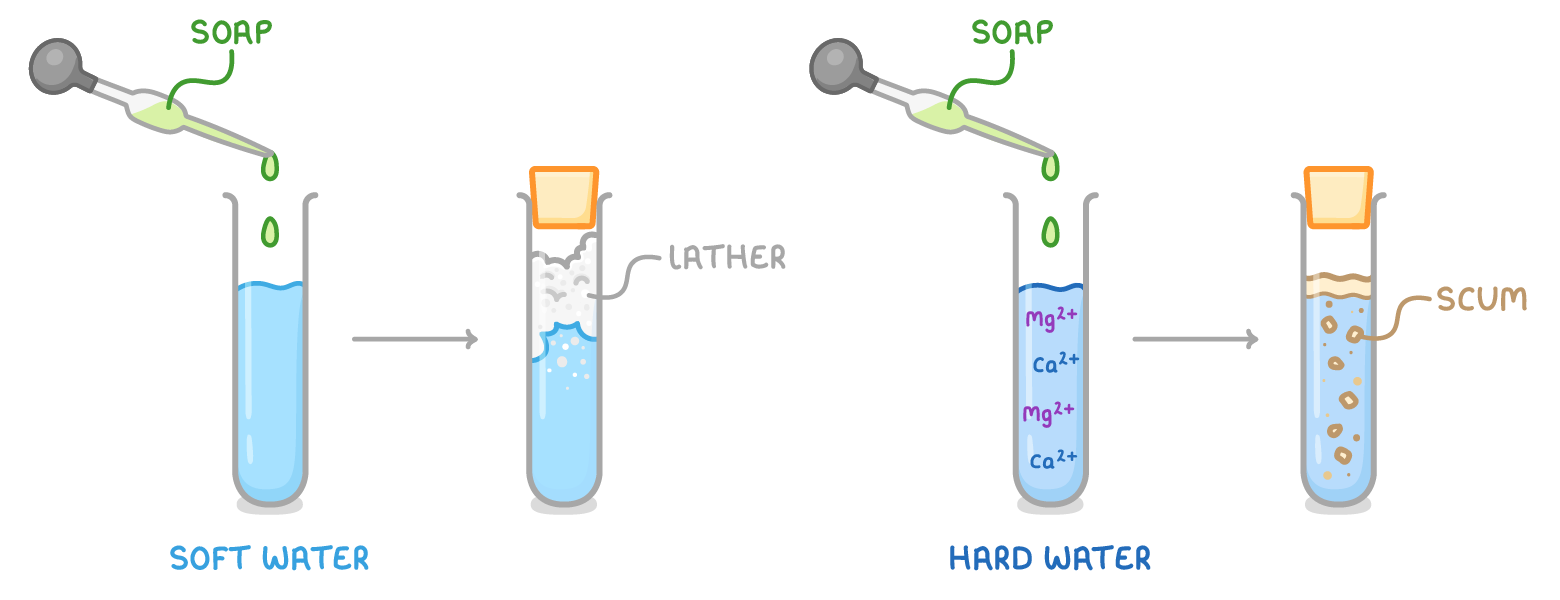
- The test is what happens when soap is added:
- Soft water forms a lather readily.
- Hard water reacts with soap to form an insoluble solid called scum, which wastes soap and prevents a lather until all the Ca2+ and Mg2+ ions have reacted.
- Hard water needs far more soap than soft water before it will lather.
Temporary and permanent hardness
- Temporary hardness is caused by dissolved calcium hydrogencarbonate and magnesium hydrogencarbonate. Boiling removes it.
- Permanent hardness is caused by dissolved sulfates (mainly calcium sulfate and magnesium sulfate). Boiling does not remove it.
- A water sample can contain temporary hardness, permanent hardness, or both. Boiling a sample with both makes it softer, but does not make it completely soft.
Softening hard water
Softening hard water means removing dissolved calcium and magnesium ions so soap lathers easily without forming scum.
Boiling
- Boiling removes temporary hardness only.
- It is simple and cheap for small volumes, but it is too expensive and impractical for softening a whole household water supply.
Adding sodium carbonate
- Sodium carbonate, Na2CO3 (washing soda), is soluble and is simply added to the water.
- It removes both temporary and permanent hardness.
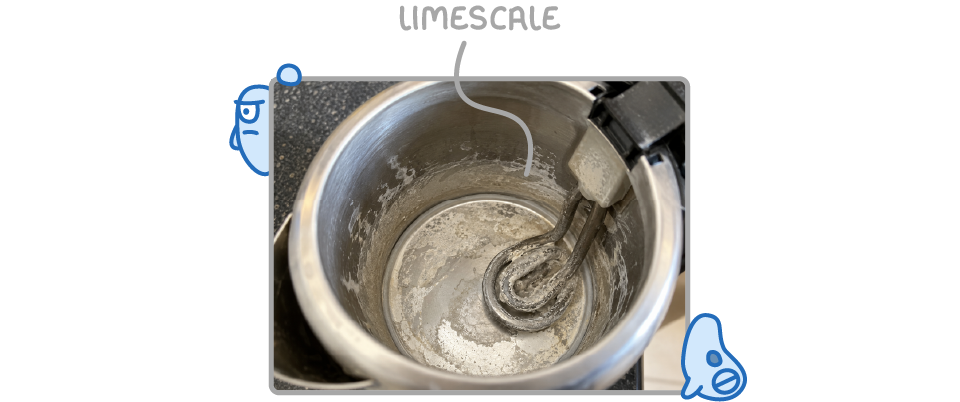
- Drawback: the precipitated carbonate forms limescale, which can build up and block pipes.
Ion exchange columns
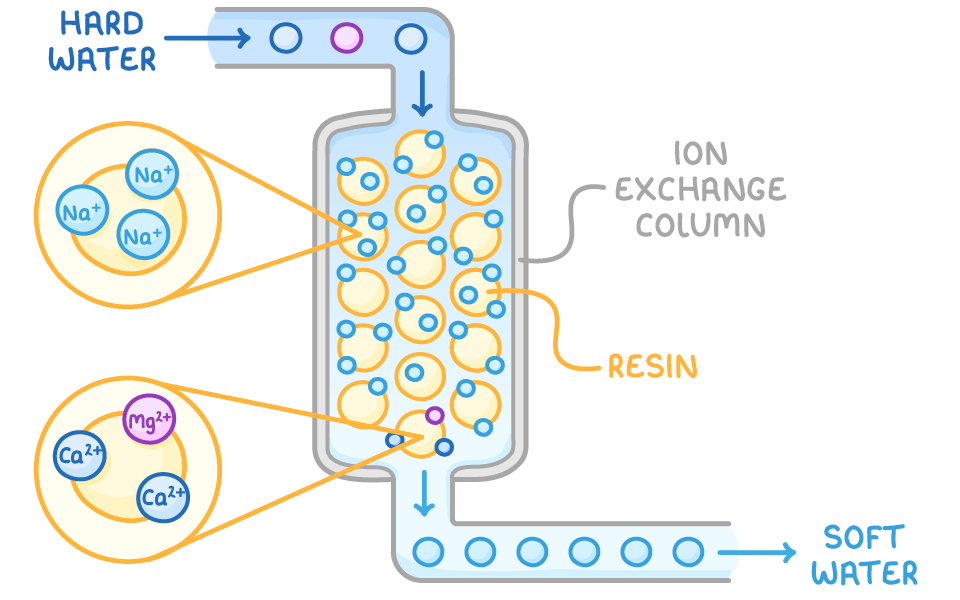
- Water is passed through an ion exchange column, where a resin swaps the calcium and magnesium ions in the water for sodium ions, which don't cause hardness.
- This removes both kinds of hardness.
- It can treat a continuous flow of water, making it suitable for household supplies.
- The column eventually runs out of sodium ions and is regenerated by flushing with concentrated sodium chloride solution.
- Drawback: ion exchange columns are expensive to buy.
The chemistry of softening
Softening works by removing dissolved Ca2+ and Mg2+ ions from solution.
Boiling
Heating decomposes dissolved hydrogencarbonate into insoluble carbonates, water, and carbon dioxide:
Ca(HCO3)2(aq) → CaCO3(s) + H2O(l) + CO2(g)
Mg(HCO3)2(aq) → MgCO3(s) + H2O(l) + CO2(g)
- The insoluble calcium and magnesium carbonates precipitate out as limescale.
- Dissolved sulfates do not decompose when heated, so boiling leaves permanent hardness unchanged.
Adding sodium carbonate
Sodium carbonate is soluble, so adding it puts carbonate ions into the water:
sodium carbonate + calcium sulfate → calcium carbonate + sodium sulfate
Na2CO3(aq) + CaSO4(aq) → CaCO3(s) + Na2SO4(aq)
Dissolved carbonate ions (CO32-) react with Ca2+ and Mg2+ ions to form insoluble precipitates:
Ca2+(aq) + CO32-(aq) → CaCO3(s)
Mg2+(aq) + CO32-(aq) → MgCO3(s)
Because the carbonate ions precipitate any dissolved Ca2+ and Mg2+, sodium carbonate removes both temporary and permanent hardness.
Ion exchange columns
- The column contains an insoluble resin coated with sodium ions, Na+.
- As hard water passes through, the resin swaps its sodium ions for calcium and magnesium ions:
- Na2Resin(s) + Ca2+(aq) → CaResin(s) + 2Na+(aq)
- Two Na+ ions are released for every Ca2+ or Mg2+ ion removed.
- Dissolved sodium ions do not cause hardness, so the water leaves soft.
- Once the resin is saturated with Ca2+ and Mg2+, flushing with concentrated sodium chloride solution displaces them and recharges the column with Na+.
What hardness does, good and bad
Advantages of hard water
- Dissolved calcium ions help build and maintain strong teeth and bones.
- Drinking hard water is linked to a reduced risk of heart disease.
Disadvantages of hard water
- Heating hard water precipitates limescale (mostly calcium carbonate) inside kettles, boilers, and hot water pipes:
- Scale on a heating element is a poor thermal conductor, so appliances take longer and use more energy to heat water.
- Scale inside pipes reduces water flow and can eventually block them.
- Hard water wastes soap and produces unsightly scum.
Worked example - Hardness of a water sample
Two water samples were each tested by adding soap solution until a lasting lather formed, once before boiling and once after boiling, alongside distilled water as a control.
Work out the total, temporary and permanent hardness of each sample, and say what type of hardness each sample contains.
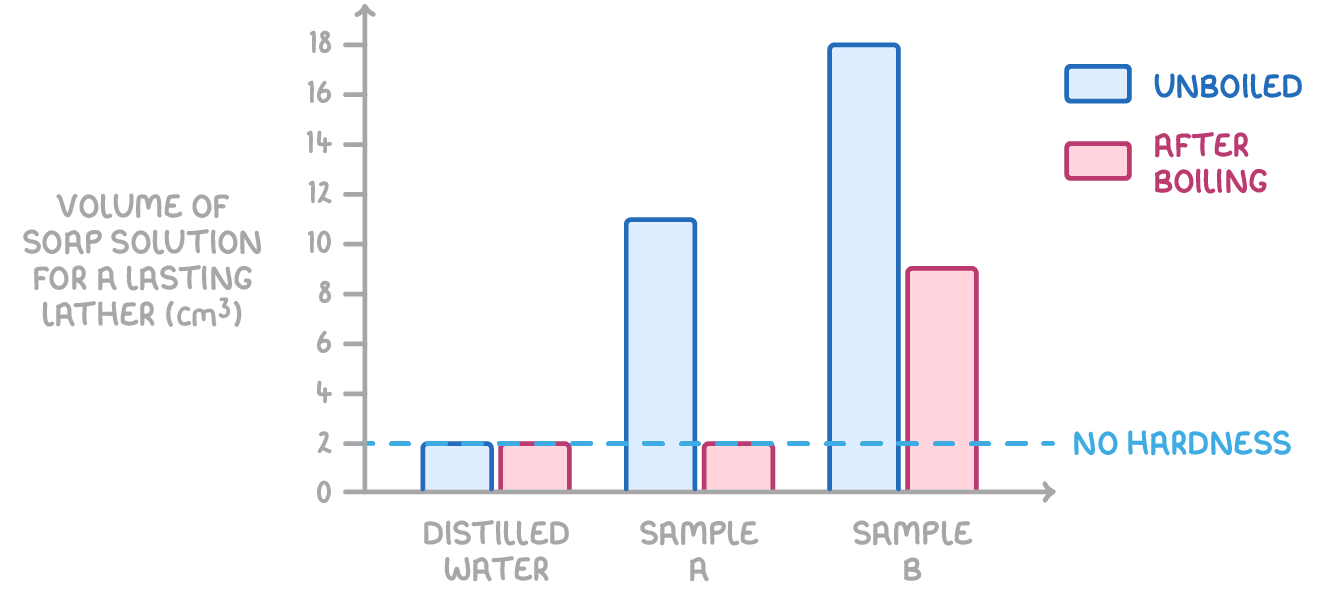
| Sample | Soap unboiled (cm3) | Soap after boiling (cm3) |
|---|---|---|
| Distilled water | 2 | 2 |
| Sample A | 11 | 2 |
| Sample B | 18 | 9 |
Step 1 - Use distilled water as the baseline
- Distilled water has zero hardness and requires 2 cm3 of soap to form a lather.
- Any soap volume above 2 cm3 is caused by hardness.
Step 2 - Calculate total hardness
- Sample A: 11 - 2 = 9 cm3
- Sample B: 18 - 2 = 16 cm3
- Sample B has greater total hardness.
Step 3 - Calculate temporary hardness (removed by boiling)
- Sample A: 11 - 2 = 9 cm3
- Sample B: 18 - 9 = 9 cm3
- Both samples have the same amount of temporary hardness.
Step 4 - Calculate permanent hardness (remaining after boiling)
- Sample A: 2 - 2 = 0 cm3 (no permanent hardness)
- Sample B: 9 - 2 = 7 cm3 of permanent hardness
Step 5 - Conclusion
- Sample B is hard water containing both temporary and permanent hardness (9 cm3 temporary and 7 cm3 permanent).
- Boiling sample B makes it softer, but leaves it with 7 cm3 of permanent hardness.