10.3 - Life Cycle of Stars
How a star is born
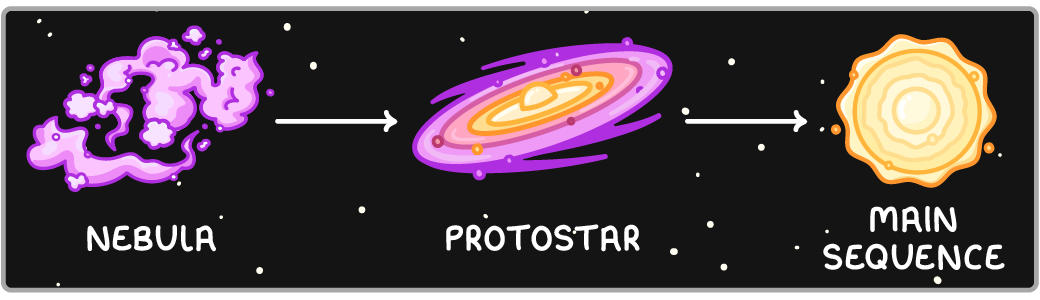
- Stars begin as a vast cloud of dust and gas called a nebula, made mostly of hydrogen.
- Gravity pulls the particles together, so the cloud collapses inwards and becomes denser.
- As particles are squeezed closer and collide more often, the core temperature rises to millions of degrees.
- This hot, dense core is called a protostar.
Nuclear fusion
- When the core gets hot enough, hydrogen nuclei join together in nuclear fusion, forming helium nuclei.
- Fusion releases enormous amounts of energy, which keeps the core hot and makes the star shine. A star in this stable, hydrogen-fusing stage is called a main sequence star.
Using spectra to find a star's composition
- A star emits a continuous spectrum of radiation from its hot interior.
- As this light passes through the cooler gases in the star's atmosphere, those gases absorb their characteristic frequencies.
- The light reaching Earth shows an absorption spectrum, with dark lines matching the elements present in the star's atmosphere.
- By comparing these absorption lines with the known spectra of elements tested in a laboratory, astronomers can identify what elements the star contains.
TermDefinition
NebulaA vast cloud of dust and gas in space.
ProtostarA cloud of gas and dust that is collapsing under gravity and heating up, before nuclear fusion has started.
Main sequenceThe long, stable stage of a star's life, when the inward pull of gravity is balanced by the outward push from nuclear fusion in its core.