2.3 - Investigating Motion
Force, mass and acceleration - Apparatus and method
- This experiment investigates how the acceleration of an object depends on the force applied to it and on its mass.
- It uses the relationship force = mass × acceleration.
Apparatus
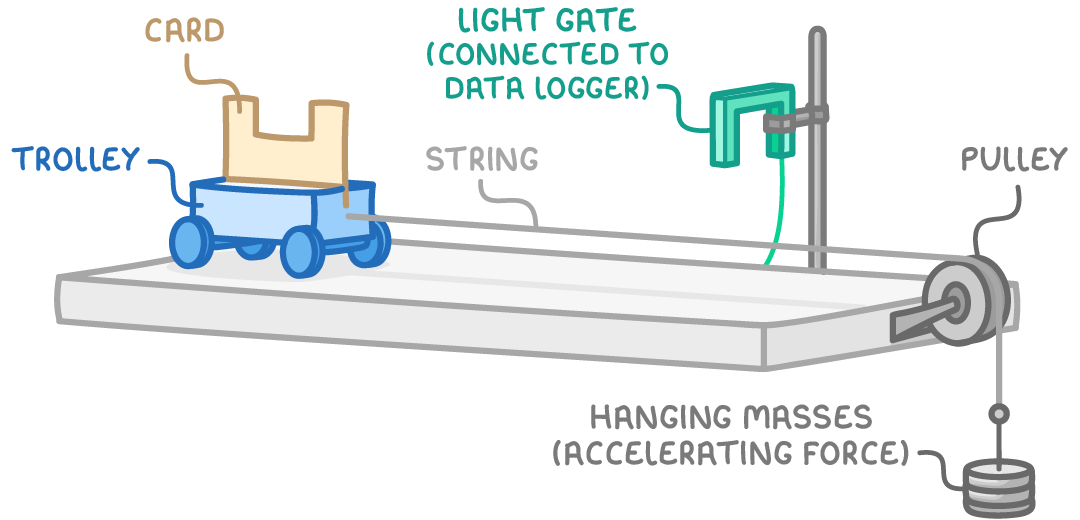
- A trolley on a flat bench or runway, carrying a piece of card that interrupts a light gate
- A light gate connected to a data logger
- A string running over a pulley fixed at the edge of the bench
- A hanging hook holding slotted masses, attached to the other end of the string
- A balance to measure the masses
The card has a gap in the middle, so it interrupts the beam twice as it passes. The light gate measures the trolley's speed at two moments a fraction of a second apart, and the data logger uses these to calculate its acceleration.
Method
- Measure the mass of the trolley, the slotted masses and the hook. Enter the length of the card sections into the data logger.
- Connect the trolley by string over the pulley to the hook. The weight of the hook and masses provides the accelerating force for the whole system (trolley, hook and masses combined).
- Mark a starting line so the trolley always travels the same distance to the light gate.
- Place the trolley on the starting line with the string taut, then release it.
- Record the acceleration measured as the trolley passes through the light gate.
- Repeat twice more and calculate an average acceleration.
Reducing friction
Friction between the trolley and the bench affects the measurements. Two common ways to reduce its effect:
- Air track - Floats the trolley (or glider) on jets of air so there's almost no friction.
- Tilted runway - Tilt the runway slightly until the trolley moves at a steady speed when given a gentle push. This compensates for friction, so the hanging weight is the only force accelerating the trolley.
Varying the mass and varying the force
Using the same apparatus, change one variable at a time while keeping the other constant.
Changing the mass (force kept constant)
- Add masses to the trolley one at a time to increase the mass of the whole system.
- Do not add masses to the hook, as that would change the accelerating force.
- Record the average acceleration for each total mass.
Acceleration decreases as mass increases - mass and acceleration are inversely proportional.
Changing the force (mass kept constant)
- Start with all the slotted masses loaded on the trolley.
- Transfer masses to the hook one at a time to increase the accelerating force.
- Record the average acceleration for each force.
Masses are transferred rather than added so the total mass of the system stays constant. Acceleration increases as force increases - force and acceleration are directly proportional.
Plotting the results
- Acceleration against force - A straight line through the origin, showing acceleration is directly proportional to force.
- Acceleration against mass - A curve showing an inverse relationship.
- Acceleration against 1 ÷ mass - A straight line through the origin, confirming acceleration is inversely proportional to mass.
TermDefinition
Light gateA sensor that records the time a beam of light is blocked, used with a data logger to calculate speed or acceleration.
Air trackA piece of apparatus that floats a glider on jets of air to almost completely remove friction.