5.5 - Hooke's Law & Spring Constant
Stretching, compressing or bending an object
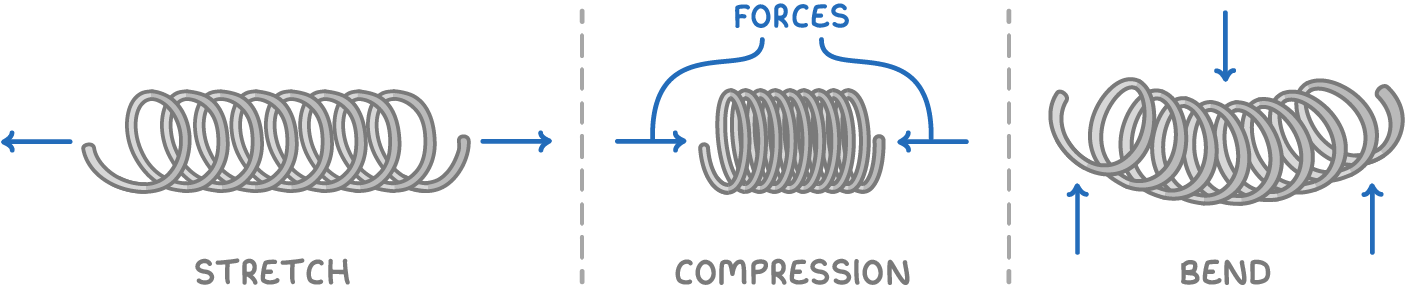
- Applying a force can change an object's shape - it can stretch, compress or bend.
- Changing an object's shape is called deforming it.
- You need more than one force to deform an object. A single force simply moves the object in that direction rather than changing its shape.
Two kinds of deformation
- Elastic deformation - The object returns to its original shape and length once the forces are removed. An object that does this is an elastic object (such as a spring).
- Inelastic deformation - The object does not return to its original shape and length after the forces are removed; it stays permanently deformed.
Energy and deformation
- Work is done when a force stretches, compresses or bends an object, transferring energy to its elastic potential energy store.
- If the deformation is elastic, all of this energy is transferred to the elastic potential energy store and can be recovered when the forces are removed.
- If the applied forces are too large, the deformation becomes inelastic and the object stays permanently deformed.
The limit of proportionality
- Hooke's law only holds up to a certain point. Increase the force far enough and extension stops being proportional to force.
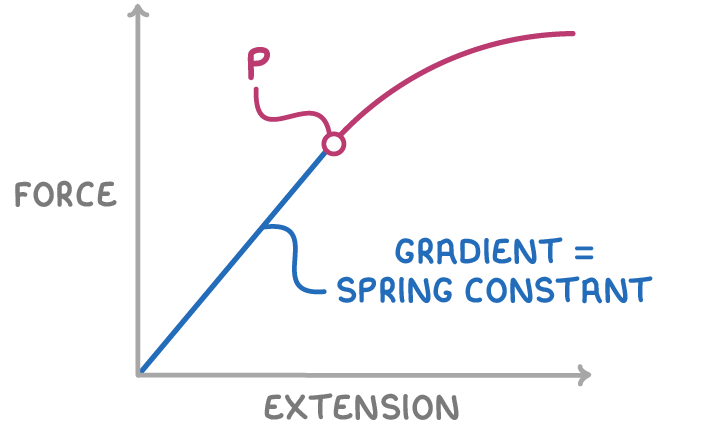
- On a force-extension graph, the line starts straight (where the spring obeys Hooke's law) and begins to curve once the force exceeds a maximum value.
- The point where the graph starts to curve is the limit of proportionality, often marked P.
- Beyond this point, the relationship is non-linear: each additional unit of force produces a larger increase in extension.
Elasticity versus Hooke's law
- An object can be elastic without obeying Hooke's law.
- A rubber band is elastic (it returns to its original shape when released), but its force-extension relationship is non-linear, so it does not obey Hooke's law.
Investigating force and extension
Setting up
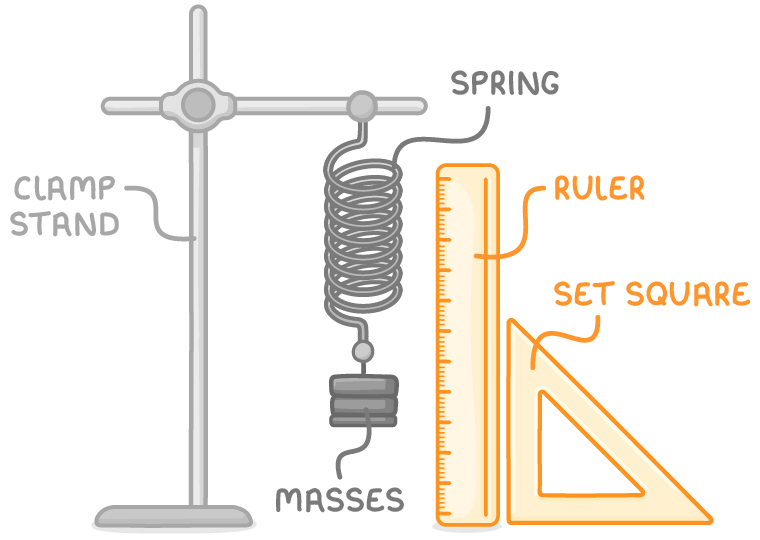
- Clamp a spring to a stand with a millimetre ruler held vertically alongside it, and have a set square to hand so each reading is taken level with the bottom of the spring.
- Have a set of slotted masses ready, each measured on a balance, so the weight (the force on the spring) can be calculated.
- Do a quick pilot run first: load an identical spring one mass at a time to check the extension increases roughly equally each time. A sudden large jump means the spring has exceeded its limit of proportionality, so use smaller masses.
Method
- Measure the spring's natural length with no masses attached, reading at eye level with a marker at the bottom of the spring.
- Add a mass, allow it to come to rest, record the total weight, and measure the new length.
- Calculate the extension (extension = new length - natural length).
- Repeat, adding one mass at a time, until there are at least six readings.
Results
- Plot a force-extension graph with force on the vertical axis and extension on the horizontal axis.
- While the line of best fit is straight, force and extension are directly proportional, the spring obeys Hooke's law, and the gradient equals the spring constant, .
- If the line begins to curve, the spring has passed its limit of proportionality.
Safety
Stand up so you can move clear if a mass falls, and wear eye protection in case the spring snaps.
TermDefinition
Elastic deformationA change in shape where the object returns to its original shape and length once the forces are removed.
Inelastic deformationA change in shape where the object does not return to its original shape and length after the forces are removed.
Limit of proportionalityThe point beyond which the extension of an object is no longer directly proportional to the force applied to it.